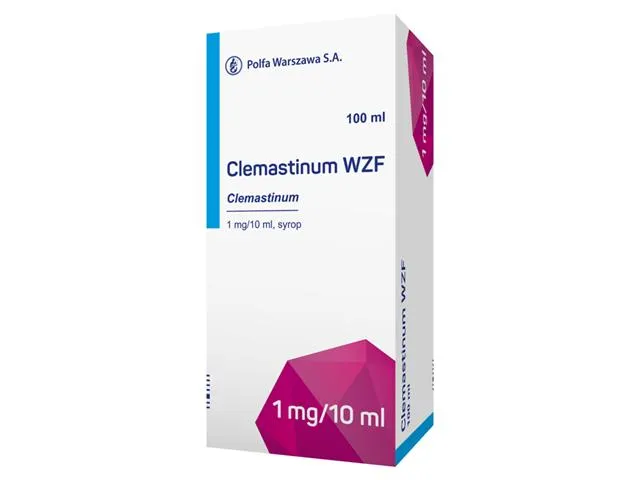
CLEMASTINUM WZF
PolandThis is an anti-allergic medication used in adults and children over 12 months of age. It helps relieve allergic symptoms of the skin and nasal mucosa, such as nasal congestion, runny nose, itchy or watery eyes, urticaria (hives), skin itching, atopic eczema, and angioedema.
Frequently asked questions
How to use Clemastinum WZF?
The syrup should be taken orally, in the morning and evening. It can be taken before, during, or after a meal. Dosage depends on age: children aged 1 to 3 years take 2.5–5 ml, children aged 3 to 6 years take 5 ml, children aged 6 to 12 years take 5–10 ml, and adults and adolescents over 12 years take 10 ml twice daily.
When not to use this medicine?
Do not use the medicine if you are allergic to clemastine or any other ingredients, if the child is less than 12 months old, or if you are taking medications from the monoamine oxidase inhibitor group. The medicine must not be used during breastfeeding.
What are the possible side effects of Clemastinum WZF?
The most common side effects may include: drowsiness, sedation, dizziness, coordination disorders, abdominal pain, nausea, vomiting, diarrhea, or constipation. Other possible side effects include, among others, dry mouth, headache, tremors, blurred vision, palpitations, or difficulty urinating.
Can you drive while using the medicine?
Due to possible side effects, such as drowsiness, fatigue, or dizziness, you should not drive vehicles or operate machinery while taking the medicine.
Can the medicine be combined with alcohol?
Alcohol should not be consumed while using the medicine. It should also be noted that the syrup itself contains a small amount of ethanol.
Should caution be exercised with other medical conditions?
Before use, consult a doctor if you suffer from glaucoma, gastric or duodenal ulcers, asthma, hyperthyroidism, cardiovascular diseases, hypertension, or porphyria. It is also important to inform the doctor about prostate diseases or liver and kidney dysfunction.
Instructions for use
Patient Information Leaflet
CLEMASTINUM WZF, 1 mg/10 ml, syrup
Clemastinum
Please read this leaflet carefully before using the medicine, as it contains
important information for the patient.
- Keep this leaflet for future reference.
- If you have any questions, consult your doctor or pharmacist.
- This medicine has been prescribed for a specific individual. Do not pass it on to others. The medicine may harm another person, even if their symptoms are similar.
- If you experience any adverse reactions, including any possible adverse reactions not listed in this leaflet, inform your doctor or pharmacist. See section 4.
Table of Contents
- What Clemastinum WZF is and what it is used for
- Important information before taking Clemastinum WZF
- How to take Clemastinum WZF
- Possible side effects
- How to store Clemastinum WZF
- Contents of the pack and other information
1. What Clemastinum WZF is and what it is used for
Clemastinum WZF is an antiallergic medicine that relieves allergic symptoms, particularly of the skin and nasal mucosa. It is used in adults and children aged 12 months and older for the treatment of the following conditions and symptoms:
- Nasal and ocular symptoms associated with allergic rhinitis (such as nasal congestion, watery nasal discharge, nasal itching, frequent sneezing, eye redness, tearing, and eye itching);
- Contact dermatitis (symptoms: skin redness, itching, blister formation, skin fissures, and even ulceration);
- Urticaria;
- Skin itching;
- Atopic eczema (symptoms: dryness, redness, scaling, and itching of the skin);
- Angioedema (symptoms: swelling of the skin and mucous membranes).
2. Important information before using Clemastinum WZF
When not to use Clemastinum WZF
- if the patient is allergic to clemastine or to any of the other ingredients of this medicine (listed in section 6), or to chlorpheniramine or diphenhydramine (substances with a structure similar to clemastine found in other medicines);
- if the child is under 12 months of age;
- when taking medicines known as monoamine oxidase inhibitors – see section: "Clemastinum WZF with other medicines".
Warnings and precautions
Before starting Clemastinum WZF, discuss this with your doctor or pharmacist:
- if the patient suffers from glaucoma or has increased intraocular pressure;
- if the patient has gastric or duodenal ulcers or other severe gastrointestinal disorders (e.g. pyloric stenosis);
- if the patient has been diagnosed with prostate enlargement or has experienced urinary retention due to other causes;
- if the patient suffers from asthma;
- if the patient has hyperthyroidism;
- if the patient has cardiovascular diseases or high blood pressure;
- if the patient has porphyria (disorders in heme formation – the red pigment which is part of certain enzymes), as the medicine may worsen porphyria symptoms;
- if the patient is over 60 years of age, as increased drowsiness, fatigue or low blood pressure cannot be ruled out.
If allergy testing is planned, the patient should stop taking the medicine several days before the test.
While taking Clemastinum WZF, as with other antiallergic medicines, the patient should not drink alcohol.
Clemastinum WZF with other medicines
Tell your doctor or pharmacist about all medicines the patient is currently taking or has recently taken, as well as any medicines the patient plans to take.
- Taking certain medicines together with clemastine may affect the central nervous system, especially if the patient is taking:
- barbiturates (sedatives and tranquilizers);
- tricyclic antidepressants (used to treat depression);
- medicines used for Parkinson's disease;
- strong opioid analgesics (e.g. morphine).
- Some antidepressants (monoamine oxidase inhibitors) prolong and intensify the effect of clemastine.
Clemastinum WZF with food and drink
Food does not noticeably affect the absorption of the medicine.
Pregnancy and breastfeeding
If the patient is pregnant or breastfeeding, suspects she may be pregnant, or is planning to have a baby, she should consult her doctor or pharmacist before using this medicine.
The medicine may be used during pregnancy only if clearly necessary. The doctor will decide whether Clemastinum WZF can be used during pregnancy.
The medicine should not be used during breastfeeding, as clemastine passes into breast milk in small amounts and may cause adverse effects in breastfed infants.
Driving and using machines
Due to the possibility of adverse effects (e.g. drowsiness, fatigue, dizziness) while taking this medicine, patients should not drive or operate machinery.
Clemastinum WZF contains sorbitol (E 420), ethanol, propylene glycol, propyl parahydroxybenzoate (E 216), methyl parahydroxybenzoate (E 218), sodium and potassium
The medicine contains 350 mg of sorbitol in each ml of syrup. Sorbitol is a source of fructose. If intolerance to certain sugars has previously been diagnosed in the patient (or their child), or if hereditary fructose intolerance – a rare genetic disorder in which the patient's body cannot break down fructose – has been diagnosed, the patient should contact a doctor before taking the medicine or giving it to a child. If the dose of sorbitol taken with Clemastinum WZF exceeds 140 mg/kg body weight per day, sorbitol may cause gastrointestinal discomfort and may have a mild laxative effect.
This medicine contains 50 mg of alcohol (96% ethanol) in each ml of syrup. The amount of alcohol in each ml of this medicine corresponds to less than 2 ml of beer or 1 ml of wine. The amount of alcohol in this medicine is unlikely to affect adults and adolescents, and its effect in children is unlikely to be noticeable. It may cause some effects in younger children, such as drowsiness. The alcohol contained in this medicine may alter the effects of other medicines. If the patient is taking other medicines, they should consult their doctor or pharmacist.
If the patient is pregnant or breastfeeding, she should consult her doctor or pharmacist before using this medicine.
If the patient is alcohol-dependent, they should consult their doctor or pharmacist before using this medicine.
The medicine contains 75.52 mg of propylene glycol in each ml of syrup. Before administering the medicine to a child under 5 years of age, contact a doctor or pharmacist, especially if the child is taking other medicines containing propylene glycol or alcohol. Patients with impaired liver or kidney function should not take this medicine without medical advice. The doctor may decide to perform additional tests in such patients.
Methyl parahydroxybenzoate (E 218) and propyl parahydroxybenzoate (E 216) may cause allergic reactions (including delayed-type reactions).
The medicine contains less than 1 mmol (23 mg) of sodium in 10 ml of syrup, meaning the medicine is considered "sodium-free".
The medicine contains less than 1 mmol (39 mg) of potassium in 10 ml of syrup, meaning the medicine is considered "potassium-free".
3. How to use Clemastinum WZF
This medicine should always be used as directed by the physician. In case of doubt, consult a doctor or pharmacist.
The package contains a measuring device with a total capacity of 10 ml, graduated to allow measurement of 2.5 ml, 5 ml, and 10 ml of syrup.
2.5 ml of syrup contains 0.25 mg of clemastine.
Clemastinum WZF is administered orally.
The medicine may be taken before, during, or after a meal.
The usual doses are given below.
Children from 1 year of age up to 3 years:
0.25 mg to 0.5 mg (2.5 ml to 5 ml of syrup) twice daily, in the morning and evening.
Children aged 3 to 6 years:
0.5 mg (5 ml of syrup) twice daily, in the morning and evening.
Children aged 6 to 12 years:
0.5 mg to 1 mg (5 ml to 10 ml of syrup) twice daily, in the morning and evening.
Adults and adolescents over 12 years of age:
1 mg (10 ml of syrup) twice daily, in the morning and evening.
Duration of treatment
The duration of treatment is determined by the physician.
Use of a higher than recommended dose of Clemastinum WZF
If a higher than recommended dose is taken, seek immediate medical advice. The doctor will decide on further management.
After ingestion of an overdose, the following may occur:
- In children: excitation, hallucinations, ataxia, motor coordination disturbances, muscle tremors, involuntary movements, hyperthermia, cyanosis, convulsions, and progressively worsening circulatory and respiratory disturbances leading to suppression of these functions. Additionally, dry mouth, pupil dilation, facial flushing, and elevated body temperature may occur.
- In adults: central nervous system disturbances are more common, manifesting as drowsiness or even coma.
Missed dose of Clemastinum WZF
If a dose is missed, take it as soon as possible. If it is almost time for the next dose, skip the missed dose and take the next one according to the prescribed dosing schedule. Do not use a double dose to make up for a missed dose.
In case of any further doubts regarding the use of this medicine, consult a doctor or pharmacist.
4. Possible adverse reactions
Like any medicine, this medicine may cause adverse reactions, although not everybody experiences them.
The adverse reactions listed below are categorized according to their frequency of occurrence.
Most frequently observed are:
- sedation, drowsiness, coordination disorders, dizziness;
- abdominal pain, heartburn, nausea, vomiting, diarrhoea, constipation;
- increased viscosity of respiratory tract secretions.
The following may occur:
- fatigue, confusion, restlessness, excessive excitation (especially in children), weakness, headache, tremors, insomnia, blurred vision, double vision, tinnitus, convulsions;
- loss of appetite, dryness of the oral mucosa;
- chest tightness, wheezing, dryness of nasal and pharyngeal mucosa, sensation of nasal congestion;
- hypotension, palpitations, tachycardia, extrasystoles;
- blood abnormalities (thrombocytopenia, granulocytopenia in peripheral blood, hemolytic anemia);
- difficulty in urination, urinary retention;
- urticaria, rash;
- excessive sweating, chills, photophobia.
In patients over 60 years of age, there is a higher probability of hypotension, drowsiness, fatigue, and dizziness.
Reporting of adverse reactions
If any adverse reactions occur, including any not listed in this leaflet, inform your doctor or pharmacist. Adverse reactions can be reported directly to the Department for Monitoring Adverse Drug Reactions of the Office for Registration of Medicinal Products, Medical Devices and Biocidal Products
Al. Jerozolimskie 181C
02-222 Warsaw
Phone: +48 22 49 21 301
Fax: +48 22 49 21 309
Website: https://smz.ezdrowie.gov.pl
Adverse reactions can also be reported to the marketing authorization holder.
Reporting adverse reactions helps to provide more information on the safety of the medicine.
5. How to store Clemastinum WZF
Keep the medicine out of sight and reach of children.
Store below 25°C.
Do not use this medicine after the expiry date stated on the carton and bottle after:
EXP. The expiry date refers to the last day of the stated month.
The marking on the packaging after the abbreviation EXP indicates the expiry date, and after the abbreviation Lot indicates the batch number.
The shelf-life of the medicine after first opening the bottle is 3 months.
Medicines must not be disposed of via wastewater or household waste. Ask your pharmacist
how to dispose of medicines no longer in use. This will help protect the environment.
6. Contents of the package and other information
What Clemastinum WZF contains
- The active substance is clemastine. 10 ml of syrup contains 1 mg of clemastine (as clemastine fumarate).
- The other ingredients are: peach flavouring, lemon flavouring, sodium saccharin (E 954), propyl parahydroxybenzoate (E 216), methyl parahydroxybenzoate (E 218), disodium phosphate dodecahydrate, potassium dihydrogen phosphate, ethanol 96%, propylene glycol, sorbitol (E 420), purified water.
What Clemastinum WZF looks like and contents of the pack
Clemastinum WZF syrup is a clear, colourless liquid.
A 100 ml amber PET bottle with a polyethylene (HDPE) cap, containing the syrup, together with a measuring spoon made of polypropylene (PP), in a cardboard box.
The measuring spoon allows measurement of 2.5 ml, 5 ml, and 10 ml of syrup.
Marketing Authorisation Holder
Zakłady Farmaceutyczne POLPHARMA S.A.
ul. Pelplińska 19, 83-200 Starogard Gdański
tel. + 48 22 364 61 01
Manufacturer
Zakłady Farmaceutyczne POLPHARMA S.A.
Medana Branch in Sieradz
ul. Władysława Łokietka 10, 98-200 Sieradz
Similar drugs
| Brand name | Dosage form | Active substance / Dosage | Manufacturer |
|---|---|---|---|
| CLEMASTINUM AFLOFARM | syrup |
|
Aflofarm Farmacja Polska Limited |
| CLEMASTINUM HASCO | syrup |
|
HASCO-LEK S.A. Pharmaceutical Production Enterprise |
The original data is available in the language of the country of manufacture.
Data source: Register of Medicinal Products of Poland (URPL)
Data last verified: September 01, 2026