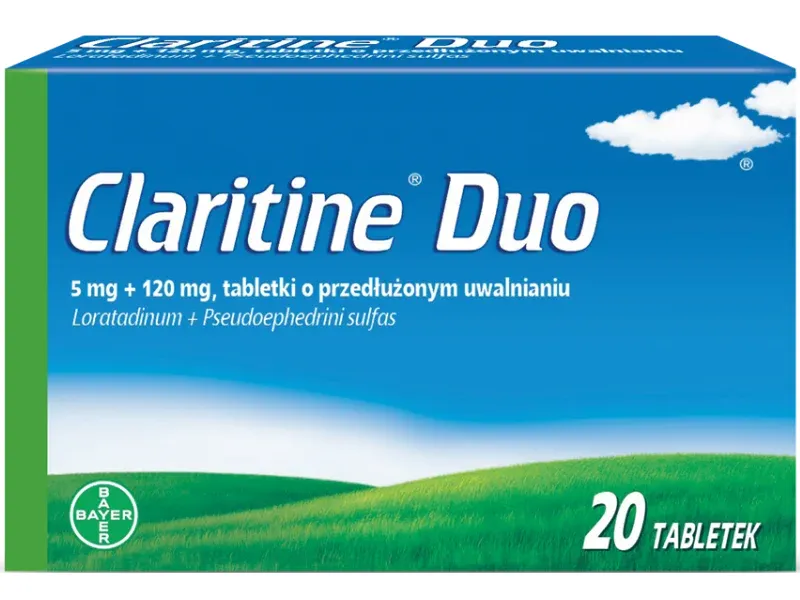
CLARITINE DUO
PolandThe medicine is used to treat the symptoms of seasonal allergic rhinitis accompanied by nasal congestion. It helps to reduce sneezing, runny nose, itching and watering of the eyes, as well as eye burning and redness.
Frequently asked questions
How should Claritine Duo be taken?
The recommended dose is 1 tablet twice daily (every 12 hours). The tablet should be swallowed whole with a glass of water. It can be taken regardless of meals. Do not divide, crush, or chew the tablets.
When should you not use this medicine?
Do not use the medicine if you are allergic to its ingredients, have narrow-angle glaucoma, hyperthyroidism, high blood pressure, heart or vascular diseases, stroke, difficulty urinating, or swallowing problems. The medicine must not be used in children under 12 years of age, pregnant or breastfeeding women, or persons over 60 years of age.
What are the possible side effects of Claritine Duo?
Common side effects may include: insomnia, thirst, nervousness, drowsiness, dizziness, dry mouth, headache, or fatigue. Very rarely, severe allergic reactions (e.g., facial swelling, difficulty breathing), heart rhythm disturbances, or high blood pressure may occur. You should contact a doctor immediately if you experience sudden abdominal pain, rectal bleeding, sudden loss of vision, or severe headache with nausea.
Can this medicine be combined with other preparations?
Caution should be exercised, as the medicine may interact with heart medications, blood pressure-lowering drugs, certain antidepressants (do not use them simultaneously or within 14 days after completing treatment), migraine medications, or appetite suppressants. Always inform your doctor about all medications you are currently taking.
How long can the medicine be used?
The medicine should not be used for longer than 10 days. The duration of treatment should be as short as possible.
Instructions for use
Patient Information Leaflet
Claritine Duo, 5 mg + 120 mg, prolonged-release tablets
Loratadine + Pseudoephedrine sulfate
Please read all of this leaflet carefully before taking this medicine, because it contains
important information for you.
- Keep this leaflet so that you can read it again if necessary.
- If you have any questions, please consult your doctor or pharmacist.
- This medicine has been prescribed for a specific individual. Do not pass it on to others. This medicine may harm someone else, even if their symptoms are the same.
- If you experience any adverse reactions, including any possible side effects not listed in this leaflet, tell your doctor or pharmacist. See section 4.
Table of Contents
- What Claritine Duo is and what it is used for
- Important information before taking Claritine Duo
- How to take Claritine Duo
- Possible side effects
- How to store Claritine Duo
- Contents of the pack and other information
1. What Claritine Duo is and what it is used for
What Claritine Duo is
Claritine Duo is a prolonged-release medicine containing two active substances:
loratadine, which has antiallergic properties, and pseudoephedrine, which has a mucosa-constricting effect.
How Claritine Duo works
- Loratadine helps reduce allergic symptoms by blocking the action in the body of a substance called histamine (antihistamine effect).
- Pseudoephedrine helps reduce nasal mucosal congestion (decongestant effect).
When to use Claritine Duo
Claritine Duo is indicated for the treatment of symptoms of seasonal allergic rhinitis associated with nasal mucosal congestion. Claritine Duo reduces the following symptoms: nasal congestion, sneezing, watery nasal discharge (runny nose), itching of the nose and eyes, tearing, burning sensation and redness of the eyes.
2. Important information before using Claritine Duo
When not to use Claritine Duo:
- if the patient is allergic to loratadine, pseudoephedrine or any of the other ingredients of this medicine (listed in section 6), or to other medicines that constrict blood vessels in the mucous membranes; allergic reactions may include, among others, difficulty breathing, wheezing, itching, hives, swelling;
- if the patient has narrow-angle glaucoma, hyperthyroidism, difficulty urinating, urinary retention, high blood pressure, heart or vascular disease;
- if the patient has previously had a stroke or is at risk of stroke;
- if the patient is currently taking or has taken within the last 14 days antidepressant medicines known as monoamine oxidase inhibitors (MAO inhibitors);
- if the patient has difficulty swallowing tablets, narrowing of the upper gastrointestinal tract, or abnormal oesophageal function;
- if the patient has very high blood pressure (severe hypertension) or hypertension that cannot be controlled with medication;
- if the patient has severe, acute (sudden) or chronic (long-term) kidney disease or renal failure;
- in children under 12 years of age;
- in pregnant women.
Warnings and precautions
Before starting Claritine Duo, discuss with a doctor or pharmacist:
- If the patient has: ➢ chronic eye disorders, ➢ diabetes, ➢ gastrointestinal, urinary bladder or prostate (prostate gland) disorders, ➢ a history of breathing difficulties (bronchospasm) or heart attack;
- Before undergoing surgery: Claritine Duo should be discontinued 24 hours before such a procedure;
- Discontinue treatment and contact a doctor if any of the following occur: ➢ high blood pressure, ➢ rapid heartbeat or palpitations, ➢ irregular heartbeat, ➢ malaise, nausea and headache or worsening headache during treatment with Claritine Duo;
- Do not use Claritine Duo for longer than 10 days;
- Claritine Duo has addictive properties that may occur if the patient takes the medicine for longer than recommended. In such cases, sudden discontinuation of Claritine Duo may lead to depression;
- Taking higher than recommended doses may cause poisoning.
If the patient develops fever with generalized skin redness and blistering rash,
stop taking Claritine Duo and contact a doctor or seek immediate medical help. See section 4.
During treatment with Claritine Duo, sudden abdominal pain or rectal bleeding due to inflammation of the large intestine (ischemic colitis) may occur.
If such gastrointestinal symptoms occur, stop taking Claritine Duo and immediately consult a doctor or seek medical help. See section 4.
During treatment with Claritine Duo, reduced blood flow to the optic nerve may occur.
If sudden vision loss occurs, stop taking Claritine Duo and immediately contact a doctor or seek medical help. See section 4.
Cases of posterior reversible encephalopathy syndrome (PRES) and reversible cerebral vasoconstriction syndrome (RCVS) have been reported with medications containing pseudoephedrine.
PRES and RCVS are rare conditions that may involve reduced blood flow to the brain.
If symptoms suggestive of PRES or RCVS occur, immediately discontinue Claritine Duo and seek immediate medical assistance (symptoms, see section 4 "Possible side effects").
Laboratory tests:
Stop using Claritine Duo at least 48 hours before undergoing skin allergy tests.
Information for athletes:
Use of Claritine Duo may result in positive anti-doping test results.
Children and adolescents
Do not use Claritine Duo in children under 12 years of age.
Interaction of Claritine Duo with other medicines
- Inform the doctor or pharmacist about all medicines currently taken, recently taken, or planned for use, as many medicines taken concurrently with Claritine Duo may cause, among others: ➢ increased or decreased blood pressure, ➢ heart rhythm disturbances, ➢ reduced effectiveness of treatment, ➢ possible need to adjust dosage.
- Do not take Claritine Duo simultaneously or within 14 days after stopping treatment with antidepressant medicines known as monoamine oxidase inhibitors (MAO inhibitors).
Claritine Duo may interact with the following medicines: cardiac glycosides (medicines used in heart disease); blood pressure-lowering medicines such as: α-methyldopa, mecamylamine, reserpine or guanethidine; oral or nasal decongestants such as: phenylpropanolamine, phenylephrine, ephedrine; appetite suppressants; amphetamine derivatives; tricyclic antidepressants; migraine medications such as: dihydroergotamine, ergotamine or methylergonovine; linezolid (an antibiotic); bromocriptine (used in infertility or Parkinson's disease); Parkinson's disease medicines such as: cabergoline, lisuride and pergolide; antacids (medicines that neutralize stomach acid); kaolin (a medicine used in diarrhoea).
Claritine Duo with food and drink
This medicine may be taken regardless of meals.
Pregnancy and breastfeeding
If the patient is pregnant or breastfeeding, suspects she may be pregnant, or is planning to have a child, she should consult a doctor or pharmacist before using this medicine.
Do not use Claritine Duo during pregnancy.
Women who are breastfeeding should not take Claritine Duo.
Driving and operating machinery
Patients should refrain from driving or operating machinery until their individual response to Claritine Duo has been established. Patients should not drive or operate machinery if symptoms such as drowsiness, dizziness, disorientation or headache occur, as these may impair the ability to drive or operate machinery.
Claritine Duo contains lactose and sucrose
If the patient has been previously diagnosed with intolerance to certain sugars, the patient should consult a doctor before taking Claritine Duo.
3. How to use Claritine Duo
This medicine should always be used according to the recommendations of your doctor or pharmacist. If in doubt,
consult your doctor or pharmacist.
Recommended dose
The recommended dose of Claritine Duo is 1 tablet twice daily (every 12 hours).
The tablet should be swallowed whole with a glass of water. Tablets must not be divided, crushed,
chewed or sucked.
Claritine Duo may be taken regardless of meals.
Do not take more tablets of Claritine Duo than recommended in the patient information leaflet.
The duration of treatment should be as short as possible.
Do not take this medicine for longer than 10 days.
If you feel that the effect of Claritine Duo is too strong or too weak, consult your doctor or pharmacist.
Use in children and adolescents
Claritine Duo is intended for use in adults and children over 12 years of age.
Use of Claritine Duo in patients with renal and/or hepatic impairment:
Claritine Duo must not be used in patients with impaired renal and/or liver function
or with renal tubular acidosis (tubular acidosis).
Use of Claritine Duo in patients over 60 years of age:
This medicine must not be used in individuals over 60 years of age.
Taking more than the recommended dose of Claritine Duo
If you take more than the recommended dose of Claritine Duo, seek immediate medical advice,
as dangerous overdose symptoms may occur, such as: apnea, cyanosis, coma, collapse, loss of consciousness, seizures.
Other symptoms that may occur after overdose include: hallucinations, high fever, irregular, slow or rapid heartbeat,
disturbances in consciousness and mood, severe drowsiness or confusion, nervousness or agitation,
vomiting, epigastric pain, blurred vision, high or low blood pressure.
Missed dose of Claritine Duo
Do not take a double dose to make up for a missed dose. If you miss a dose, take it as soon as possible,
ensuring that a 12-hour interval is maintained between consecutive doses.
If you have any further doubts concerning the use of this medicine, consult your doctor or pharmacist.
4. Possible side effects
Like all medicines, this medicine can cause side effects, although not everybody will experience them.
If any of the following symptoms occur, which may indicate
a severe allergic reaction: difficulty breathing, wheezing, itching,
hives, swelling, dizziness, high blood pressure, urinary retention, fever,
rash or small pustules all over the body, you must stop taking the medicine immediately
and contact your doctor.
➢ Side effects with unknown frequency (frequency cannot be estimated from available data):
- Severe conditions affecting blood vessels in the brain, known as posterior reversible encephalopathy syndrome (PRES) and reversible cerebral vasoconstriction syndrome (RCVS).
You must stop taking Claritine Duo immediately and seek medical help immediately if symptoms indicating posterior reversible encephalopathy syndrome (PRES) or reversible cerebral vasoconstriction syndrome (RCVS) occur. These include:
- Sudden, severe headache,
- Nausea,
- Vomiting,
- Confusion,
- Seizures,
- Visual disturbances.
- Weight gain, reduced blood flow in the optic nerve (ischaemic optic neuropathy), inflammation of the large intestine due to insufficient blood supply (ischaemic colitis). Sudden fever, skin redness or numerous small pustules (possible symptoms of acute generalized exanthematous pustulosis - AGEP) may occur within the first 2 days of taking Claritine Duo. See section 2. If such symptoms occur, discontinue use of Claritine Duo and contact your doctor or seek immediate medical assistance.
➢ Very common side effects associated with taking Claritine Duo (occurring in more than 1 in 10 patients using the medicine): insomnia.
➢ Common side effects associated with taking Claritine Duo (occurring in 1 to 10 out of 100 patients using the medicine): thirst, nervousness, drowsiness, depression, excitation, loss of appetite, dizziness, dry mouth, palpitations (rapid heartbeat), sore throat, nasal mucosal inflammation, constipation, nausea, headache, feeling of fatigue.
➢ Uncommon side effects associated with taking Claritine Duo (occurring in 1 to 10 out of 1,000 patients using the medicine): disorientation, tremor, increased sweating, hot flushes, taste disturbances, excessive tearing, tinnitus, palpitations, nosebleeds, frequent urination and urinary disorders, itching.
➢ Very rare side effects associated with taking Claritine Duo (occurring in less than 1 in 10,000 patients using the medicine): severe allergic reactions, including rash, hives, angioedema (swelling of the face, lips, tongue and/or throat, which may cause difficulty breathing and swallowing), dizziness, seizures, irregular heartbeat, high blood pressure, cough, breathing difficulties (bronchospasm), abnormal liver function, urinary retention, hair loss.
Other side effects observed in clinical studies and after marketing of the medicine associated with loratadine use include: increased appetite, rash, and gastritis.
Other side effects may occur in some individuals during treatment with Claritine Duo.
Reporting of side effects
If you experience any side effects, including any not listed in this leaflet, tell your doctor, pharmacist, or nurse. Side effects can be reported directly to the Department of Monitoring Adverse Drug Reactions of the Office for Registration of Medicinal Products, Medical Devices and Biocidal Products:
Al. Jerozolimskie 181C, 02-222 Warsaw, tel.: 22 49-21-301, fax: 22 49-21-309, website:
https://smz.ezdrowie.gov.pl
Side effects can also be reported to the marketing authorization holder.
Reporting side effects helps provide more information on the safety of this medicine.
5. How to store Claritine Duo
Keep the medicine out of sight and reach of children.
Do not use this medicine after the expiry date stated on the carton and blister pack following:
Expiry date (EXP) or EXP. The expiry date refers to the last day of the stated month.
Store below 25°C.
Blister packs should be kept in the original packaging.
Medicines must not be disposed of via the sewage system or household waste. Ask your pharmacist how to dispose of medicines no longer required. Such measures help protect the environment.
6. Contents of the pack and other information
What Claritine Duo contains
- The active substances are loratadine and pseudoephedrine sulfate. One tablet contains 5 mg of loratadine and 120 mg of pseudoephedrine sulfate (60 mg of pseudoephedrine sulfate is contained in both the coating and the core of the tablet).
- The other ingredients (excipients) are: lactose monohydrate, corn starch, povidone, magnesium stearate. The coating contains: acacia gum, sucrose, calcium sulfate dihydrate, anhydrous calcium sulfate, colophony, zein, oleic acid, neutral soap, talc, microcrystalline cellulose, titanium dioxide, white wax, Carnauba wax.
What Claritine Duo looks like and contents of the pack
Claritine Duo is a white or almost white, round, biconvex coated tablet.
Claritine Duo tablets are packed in blisters of 6, 10 or 20 tablets, in a cardboard box.
Marketing Authorisation Holder and Manufacturer
Marketing Authorisation Holder:
Bayer Sp. z o.o.
Al. Jerozolimskie 158
02-326 Warsaw
Tel.: +48 22 572 35 00
Manufacturer:
SAG Manufacturing SLU
Carretera N-1, km 36
28750 San Agustin de Guadalix
Spain
Similar drugs
| Brand name | Dosage form | Active substance / Dosage | Manufacturer |
|---|---|---|---|
| CLARITIN ACTIVE | tablets, prolonged release |
|
SAG MANUFACTURING, S.L.U. |
The original data is available in the language of the country of manufacture.
Data source: Register of Medicinal Products of Poland (URPL)
Data last verified: September 01, 2026