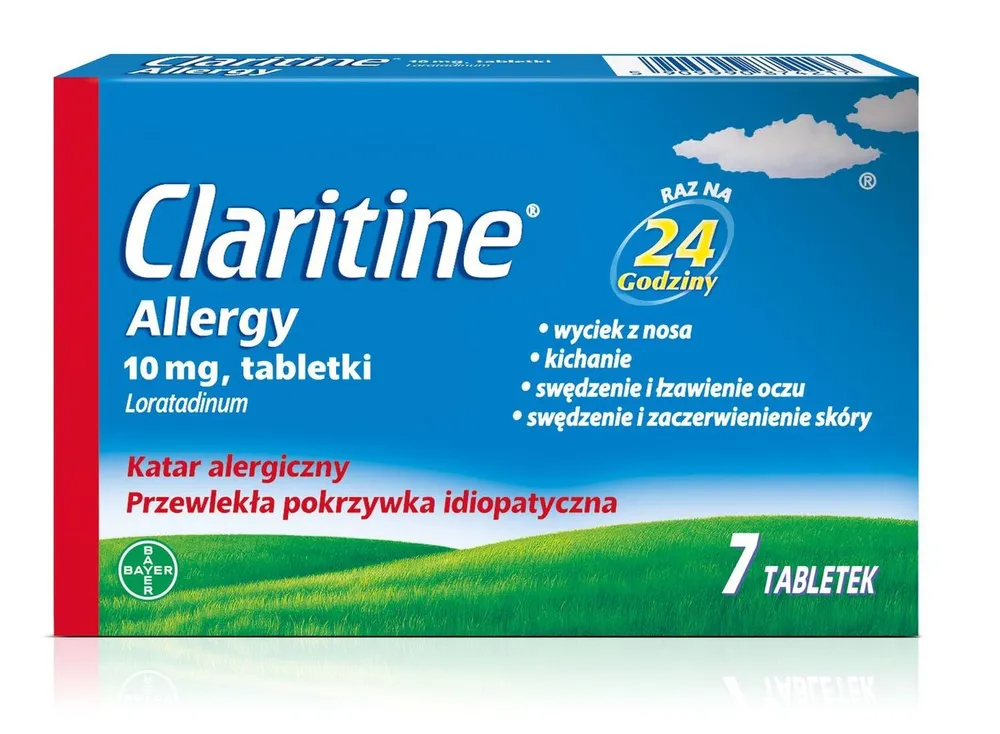
CLARITIN ALLERGY
PolandThe medicine is used to treat the symptoms of allergic rhinitis (such as sneezing, runny nose, itching, and eye irritation/burning) and to treat chronic idiopathic urticaria.
Frequently asked questions
How to use Claritine Allergy?
Adults and children over 12 years of age should take 1 tablet (10 mg) once daily. Children aged 6 to 12 years weighing more than 30 kg should also take 1 tablet once daily. The medicine can be taken regardless of meals. In cases of severe hepatic impairment, the dosage must be different (1 tablet every other day) and should be determined by a physician.
When should you not take this medicine?
Do not use the medicine if you are allergic to the active substance or any of the other ingredients. Persons with severe hepatic impairment should consult a doctor before use.
What are the possible side effects of Claritine Allergy?
Drowsiness occurs frequently in adults and adolescents. In children (2–12 years), headache, nervousness, and fatigue may occur. Other possible symptoms include, among others, headache, dry mouth, nausea, insomnia, or increased appetite. Very rarely, severe allergic reactions (e.g., difficulty breathing, swelling) may occur, which require immediate medical attention.
Can I take this medicine if I am pregnant or breastfeeding?
Avoid using the medicine during pregnancy. Since the active substance passes into breast milk, use of the medicine is not recommended during breastfeeding.
Does the medicine interact with other medications or alcohol?
The medicine can be taken with alcohol, as it does not significantly enhance its effects. However, caution should be exercised, and a doctor should be consulted when taking other medications that affect hepatic metabolism (e.g., ketoconazole, erythromycin, or cimetidine).
Does the medicine affect driving?
In clinical trials, the medicine had no significant effect on the ability to drive vehicles; however, in some individuals, drowsiness may occur very rarely, which could impair this ability.
Instructions for use
Package leaflet: Information for the user
Warning! Keep this leaflet. The information on the immediate packaging is in a foreign language.
Claritine Allergy (Clarityne)
10 mg, tablets
Loratadine
Claritine Allergy and Clarityne are different trade names for the same medicine.
Please read all of this leaflet carefully before taking this medicine because it contains
important information for you.
This medicine should always be taken exactly as described in this patient leaflet or as directed by
your doctor or pharmacist.
- Keep this leaflet so that you can read it again if necessary.
- If you need advice or further information, please consult your pharmacist.
- If you experience any adverse effects, including any possible adverse effects not listed in this leaflet, tell your doctor, pharmacist or nurse. See section 4.
- If there is no improvement after 3 days, or if you feel worse, contact your doctor.
Contents of the leaflet
- What Claritine Allergy is and what it is used for
- What you need to know before taking Claritine Allergy
- How to take Claritine Allergy
- Possible side effects
- How to store Claritine Allergy
- Contents of the pack and other information
1. What Claritine Allergy is and what it is used for
The active substance in Claritine Allergy – loratadine – is a tricyclic antihistamine and a selective peripheral H₁ histamine receptor antagonist.
Claritine Allergy is an antiallergic medicine that does not cause drowsiness. Claritine Allergy is indicated for the treatment of symptoms of allergic rhinitis (such as sneezing, runny nose, nasal itching, and eye itching and burning) and chronic idiopathic urticaria.
2. Important information before using Claritine Allergy
When not to use Claritine Allergy:
- if the patient is allergic to the active substance or to any of the other ingredients of this medicine (listed in section 6).
Warnings and precautions
Before starting treatment with Claritine Allergy, consult a doctor or pharmacist:
- if the patient has severe liver impairment (see section 3. How to use Claritine Allergy).
Treatment with loratadine without a doctor's recommendation should not exceed 10 days.
Skin tests:
Claritine Allergy should be discontinued approximately 48 hours before planned skin testing, as antihistamines may cause false-negative results (they may reduce or completely suppress the skin reaction that would normally be positive).
Claritine Allergy and other medicines
Adverse effects may be intensified when Claritine Allergy is used concomitantly with medicines affecting the activity of certain enzymes responsible for drug metabolism in the liver. However, in clinical studies, no intensification of adverse effects was observed during concomitant use of loratadine with medicines affecting these enzymes. Concurrent administration of loratadine with ketoconazole, erythromycin, or cimetidine increases the plasma concentration of loratadine, but without clinical consequences. Concomitant use of loratadine with medicines affecting hepatic metabolism should be carried out under medical supervision.
Inform your doctor or pharmacist about all medicines currently used or recently used, as well as any medicines you plan to take. This includes also medicines available without a prescription.
Use of Claritine Allergy with food, drink, and alcohol
This medicine can be taken regardless of meals.
When administered together with alcohol, this medicine does not intensify its effects to a degree detectable by psychomotor tests.
Pregnancy, breastfeeding, and fertility
If the patient is pregnant or breastfeeding, suspects she may be pregnant, or is planning to have a child, she should consult a doctor or pharmacist before using this medicine.
As a precautionary measure, it is recommended to avoid using Claritine Allergy during pregnancy.
Loratadine passes into breast milk; therefore, use of this medicine is not recommended during breastfeeding.
There are no data available on fertility in men and women.
Driving and operating machinery
In clinical studies, loratadine had no effect or had negligible effect on the ability to drive and operate machinery. In some individuals, somnolence has very rarely occurred, which may impair the ability to drive and operate machinery.
Claritine Allergy contains monohydrate lactose
This medicine contains, as an excipient, monohydrate lactose. If the patient has previously been diagnosed with intolerance to certain sugars, the patient should consult a doctor before taking this medicine.
3. How to use Claritine Allergy
This medicine should always be taken exactly as described in the patient information leaflet or as advised by your doctor or pharmacist. If in doubt, consult your doctor or pharmacist.
The break line on the tablet is intended only to facilitate splitting the tablet for easier swallowing.
Recommended dose
Adults and children over 12 years of age:
1 tablet (10 mg) once daily. The medicine can be taken with or without food.
Children aged 6 to 12 years:
Body weight above 30 kg: 1 tablet (10 mg) once daily.
The use of tablets (10 mg) is not recommended in children with body weight below 30 kg.
Patients with liver function disorders
A reduced initial dose should be used in patients with severe hepatic impairment, as loratadine clearance may be reduced in these individuals. In such cases, adults and children weighing more than 30 kg should receive 1 tablet (10 mg loratadine) every other day.
No dose adjustment is necessary for elderly patients or patients with renal impairment.
If you have any doubts regarding dosage, consult your doctor.
If you feel the effect of Claritine Allergy is too strong or too weak, consult your doctor.
Use of a higher than recommended dose of Claritine Allergy
If you take more Claritine Allergy than recommended, contact your doctor or pharmacist immediately.
Overdose symptoms observed with loratadine include: drowsiness, tachycardia, and headache.
In case of overdose, symptomatic and supportive treatment should be initiated immediately and continued as long as necessary. Activated charcoal may be administered as an aqueous suspension. Gastric lavage may also be performed. Loratadine cannot be removed from the body by hemodialysis. It is unknown whether peritoneal dialysis is effective in removing loratadine.
After treatment, the patient should continue to be monitored.
There are no data indicating that loratadine causes abuse or dependence.
Missed dose of Claritine Allergy
Do not take a double dose to make up for a missed dose.
If you have any further questions about the use of this medicine, consult your doctor or pharmacist.
4. Possible adverse reactions
Like all medicines, this medicine can cause adverse reactions, although not everybody will experience them.
Common adverse reactions associated with the use of Claritine Allergy (occurring in 1 to 10 out of 100 patients taking the medicine):
- In children aged 2 to 12 years – headache, nervousness, and fatigue.
- In adults and adolescents – drowsiness.
Uncommon adverse reactions associated with the use of Claritine Allergy (occurring in 1 to 10 out of 1,000 patients taking the medicine) in adults and adolescents:
- Headache, increased appetite, insomnia, fatigue, gastrointestinal disorders such as nausea, dry mouth, gastric mucosal inflammation, and allergic symptoms such as rash.
Very rare adverse reactions (occurring in fewer than 1 out of 10,000 patients taking the medicine), observed after the medicine was introduced to the market:
- Severe allergic reaction (including difficulty breathing, wheezing, itching, urticaria, swelling). If severe allergic reactions occur, discontinue taking the medicine and contact a doctor immediately.
- Dizziness, convulsions, increased heart rate, palpitations, abnormal liver function, hair loss.
Adverse reaction with unknown frequency (frequency cannot be estimated from available data): weight gain.
Other adverse reactions may occur in some individuals during treatment with Claritine Allergy.
Reporting of adverse reactions
If any adverse reactions occur, including any not listed in this leaflet, inform your doctor, pharmacist, or nurse. Adverse reactions can also be reported directly to the Department of Monitoring Adverse Drug Reactions, Office for Registration of Medicinal Products, Medical Devices and Biocidal Products, Al. Jerozolimskie 181C, 02-222 Warsaw, phone: +48 22 49-21-301, fax: +48 22 49-21-309, website: https://smz.ezdrowie.gov.pl
Reporting adverse reactions helps to provide more information on the safety of the medicine.
5. How to store Claritine Allergy
Keep this medicine out of sight and reach of children.
Store below 25°C.
Do not use this medicine after the expiry date stated on the packaging. The expiry date refers to the last day of the stated month.
Medicines must not be disposed of via wastewater or household waste. Ask your pharmacist how to dispose of medicines no longer required. This will help protect the environment.
6. Contents of the pack and other information
What Claritine Allergy contains
- The active substance is loratadine. One tablet contains 10 mg of loratadine.
- The other ingredients (excipients) are: monohydrate lactose, corn starch, magnesium stearate.
What Claritine Allergy looks like and contents of the pack
Claritine Allergy is a white or almost white tablet, free from impurities, oval in shape, with a division line on one side and smooth on the other.
Tablets are available in blister packs (7, 10 tablets), in a cardboard box.
For more detailed information, please contact the responsible party or parallel importer.
Responsible party in Greece, country of export:
Bayer Hellas A.B.E.E., Sorou 18-20, Gr-15125 Maroussi/Athens, Greece
Manufacturer:
Bayer Bitterfeld GmbH, OT Greppin, Salegaster Chaussee 1, 06803 Bitterfeld-Wolfen, Germany
Parallel importer:
Delfarma Sp. z o.o., ul. Św. Teresy od Dzieciątka Jezus 111, 91-222 Łódź
Repackaged in:
Delfarma Sp. z o.o., ul. Św. Teresy od Dzieciątka Jezus 111, 91-222 Łódź
Authorization numbers in Greece, country of export: 37542/7-9-09
43771/08/16-1-2009
84080/10/1-4-11
65448/2-10-2015
Parallel import authorization number: 375/13
Similar drugs
| Brand name | Dosage form | Active substance / Dosage | Manufacturer |
|---|---|---|---|
| ALERIC LORA | tablets |
|
US Pharmacia Sp. z o.o. |
| CLARITIN | tablets |
|
Bayer Bitterfeld GmbH |
| CLARITIN ALLERGY | tablets |
|
Bayer Hellas ABEE |
| FLONIDAN | tablets |
|
Lek Pharmaceuticals d.d. |
| LORATADINE GALENA | tablets |
|
Galena Pharmaceutical Cooperative - Plant No. 2 |
| LORATADINE PYLOX | tablets |
|
Pharmaceutical Workers' Cooperative "GALENA" |
| NASOMETIN ALERGIA LORA | tablets |
|
LEK S.A. Salutas Pharma GmbH |
The original data is available in the language of the country of manufacture.
Data source: Register of Medicinal Products of Poland (URPL)
Data last verified: September 01, 2026