BOCOUTURE
PolandThe medicinal product is used for the temporary improvement of the appearance of wrinkles in the upper part of the face in adults under 65 years of age. It is used for vertical wrinkles between the eyebrows, horizontal forehead wrinkles, and wrinkles at the corners of the eyes (so-called crow's feet).

Frequently asked questions
When should you not use BOCOUTURE?
It should not be used if there is a hypersensitivity to the ingredients of the medicinal product, muscle function disorders (e.g., myasthenia gravis), or if there is an infection or inflammation at the planned injection site. The medicinal product should not be used in children, adolescents, or persons over 65 years of age.
How is the medicinal product administered?
The medicinal product is injected into the muscle by a physician with specialist knowledge. The interval between consecutive treatments should not be shorter than 3 months.
What side effects may occur after administration of BOCOUTURE?
Pain, swelling, redness, bruising, or ecchymosis may occur at the injection site. Headaches or dry eyes also occur frequently. Uncommon side effects may include, among others, eyelid drooping, muscle tremors, blurred vision, or fatigue.
When should you contact a doctor immediately?
Seek medical assistance immediately if difficulty breathing, swallowing, or speaking occurs, as well as facial or throat swelling, urticaria, wheezing, or a severe allergic reaction.
Does BOCOUTURE interact with other medicines?
The effect of the medicinal product may be increased by certain antibiotics (e.g., neomycin, kanamycin) and muscle relaxants. Conversely, certain anti-malarial or anti-rheumatic drugs may weaken its effect. You should inform your doctor about all medicines you are taking, especially those that prevent blood clotting.
What should you do in case of overdose?
If symptoms of overdose occur, such as general weakness, double vision, speech or breathing disturbances, call emergency services immediately or go to the hospital.
Instructions for use
Table of contents
Package leaflet: Information for the patient
BOCOUTURE, 50 units, powder for solution for injection
BOCOUTURE, 100 units, powder for solution for injection
Botulinum toxin type A (150 kD), free from complexing proteins
Please read this leaflet carefully before using this medicine, as it contains important information for you.
- Keep this leaflet for future reference.
- If you have any questions, please consult your doctor, pharmacist, or nurse.
- If you experience any adverse reactions, including any not listed in this leaflet, inform your doctor, pharmacist, or nurse. See section 4.
Leaflet contents:
- What BOCOUTURE is and what it is used for
- Important information before using BOCOUTURE
- How to use BOCOUTURE
- Possible side effects
- How to store BOCOUTURE
- Contents of the pack and other information
1. What BOCOUTURE is and what it is used for
BOCOUTURE is a medicine containing botulinum toxin type A as the active substance, which relaxes the muscles into which it is injected.
BOCOUTURE is used to achieve a temporary improvement in the appearance of facial lines in adults under 65 years of age, when the depth of the lines has significant psychological impact on the patient:
- moderate to severe vertical lines between the eyebrows, visible at maximum forehead contraction (glabellar lines), and/or
- moderate to severe lateral periorbital lines, visible at full smile ("crow's feet"), and/or
- moderate to severe horizontal forehead lines, visible at maximum forehead contraction.
2. Information before using BOCOUTURE
When not to use BOCOUTURE
- if the patient is allergic to botulinum toxin type A or any of the other ingredients of this medicine (listed in section 6)
- if the patient has muscle function disorders (e.g. myasthenia gravis, Lambert-Eaton syndrome)
- if there is an infection or inflammatory condition at the planned injection site
Warnings and precautions
Adverse effects may result from injecting botulinum neurotoxin type A into an incorrect site, leading to temporary paralysis of nearby muscle groups. Very rarely, adverse effects have been reported due to the spread of the toxin to sites distant from the injection site, causing symptoms consistent with the effects of botulinum toxin type A (e.g. excessive muscle weakness, generalized weakness, swallowing difficulties, or accidental aspiration of food or liquids). Patients receiving recommended doses may experience excessive muscle weakness.
Contact a doctor or seek medical help if the patient experiences any of the following symptoms:
- difficulty breathing, swallowing or speaking,
- urticaria, swelling including facial or throat swelling, wheezing, feeling weak, or shortness of breath (possible severe allergic reaction symptoms) (see section 4).
If the dose is too high or the medicine is administered too frequently, the risk of developing antibodies may increase. The formation of antibodies may lead to treatment failure with botulinum toxin type A, regardless of the reason for administration.
Before starting treatment with BOCOUTURE, discuss the following with your doctor:
- if the patient has any disorders of the blood coagulation system,
- if the patient is taking medications that prevent blood clotting (e.g. coumarin derivatives, heparin, acetylsalicylic acid, clopidogrel),
- if the patient has significant muscle weakness or reduced muscle mass in the muscle to be injected,
- if the patient has a disease called amyotrophic lateral sclerosis, which may lead to generalized muscle atrophy,
- if the patient has any disease affecting nerve-muscle interactions at the neuromuscular junction (peripheral neuromuscular dysfunction),
- if the patient currently has or has previously had swallowing difficulties,
- if the patient has experienced problems after previous injections of botulinum toxin type A,
- if the patient is scheduled for surgery.
Repeated injections of BOCOUTURE
When repeated injections of BOCOUTURE are given, the therapeutic effect may vary. Possible reasons for increased or decreased effect include:
- different reconstitution techniques used by the physician,
- varying durations of treatment intervals,
- injections into a different muscle,
- lack of response/failure of therapy during the course of treatment.
Elderly patients
Information on treatment of patients over 65 years of age is limited. Therefore, BOCOUTURE should not be used in patients over 65 years of age.
Children and adolescents
BOCOUTURE should not be used in children and adolescents under 18 years of age, as the use of BOCOUTURE in this population is not recommended.
BOCOUTURE and other medicines
Tell your doctor about all medicines the patient is currently taking or has recently taken, as well as any medicines the patient plans to take.
The effect of BOCOUTURE may be enhanced by:
- medicines used to treat certain infectious diseases (spectinomycin or aminoglycoside antibiotics [e.g. neomycin, kanamycin, tobramycin]),
- other muscle relaxants (e.g. tubocurarine-type muscle relaxants). Such medicines are used, for example, during general anesthesia. Inform the anesthesiologist about BOCOUTURE treatment before surgery.
In such cases, caution should be exercised when using BOCOUTURE.
Some antimalarial/antirheumatic medicines (aminoquinolines) may reduce the effect of BOCOUTURE.
Pregnancy, breastfeeding and fertility
If the patient is pregnant or breastfeeding, suspects she may be pregnant, or is planning to have a child, she should consult a doctor or pharmacist before using this medicine.
BOCOUTURE should not be used during pregnancy unless the doctor decides it is absolutely necessary and the expected benefit outweighs the potential risk to the fetus.
Use of BOCOUTURE is not recommended in breastfeeding women.
Driving and operating machinery
Do not drive or operate machinery if eyelid ptosis, weakness (asthenia), muscle weakness, dizziness, or visual disturbances occur. In case of doubt, consult a doctor.
3. How to use BOCOUTURE
BOCOUTURE must only be administered by physicians with specialist knowledge
in type A botulinum toxin treatment.
Vertical frown lines between the eyebrows visible at maximum forehead contraction
(glabellar lines)
In the treatment of vertical frown lines between the eyebrows visible at maximum
forehead contraction (glabellar lines), the usual total dose is 20 units. The physician injects
4 units into each of 5 injection sites. If necessary, the total dose may be increased by the physician
up to 30 units, maintaining at least a three-month interval between treatment cycles.
Reduction of vertical frown lines between the eyebrows visible at maximum
forehead contraction (glabellar lines) is usually observed within 2 to 3 days after injection,
with maximum effect occurring at 30 days. The effect of the medicine lasts up to
4 months after administration.
Lateral periorbital lines visible at full smile ("crow's feet")
In the treatment of lateral periorbital lines visible at full smile ("crow's feet"),
the physician injects the standard dose of 24 units (12 units per eye). 4 units
are injected into each of 3 injection sites.
Reduction of lateral periorbital lines visible at full smile
is usually observed within 6 days after injection, with maximum effect occurring at
30 days. The effect of the medicine lasts up to 4 months after administration.
Horizontal forehead lines visible at maximum forehead contraction
In the treatment of horizontal forehead lines visible at maximum forehead contraction,
the physician may use doses ranging from 10 to 20 units, according to individual
patient needs. The recommended dose of 10 to 20 units is injected into five horizontally
aligned sites (2 units, 3 units or 4 units per injection point, respectively).
Reduction of horizontal forehead lines visible at maximum forehead contraction
occurs within 7 days, with maximum effect observed on day 30. This effect lasts up to
4 months after injection.
Method of administration
Reconstituted BOCOUTURE is intended for intramuscular injection (see
information for healthcare professionals at the end of this leaflet).
The interval between two treatments should not be shorter than 3 months.
Use of a higher than recommended dose of BOCOUTURE
Symptoms of overdose:
Overdose symptoms do not occur immediately after injection and may include general
weakness, eyelid ptosis, double vision, respiratory disturbances, speech disorders, and paralysis of respiratory muscles or swallowing difficulties, which may lead to pneumonia.
Management in case of overdose:
If symptoms of overdose occur, emergency medical assistance should be sought immediately (or a close person should be asked to call for help), or the patient should go to hospital. Several days of medical care and respiratory support may be necessary in such cases.
If you have any further questions about the use of this medicine, please consult your doctor, pharmacist, or nurse.
4. Possible adverse reactions
Like all medicines, this medicine can cause adverse reactions, although not everyone experiences them.
BOCOUTURE may cause an allergic reaction. Severe and/or sudden allergic reactions (anaphylactic shock) or serum-related allergic reactions (serum sickness) have been reported rarely. These may include, for example, breathing difficulties (dyspnoea), skin rash (urticaria), or swelling of soft tissues (oedema). Some of these reactions have been observed after administration of conventional botulinum toxin type A complex. These reactions occurred when the toxin was given alone or in combination with other medicines causing similar reactions. Such reactions cannot be completely ruled out when using BOCOUTURE.
An allergic reaction may cause any of the following symptoms:
- breathing, swallowing or speech difficulties due to swelling of the face, lips, mouth or throat,
- swelling of hands, feet or ankles.
If any of the above symptoms occur, contact your doctor immediately or ask someone nearby to do so and go to the emergency department of the nearest hospital.
Usually, adverse reactions occur within the first week after injection and are transient in nature.
Adverse reactions may be related to the medicine itself, to the injection technique, or to both factors. At the injection site, botulinum toxin causes local muscle weakness. Drooping of the eyelid may be caused by both the injection technique and the effect of the medicine.
The following reactions may occur at the injection site:
- local pain
- inflammation
- tingling and pricking sensation
- numbness
- tenderness
- itching
- swelling (generalised)
- soft tissue swelling (oedema)
- skin redness (erythema)
- local infection
- bruising
- bleeding
- discolouration
In patients who are afraid of injections or needle pain, transient generalised reactions may occur, such as:
- fainting
- circulatory problems
- nausea
- ringing in the ears
Other possible adverse reactions
The following adverse reactions have been reported after administration of BOCOUTURE:
Vertical lines between the eyebrows visible when frowning (glabellar lines)
Common (may occur in up to 1 in 10 people)
- headache
- "Mephisto effect" (elevation of the outer parts of the eyebrows)
Uncommon (may occur in up to 1 in 100 people):
- nasopharyngitis
- bronchitis
- influenza-like illness
- brow ptosis
- eyelid ptosis
- fluid accumulation in the eyelids (eyelid oedema)
- discomfort (feeling of heaviness in eyelids/eyebrows)
- blurred vision
- muscle twitching (muscle spasms)
- eyebrow asymmetry
- feeling of tension at the injection site
- fatigue
- pain or bruising at the injection site
- itching
- bruises
- skin nodules
- insomnia
Wrinkles at the outer corners of the eyes visible during full smile ("crow's feet")
Common (may occur in up to 1 in 10 people):
- eyelid swelling
- dry eyes
- bruising at the injection site
Upper facial wrinkles
Common (may occur in up to 1 in 10 people):
- headache
- bruising at the injection site
Uncommon (may occur in up to 1 in 100 people):
- numbness
- discomfort (feeling of heaviness in forehead)
- eyelid swelling
- drooping eyelids (ptosis)
- dry eye syndrome
- brow ptosis
- facial asymmetry
- "Mephisto effect" (elevation of the outer parts of the eyebrows)
- nausea
Post-marketing experience
After marketing authorisation and use of BOCOUTURE, the following adverse reactions of unknown frequency have been observed, regardless of the treated area:
influenza-like illness, muscle atrophy after injection, and hypersensitivity reactions such as swelling, soft tissue swelling (oedema), including at sites distant from the injection site, erythema, itching, rash (local and generalised), and dyspnoea.
During treatment with botulinum toxin type A for conditions other than upper facial wrinkles, the following adverse reactions have been observed very rarely (see section 2):
- excessive muscle weakness
- difficulty swallowing
- difficulty swallowing leading to aspiration of foreign bodies, resulting in pneumonia, and in some cases, patient death
Such adverse reactions are caused by muscle relaxation in areas distant from the injection site.
Reporting of adverse reactions
If any adverse reactions occur, including any not listed in this leaflet, inform your doctor, pharmacist, or nurse. Adverse reactions can be reported directly to the Department of Monitoring of Adverse Drug Reactions at the Office for Registration of Medicinal Products, Medical Devices and Biocidal Products
Al. Jerozolimskie 181C, 02-222 Warsaw
Tel.: +48 22 49 21 301
Fax: +48 22 49 21 309
Website: https://smz.ezdrowie.gov.pl
Adverse reactions may also be reported to the marketing authorisation holder.
Reporting adverse reactions helps to provide more information on the safety of the medicine.
5. How to store the medicine BOCOUTURE
The medicine should be stored out of sight and reach of children.
Do not use this medicine after the expiry date stated on the carton and on the vial label
following the text "Expiry date:". The expiry date refers to the last day of the stated month.
Unopened vial: Do not store above 25°C.
Reconstituted solution: Chemical and physical in-use stability has been demonstrated for 24 hours
at a temperature of 2°C to 8°C.
From a microbiological standpoint, the medicine should be used immediately. If not used
immediately, the user is responsible for the storage conditions and duration prior to use,
which should not exceed 24 hours at a temperature of 2°C to 8°C, unless reconstitution was carried out under controlled aseptic conditions.
The physician should not use the medicine BOCOUTURE if the solution is cloudy or contains undissolved
particles.
Medicines must not be disposed of via wastewater.
For information on how to dispose of the medicine, please refer to the section intended for healthcare professionals located at the end of this leaflet.
6. Contents of the pack and other information
What BOCOUTURE contains
- The active substance is botulinum toxin type A (150 kD), free from complexing proteins.
BOCOUTURE, 50 units One vial contains 50 units of botulinum toxin type A (150 kD), free from complexing proteins.
BOCOUTURE, 100 units One vial contains 100 units of botulinum toxin type A (150 kD), free from complexing proteins. - Other ingredients are: human albumin, sucrose.
What BOCOUTURE looks like and contents of the pack
BOCOUTURE is a powder for solution for injection (injection powder).
The powder is white.
After reconstitution, a clear and colourless solution is obtained.
Pack sizes: 1, 2, 3 or 6 vials.
Not all pack sizes may be marketed.
Marketing Authorisation Holder
Merz Pharmaceuticals GmbH
Eckenheimer Landstrasse 100
60318 Frankfurt am Main
Germany
Tel.: +49-69/15 03-1
Fax: +49-69/15 03-200
Manufacturer
Merz Pharma GmbH & Co. KGaA
Eckenheimer Landstrasse 100
60318 Frankfurt/Main
Germany
The following information is intended for healthcare professionals only:
Instructions for preparing the injection solution:
Before administration, BOCOUTURE must be reconstituted with 0.9% (9 mg/mL) sodium chloride injection solution.
BOCOUTURE must be used only as intended, for the treatment of a single patient during one procedure.
Good practice is to prepare the solution and handle the syringe over a paper-covered tray lined with foil, in case of spillage. Draw the appropriate amount of sodium chloride solution into the syringe. A short-beveled needle of 20–27 G is recommended for reconstitution. Pierce the rubber stopper at a right angle and slowly inject the diluent into the vial to avoid foaming. Discard the vial if the diluent is not drawn into the vial under vacuum. Remove the syringe from the vial and mix BOCOUTURE with the diluent by gently swirling or rotating the vial, or by tapping it—do not shake vigorously. If necessary, the needle used for reconstitution may remain in the vial, and the required amount of solution should be withdrawn using a new, sterile syringe suitable for drug injection.
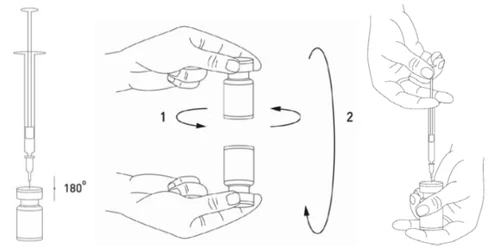
Reconstituted BOCOUTURE is a clear, colorless solution.
Do not use BOCOUTURE if the prepared solution (prepared as above) appears cloudy or contains particles or precipitate.
Possible dilutions for BOCOUTURE 50 and 100 units are given in the table below:
| Received dose (units per 0.1 ml) | Added diluent (sodium chloride 9 mg/ml (0.9%) solution for injection) | |
| Vial containing 50 units | Vial containing 100 units | |
| 5 units | 1 ml | 2 ml |
| 4 units | 1.25 ml | 2.5 ml |
Instructions for drug disposal
The injection solution stored for longer than 24 hours and any unused injection solution
must be discarded.
Safe disposal procedures for vials, syringes, and used materials
Unused vials or remaining solution and/or syringes should be sterilized in an autoclave.
Alternatively, any residual BOCOUTURE medication may be inactivated by adding one
of the following solutions: 70% ethanol, 50% isopropanol, 0.1% SDS (anionic detergent),
diluted sodium hydroxide (at least 0.1 N NaOH), or diluted sodium hypochlorite solution
(at least 0.1% NaOCl).
After inactivation, used vials, syringes, and materials must not be emptied but should be placed
in appropriate containers and disposed of in accordance with local regulations.
Recommendations for procedures in case of unexpected incidents during administration of botulinum toxin type A
- Any drug leakage must be immediately cleaned up: in the case of powder, use an absorbent material soaked in one of the above solutions; in the case of reconstituted drug, use dry absorbent material.
- The contaminated surface should be wiped with an absorbent material soaked in one of the above solutions, then dried.
- If a vial is broken, follow the above instructions. Carefully collect the broken glass pieces and wipe up any remaining medication, avoiding cuts.
- If the drug comes into contact with the skin, rinse the affected area thoroughly with large amounts of water.
- If the drug gets into the eyes, rinse the eyes thoroughly with large amounts of water or eye irrigation solution.
- If the drug enters a wound, cut, or skin fissure, thoroughly rinse the area with large amounts of water, then take appropriate medical measures depending on the injected dose.
Strict adherence to instructions regarding preparation and disposal of the drug is essential.
Similar drugs
| Brand name | Dosage form | Active substance / Dosage | Manufacturer |
|---|---|---|---|
| AZZALURE | powder for preparation of injection solution |
|
Ipsen Pharma |
| AZZALURE | powder for preparation of injection solution |
|
Ipsen Pharma |
| AZZALURE | powder for preparation of injection solution |
|
Ipsen Pharma |
| AZZALURE | powder for preparation of injection solution |
|
Ipsen Pharma |
| AZZALURE | powder for preparation of injection solution |
|
Ipsen Pharma |
| BOTOX | powder for preparation of injection solution |
|
Allergan Pharmaceuticals Ireland |
| BOTOX | powder for preparation of injection solution |
|
Allergan Pharmaceuticals Ireland |
| DYSPORT | powder for preparation of injection solution |
|
Ipsen Manufacturing Ireland Limited |
| DYSPORT | powder for preparation of injection solution | Ipsen Manufacturing Ireland Limited | |
| LETYBO | powder for preparation of injection solution |
|
Croma-Pharma GmbH |
| VISTABEL | powder for preparation of injection solution |
|
Allergan Pharmaceuticals Ireland |
| XEOMIN | powder for preparation of injection solution |
|
Merz Pharma GmbH & Co. KGaA |
The original data is available in the language of the country of manufacture.
Data source: Register of Medicinal Products of Poland (URPL)
Data last verified: September 01, 2026