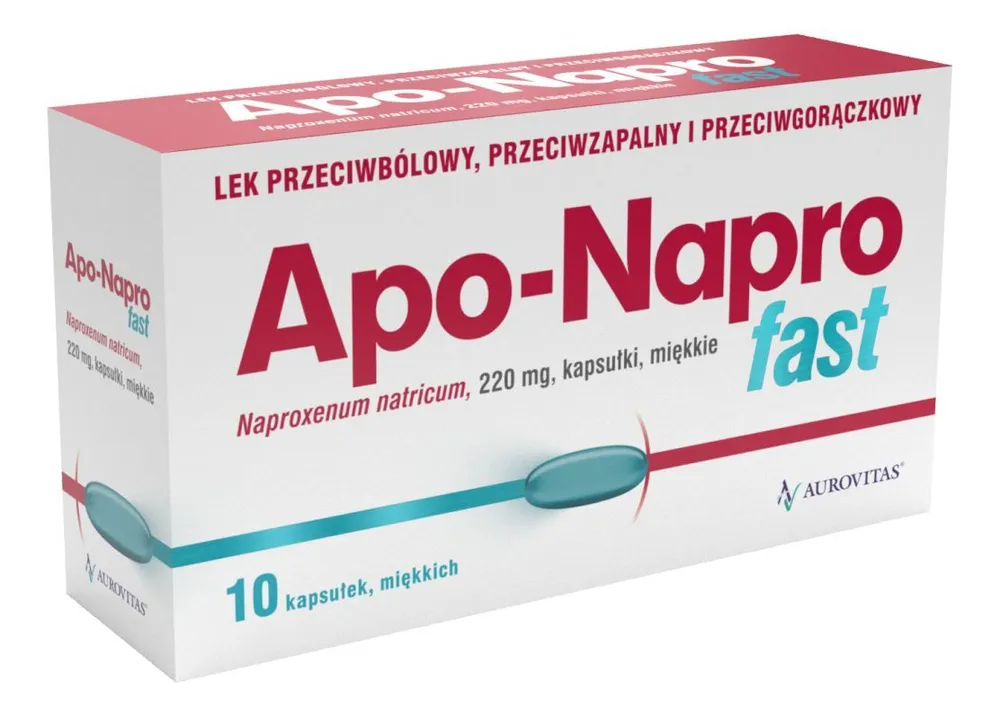
APO-NAPRO FAST
PolandThe medicine is used for the short-term relief of mild to moderate pain, such as headache, toothache, muscle pain, joint pain, back pain, painful menstruation, and pains associated with the common cold. It also helps to reduce fever.
Frequently asked questions
How to use Apo-Napro Fast?
Adults and children over 12 years of age should take 1 capsule every 8 to 12 hours, preferably immediately after a meal, drinking plenty of water or milk. An initial dose of 2 capsules may be taken. Do not exceed 3 capsules per day. Persons over 65 years of age should not take more than 2 capsules per day.
When should you not take this medicine?
Do not use the medicine if you are allergic to naproxen or other non-steroidal anti-inflammatory drugs (NSAIDs), if you have had allergic reactions (e.g., asthma, rhinitis, itching) after aspirin or ibuprofen, if you have or have had stomach ulcers, gastrointestinal bleeding, severe kidney, liver, or heart disorders, or during the last 3 months of pregnancy.
What are the possible side effects of Apo-Napro Fast?
Gastrointestinal problems, such as abdominal pain, nausea, vomiting, diarrhea, or constipation, may occur most frequently. Other possible symptoms include pain or dizziness, drowsiness, heartburn, and less commonly, serious reactions such as gastrointestinal bleeding or skin reactions.
Can the medicine be used with other preparations?
Caution should be exercised and a doctor should be consulted if you are taking anticoagulants, antidiabetic drugs, certain antibiotics, anticonvulsants, corticosteroids, or other painkillers and anti-inflammatory drugs. Do not use the medicine simultaneously with other non-steroidal anti-inflammatory drugs (NSAIDs).
When should you contact a doctor?
You should consult a doctor if the fever does not subside after 3 days, and the pain does not go away after 5 days of using the medicine. Medical assistance is also necessary if side effects occur, e.g., gastrointestinal bleeding or severe skin reactions.
Does the medicine affect driving?
The medicine may cause drowsiness, dizziness, and difficulty falling asleep; therefore, in such cases, you should not drive vehicles or operate machinery.
Instructions for use
Package leaflet: Information for the patient
Apo-Napro Fast, 220 mg, soft capsules
Naproxenum natricum
Please read the entire leaflet carefully before taking this medicine, as it contains
important information for the patient.
This medicine should always be taken exactly as described in this patient leaflet or as directed by
the doctor or pharmacist.
- Keep this leaflet, so that you can read it again if necessary.
- If you need advice or further information, please consult your pharmacist.
- If you experience any adverse reactions, including any possible adverse reactions not listed in this leaflet, inform your doctor, pharmacist, or nurse. See section 4.
- If there is no improvement after 3 days of treatment for fever or after 5 days of treatment for pain, or if you feel worse, consult your doctor.
Table of contents of the leaflet
- What Apo-Napro Fast is and what it is used for
- What you need to know before taking Apo-Napro Fast
- How to take Apo-Napro Fast
- Possible side effects
- How to store Apo-Napro Fast
- Contents of the pack and other information
1. What Apo-Napro Fast is and what it is used for
Apo-Napro Fast contains naproxen, which is a medicine with anti-inflammatory, analgesic, and antipyretic properties. It belongs to a group of medicines called NSAIDs (non-steroidal anti-inflammatory drugs).
Apo-Napro Fast is used for short-term treatment of mild to moderate pain in adults and children aged 12 years and older.
Indications
Treatment of mild to moderate pain, such as:
- headache,
- toothache,
- muscle pain,
- joint pain,
- back pain,
- painful menstruation,
- mild pain associated with colds.
Reduction of fever.
Consult your doctor if your condition does not improve or worsens after 3 days of treatment for fever or after 5 days of treatment for pain.
2. Important information before taking Apo-Napro Fast
When not to take Apo-Napro Fast:
- if the patient is allergic to naproxen or sodium naproxen or to any of the other ingredients of this medicine (listed in section 6)
- if the patient has ever experienced an allergic reaction such as asthma, rhinitis or itching after taking aspirin, ibuprofen or other painkillers and anti-inflammatory medicines (NSAIDs)
- if the patient has previously experienced gastrointestinal bleeding or perforation after using non-steroidal anti-inflammatory drugs (known as NSAIDs)
- if the patient has or has had recurrent stomach/duodenal ulcers or bleeding (at least two separate episodes of confirmed ulceration or bleeding)
- if the patient has peptic ulcer disease, gastric mucosal inflammation or stomach pain
- if the patient has internal bleeding (e.g. bleeding from the stomach, intestines or brain)
- if the patient has a tendency to bleed or is being treated with anticoagulant medicines (blood-thinning medicines)
- if the patient has severe kidney function disorders
- if the patient has severe liver function disorders
- if the patient has severe heart failure
- if the patient is in the last three months of pregnancy.
Warnings and precautions
Adverse effects can be minimized by using the lowest effective dose for the shortest duration necessary to control symptoms (see below - gastrointestinal and cardiovascular risks).
Before starting treatment with Apo-Napro Fast, discuss with your doctor, pharmacist or nurse:
- if pain or fever does not subside, worsens or recurs regularly, even if these symptoms are mild
- if gastrointestinal discomfort (such as stomach pain or heartburn) occurs during treatment with this medicine
- if the patient has high blood pressure or heart disease
- if the patient has an infection
- if the patient is elderly
- if the patient has liver problems
- if the patient has kidney problems.
In case of heart disorders, previous stroke or suspected risk of such disorders (e.g. high blood pressure, diabetes, elevated cholesterol levels or smoking), discuss this with your doctor or pharmacist before taking the medicine.
Taking medicines such as Apo-Napro Fast may be associated with a small increased risk of heart attack (myocardial infarction) or stroke. This risk is higher in patients taking high doses or undergoing long-term treatment. Do not exceed the recommended dose or duration of treatment (10 days).
Additional precautions are necessary in patients with gastrointestinal problems:
Gastrointestinal bleeding, ulceration and perforation have been reported during treatment with all NSAIDs, sometimes fatal. These events may occur at any time during treatment, with or without warning symptoms, or if serious gastrointestinal events occurred previously.
The risk of gastrointestinal bleeding, ulceration and perforation increases with higher doses of NSAIDs and is higher in patients with a history of peptic ulcer disease, especially with complications such as bleeding or perforation (see section 2: When not to take Apo-Napro Fast), and in elderly patients. These patients should start treatment with the lowest available dose. In these patients, as well as in those requiring additional low-dose acetylsalicylic acid or other medicines that may increase gastrointestinal risk, consider combination therapy with protective active substances (e.g. misoprostol or proton pump inhibitors).
If the patient has previously experienced gastrointestinal adverse effects, especially in elderly individuals, report any unusual abdominal symptoms (particularly gastrointestinal bleeding), especially during the initial phase of treatment.
Caution is advised when taking other medicines that may increase the risk of ulcers or bleeding, such as oral corticosteroids, anticoagulants (blood thinners), e.g. warfarin, selective serotonin reuptake inhibitors (used to treat psychiatric disorders, including depression) or antiplatelet agents, e.g. acetylsalicylic acid (see section 2: Apo-Napro Fast and other medicines).
If gastrointestinal bleeding or ulceration occurs during treatment with Apo-Napro Fast, discontinue treatment and consult your doctor.
NSAIDs should be used cautiously in patients with a history of gastrointestinal disorders (ulcerative colitis, Crohn's disease), as their condition may worsen (see section 4).
If stomach discomfort occurs or has occurred previously, do not use Apo-Napro Fast unless directed by a doctor.
Patients with blood clotting disorders should use this medicine only under medical supervision.
This medicine is not suitable for treating pain caused by gastrointestinal disorders.
Avoid using Apo-Napro Fast simultaneously with other non-steroidal anti-inflammatory drugs, including so-called COX-2 inhibitors (cyclooxygenase-2 inhibitors).
Use of NSAIDs in elderly people is associated with an increased risk of adverse effects, particularly (sometimes fatal) gastrointestinal bleeding and perforation.
Talk to your doctor if any of the above warnings apply to your current or past medical history.
Serious skin reactions, including exfoliative dermatitis, Stevens-Johnson syndrome, toxic epidermal necrolysis, and drug reaction with eosinophilia and systemic symptoms (DRESS syndrome), have been reported with the use of Apo-Napro Fast. The risk of such reactions appears to be highest at the beginning of therapy, as most cases occurred within the first month of treatment. Discontinue use of Apo-Napro Fast and seek immediate medical attention if any of the symptoms associated with these serious skin reactions described in section 4 occur.
This product belongs to a group of medicines (NSAIDs) that may negatively affect female fertility during use. This effect is reversible upon discontinuation of the medicine.
Apo-Napro Fast and other medicines
Tell your doctor or pharmacist about all medicines you are currently taking, have recently taken or plan to take, including over-the-counter medicines.
Do not take Apo-Napro Fast with the following medicines:
Apo-Napro Fast may enhance the effect of:
- certain anticoagulants (blood-thinning medicines)
- certain oral antidiabetic medicines
- certain antibiotics
- certain anticonvulsants (hydantoin derivatives), such as phenytoin
- certain sulfonamides, such as sulfadoxine
- certain narcotic medicines, such as thiopental
- acetylsalicylic acid used for prevention of blood clots.
Apo-Napro Fast may reduce the effectiveness of certain antihypertensive medicines (beta-blockers and diuretics).
Apo-Napro Fast may delay the elimination of lithium preparations (used in the treatment of nervous system disorders).
Apo-Napro Fast increases the risk of adverse effects when used concomitantly with:
- methotrexate (used in the treatment of rheumatism)
- angiotensin-converting enzyme inhibitors (medicines used, for example, in the treatment of hypertension)
- cyclosporines (medicines used in the treatment of autoimmune disease – a condition in which the immune system produces antibodies against the body's own tissues)
- other painkillers and anti-inflammatory medicines.
Concomitant use of Apo-Napro Fast with probenecid (used in the treatment of gout) may delay naproxen elimination.
Consult your doctor also when using other medicines that increase the risk of ulceration or bleeding, such as oral corticosteroids (medicines that suppress inflammation), anticoagulants (e.g. warfarin), selective serotonin reuptake inhibitors (used in depression) and medicines preventing blood clotting, e.g. acetylsalicylic acid.
Pregnancy, breastfeeding and effects on fertility
If the patient is pregnant or breastfeeding, suspects she may be pregnant or is planning to become pregnant, she should consult her doctor or pharmacist before using this medicine.
Pregnancy
Do not take Apo-Napro Fast during the last three months of pregnancy, as it may harm the unborn child or cause problems during delivery. The medicine may cause kidney and heart problems in the unborn child. It may increase the tendency to bleed in both mother and child and may delay or prolong labour. Do not take Apo-Napro Fast during the first 6 months of pregnancy unless absolutely necessary and recommended by a doctor. If treatment is required during this period or when trying to conceive, use the lowest possible dose for the shortest possible time. If Apo-Napro Fast is used for longer than a few days beyond week 20 of pregnancy, it may cause kidney problems in the unborn child, which may lead to low amniotic fluid levels surrounding the baby (oligohydramnios) or narrowing of a blood vessel (ductus arteriosus) in the baby's heart. If longer-term treatment is required, your doctor may recommend additional monitoring.
Breastfeeding
Naproxen, the active substance in Apo-Napro Fast, passes into breast milk. Therefore, Apo-Napro Fast should not be used during breastfeeding.
Fertility
Apo-Napro Fast is a non-steroidal anti-inflammatory drug (NSAID) that may impair fertility in women. This effect ceases after discontinuation of the medicine. Occasional use is unlikely to affect the likelihood of conception; however, if there are difficulties becoming pregnant, consult your doctor before taking this medicine.
Driving and operating machinery
Apo-Napro Fast may cause drowsiness, dizziness and difficulty sleeping as adverse effects. In such cases, do not drive or operate machinery.
Apo-Napro Fast contains sorbitol
If the patient has previously been diagnosed with intolerance to certain sugars, the patient should consult a doctor before taking this medicine.
Apo-Napro Fast contains lecithin derived from soybean oil
Patients with an allergy (hypersensitivity) to peanuts or soybeans should not take this medicine.
Apo-Napro Fast contains sodium
This medicine contains less than 1 mmol (23 mg) of sodium per capsule, which means it is essentially "sodium-free".
3. How to take Apo-Napro Fast
This medicine should always be taken exactly as described in this patient leaflet or as directed by your doctor, pharmacist, or nurse. If in doubt, consult your doctor, pharmacist, or nurse.
Recommended dose:
Adults and children aged 12 years and older:
The recommended dose is 1 capsule every 8 to 12 hours. As an initial dose, 2 capsules may be taken, and if symptoms persist, take another capsule after 12 hours. Do not take more than 3 capsules within a 24-hour period.
Capsules should be taken with a large amount of water or milk, preferably just after a meal.
Patients should contact their doctor if they do not feel better or feel worse after 3 days of treatment for fever or after 5 days of treatment for pain.
Do not use Apo-Napro Fast for longer than 10 days without consulting a doctor.
Patients over 65 years of age:
Do not take more than 2 capsules per day.
Patients with impaired kidney function:
Patients with mild impairment of kidney function should use the lowest effective dose under medical supervision, with regular monitoring of kidney function. Naproxen should be avoided in patients with moderate impairment of kidney function. Naproxen is contraindicated in patients with severe impairment of kidney function.
Patients with impaired liver function:
Patients with impaired liver function should exercise particular caution when taking Apo-Napro Fast. Apo-Napro Fast should be avoided in patients with severe liver impairment or liver cirrhosis.
Method of administration
The capsules should be taken orally, swallowed with plenty of water or milk, preferably immediately after food.
Overdose of Apo-Napro Fast
In case of overdose, seek immediate medical advice from a doctor or pharmacist. Show the doctor the medicine pack or leaflet.
Symptoms of overdose include: nausea, vomiting, stomach pain, drowsiness, dizziness, disorientation, diarrhoea, gastrointestinal bleeding, high blood sodium levels (hypernatraemia), seizures (rare), transient liver dysfunction, kidney dysfunction, respiratory depression, and blood acidification (metabolic acidosis).
Missed dose of Apo-Napro Fast
Take the missed dose as soon as possible. Do not take a double dose to make up for a missed dose.
If you have any further questions about the use of this medicine, consult your doctor or pharmacist.
4. Possible adverse effects
Like all medicines, this medicine can cause adverse effects, although not everyone will experience them.
The most commonly observed adverse effects are gastrointestinal disorders. Gastric/duodenal ulcers (peptic ulcers), gastrointestinal perforation or bleeding, sometimes fatal (particularly in elderly patients), may occur. After administration of the medicine, nausea, vomiting, diarrhoea, flatulence, constipation, dyspepsia, abdominal pain, black tarry stools (melena), vomiting blood (haematemesis), inflammation of the oral mucosa (ulcerative stomatitis), and exacerbation of colitis or Crohn's disease have been reported. Gastritis (inflammation of the stomach lining) has been observed less frequently.
Fluid retention, high blood pressure and heart failure have been reported in association with the use of NSAIDs.
Medicines such as Apo-Napro Fast may be associated with a small increased risk of heart attack or stroke.
If any of the adverse effects listed below occur, stop taking Apo-Napro Fast and contact your doctor immediately:
Frequency unknown: frequency cannot be estimated from the available data
- Extensive rash, high body temperature, elevated liver enzymes, blood disorders (eosinophilia), swollen lymph nodes and involvement of other organs (drug reaction with eosinophilia and systemic symptoms, also known as DRESS syndrome). See also section 2.
- A characteristic skin allergic reaction called fixed drug eruption, which usually recurs in the same location(s) upon re-exposure to the drug and may present as round or oval red patches and swelling of the skin, blisters (urticaria), and itching.
The following adverse effects may occur:
Very common (may affect more than 1 in 10 people)
- Abdominal discomfort.
Common (may affect 1 to 10 people in 100)
-
Headache
-
Dizziness
-
Drowsiness
-
Feeling of emptiness in the head
-
Visual disturbances
-
Ringing or buzzing in the ears (tinnitus)
-
Nausea
-
Indigestion
-
Heartburn.
Uncommon (may affect 1 to 10 people in 1,000)
- Difficulty concentrating
- Sleep problems (insomnia)
- Concentration or memory problems (cognitive disorders)
- Vomiting
- Diarrhoea
- Constipation
- Gastrointestinal bleeding and/or perforation
- Light sensitivity
- Rash
- Itching.
Rare (may affect 1 to 10 people in 10,000)
- Allergic reactions to naproxen and sodium naproxen. Allergic reactions usually occur in patients with known hypersensitivity to acetylsalicylic acid (aspirin), other NSAIDs, or to Apo-Napro Fast. However, they may also occur in patients who have not previously experienced such allergies.
- High potassium levels in the blood (hyperkalaemia)
- Hearing disturbances
- Vasculitis (inflammation of blood vessels)
- Lung inflammation (eosinophilic pneumonia)
- Oral ulcers
- Vomiting blood.
Very rare (may affect less than 1 person in 100,000)
- Marked decrease in blood cells, which may cause weakness, appearance of bruising, or increased risk of infections (aplastic anaemia)
- Decrease in red blood cells, which may cause pale-yellow skin colouration and lead to weakness and breathlessness (haemolytic anaemia)
- Decrease in white blood cells (granulocytopenia)
- Decrease in platelets (thrombocytopenia)
- Seizures
- Non-infectious inflammation of the membranes surrounding the brain (aseptic meningitis)
- Increased heart rate
- Swollen ankles and feet (oedema)
- High blood pressure
- Inadequate pumping function of the heart (heart failure)
- Shortness of breath
- Asthma
- Inflammation of the large intestine (colitis)
- Life-threatening liver inflammation (fatal hepatitis)
- Jaundice
- Stevens-Johnson syndrome (blisters on hands and feet)
- Skin redness (erythema multiforme)
- Skin peeling (toxic epidermal necrolysis)
- Hair loss (alopecia)
- Reactions due to exposure to light, such as skin inflammation and blistering (porphyria cutanea tarda or reactions resembling blistering epidermal detachment)
- Blood in the urine (haematuria)
- Kidney function disorders, including glomerulonephritis or interstitial nephritis, renal papillary necrosis (necrosis of tissue parts in the kidneys) and nephrotic syndrome (proteinuria).
Frequency unknown (frequency cannot be estimated from the available data)
- Gout
- Gastrointestinal ulcers other than peptic ulcers, peptic ulcers
- Swelling of the neck and face (angioedema)
- Kidney failure
- Decreased fertility in women
- Mild swelling of ankles and feet (mild peripheral oedema).
Reporting of adverse effects
If you experience any adverse effects, including any not listed in this leaflet, tell your doctor, pharmacist or nurse. Adverse effects can be reported directly to the Department of Monitoring Adverse Drug Reactions of the Office for Registration of Medicinal Products, Medical Devices and Biocidal Products:
Al. Jerozolimskie 181C, 02-222 Warsaw, tel.: +48 22 49-21-301, fax: +48 22 49-21-309, website: https://smz.ezdrowie.gov.pl .
Adverse effects can also be reported to the marketing authorisation holder or its representative in Poland.
Reporting adverse effects helps provide more information on the safety of this medicine.
5. How to store Apo-Napro Fast
Keep this medicine out of the sight and reach of children.
Do not use this medicine after the expiry date stated on the packaging following the term EXP.
The “Expiry date (EXP):” refers to the last day of the stated month.
Store below 25°C. Do not freeze.
Keep in the original packaging to protect from moisture.
Medicines must not be disposed of via wastewater or household waste. Ask your pharmacist how to properly dispose of medicines no longer in use. This will help protect the environment.
6. Contents of the package and other information
What Apo-Napro Fast contains
- The active substance is naproxen sodium. Each capsule contains 220 mg of naproxen sodium.
- The other ingredients (excipients) are: macrogol 600, lactic acid, propylene glycol, povidone K-30, gelatin, sorbitol liquid, partially dehydrated, glycerol, purified water, patent blue V (E 131), medium-chain triglycerides of saturated fatty acids, isopropyl alcohol, lecithin.
What Apo-Napro Fast looks like and contents of the pack
- Apo-Napro Fast is blue, transparent soft gelatin capsules containing 220 mg of naproxen sodium per capsule.
- Each cardboard box contains 10 or 20 soft capsules in blisters made of PVDC/PE/PVC/Aluminium foil. Not all pack sizes may be marketed.
Marketing Authorisation Holder and Manufacturer
Marketing Authorisation Holder
Aurovitas Pharma Polska Sp. z o.o.
ul. Sokratesa 13D lok.27
01-909 Warszawa
Poland
Manufacturer
Generis Farmacêutica, S.A.
Rua João de Deus, n. 19,
Venda Nova, 2700-487 Amadora
Portugal
The leaflet does not contain all the information about this medicinal product. If you have any further questions or
doubts, please consult your doctor, pharmacist, or representative of the Marketing Authorisation Holder:
Aurovitas Pharma Polska Sp. z o.o.,
tel.: 22 311 20 00
The original data is available in the language of the country of manufacture.
Data source: Register of Medicinal Products of Poland (URPL)
Data last verified: September 01, 2026