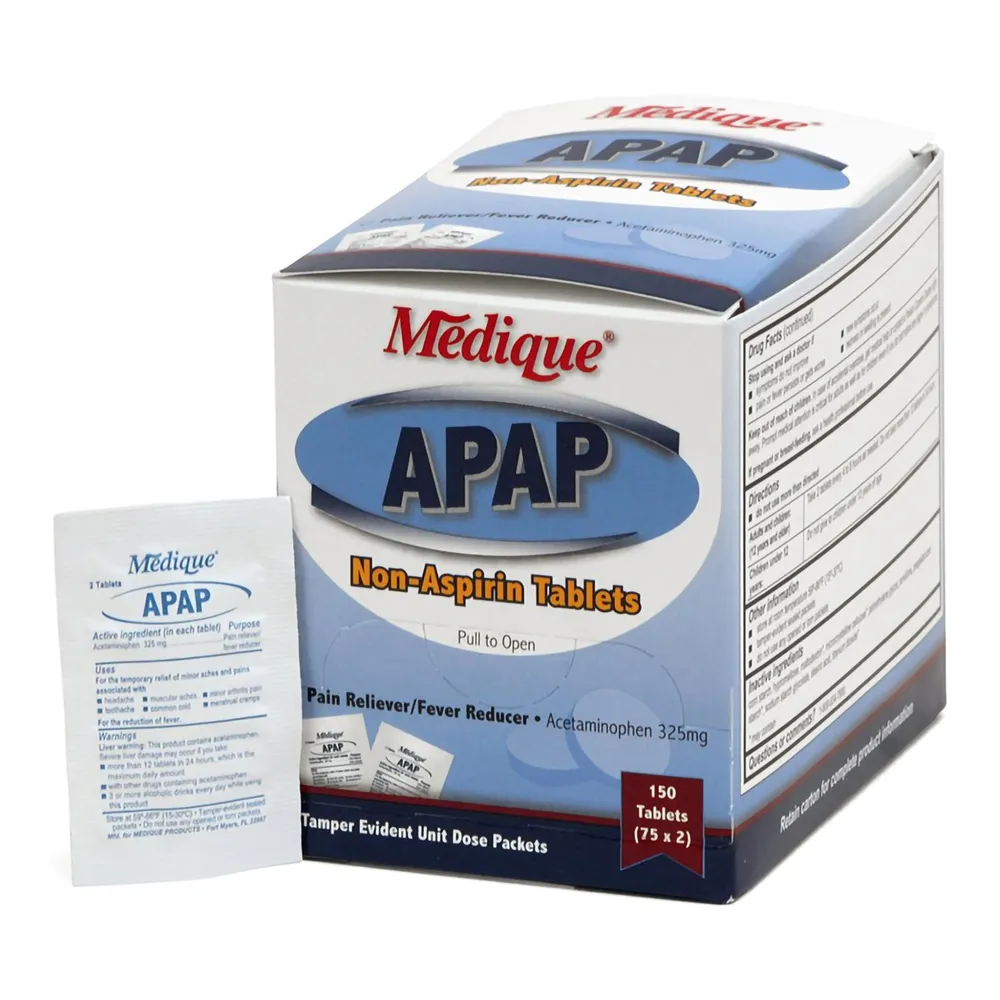
APAP 325 MG
PolandThis is an analgesic and antipyretic medication. It helps with mild to moderate headaches, migraines, neuralgia, toothaches, sore throat, spinal pain, muscle pain, and menstrual pain. It also relieves symptoms of the common cold and flu, such as fever, chills, and muscle and bone-joint pain.
Frequently asked questions
When should this medicine not be used?
Do not take this medicine if you are allergic to paracetamol or any of the ingredients, or in cases of severe liver or kidney failure.
How to use APAP 325 mg?
Adults and adolescents over 12 years of age: 2 tablets every 4–6 hours (maximum 10 tablets per day). Children aged 6–11 years: 1 tablet every 4–6 hours (maximum 5 tablets per day). Tablets should be swallowed whole with liquid. Use in children under 6 years of age is not recommended.
Can this medicine be combined with other preparations?
This medicine must not be used simultaneously with other medicines containing paracetamol. Some medicines (e.g., anticoagulants, anticonvulsants, or certain antibiotics) may interact, therefore their simultaneous use requires consultation with a doctor.
What are the possible side effects of APAP 325 mg?
Side effects may include, among others, nausea, vomiting, diarrhea, abdominal pain, dizziness, rash, itching, or vision problems. Very rarely, life-threatening conditions may occur, such as swelling of the face or throat causing difficulty breathing, anaphylactic shock, or severe skin reactions.
Should alcohol be avoided during treatment?
Yes, alcohol should not be consumed while using paracetamol, as it increases the risk of toxic liver damage.
What to do in case of overdose?
In case of taking a dose greater than recommended, contact a doctor immediately, even if no symptoms appear, as life-threatening liver damage may occur.
Instructions for use
Package leaflet: Information for the user
APAP 325 mg
325 mg, coated tablets
Paracetamolum
Please read all of this leaflet carefully before taking this medicine, because it contains
important information for you.
This medicine should always be taken exactly as described in this patient leaflet or as directed
by your doctor or pharmacist.
- Keep this leaflet, as you may need to read it again.
- If you need advice or further information, please consult your pharmacist.
- If you experience any adverse reactions, including any possible adverse reactions not listed in this leaflet, inform your doctor or pharmacist. See section 4.
- If pain persists for more than 5 days or fever for more than 3 days, consult your doctor.
Table of contents
- What APAP 325 mg is and what it is used for
- Important information before taking APAP 325 mg
- How to take APAP 325 mg
- Possible side effects
- How to store APAP 325 mg
- Contents of the pack and other information
1. What APAP 325 mg is and what it is used for
APAP 325 mg is an analgesic and antipyretic medicine. It contains paracetamol as the active substance. The medicine provides analgesic effects in mild to moderate pain, such as headaches, migraines, neuralgia, toothache, sore throat, back pain, muscle pain, and menstrual pain. It also relieves symptoms of cold and flu, including fever, chills, headache, sore throat, muscle aches, and bone and joint pain.
2. Important information before taking APAP 325 mg
When not to take APAP 325 mg
Do not take this medicine if you:
- are allergic to paracetamol or any of the other ingredients of this medicine;
- have severe liver impairment;
- have severe kidney impairment.
Warnings and precautions
This medicine contains paracetamol. To avoid overdose, ensure that none of the other medicines you are taking concurrently contain paracetamol. Do not take other medicines containing paracetamol at the same time.
Prolonged or frequent use of this medicine is not recommended.
If you take more than the recommended dose, contact your doctor immediately, even if no adverse symptoms are present, as this may lead to life-threatening liver damage.
Before starting treatment with APAP 325 mg, consult your doctor or pharmacist if you have:
- liver impairment;
- chronic alcoholism;
- kidney impairment;
- Gilbert's syndrome (hereditary non-haemolytic jaundice);
- acute hepatitis;
- glucose-6-phosphate dehydrogenase deficiency or haemolytic anaemia;
- methemoglobin reductase deficiency;
- asthma or hypersensitivity to acetylsalicylic acid or other non-steroidal anti-inflammatory drugs (NSAIDs), as bronchospasm has been observed in less than 5% of individuals after taking paracetamol;
- are taking other medicines that affect liver function.
During treatment with APAP 325 mg, contact your doctor immediately if:
- you have severe medical conditions, including severe kidney dysfunction or sepsis (when bacteria and their toxins circulate in the blood, leading to organ damage), malnutrition, chronic alcoholism, or if you are also taking flucloxacillin (an antibiotic). In such cases, severe metabolic acidosis (an imbalance in blood and body fluid chemistry) has been reported in patients taking paracetamol at standard doses over a prolonged period or when paracetamol is taken together with flucloxacillin. Symptoms of metabolic acidosis may include severe breathing difficulties, including rapid deep breathing, drowsiness, nausea, and vomiting.
Prolonged, high-dose, inappropriate use of analgesics may lead to headaches. In such cases, do not increase the dose of the analgesic; instead, discontinue treatment and consult your doctor.
Habitual use of analgesics, especially combinations of multiple analgesic substances, may lead to permanent kidney damage with risk of kidney failure (analgesic nephropathy).
Prolonged or frequent use of this medicine is not recommended. Do not take other medicines containing paracetamol simultaneously. Taking multiple daily doses at once may cause severe liver damage. In such cases, loss of consciousness does not occur, but immediate medical attention is required. Prolonged use without medical supervision may be harmful.
Sudden discontinuation after prolonged, high-dose, inappropriate use of analgesics may cause headaches, weakness, muscle pain, restlessness, and autonomic symptoms (such as sweating, palpitations, and hand tremors). These withdrawal symptoms usually resolve within a few days. Do not increase the dose of paracetamol during this time, and avoid further use of analgesics; do not restart them without consulting your doctor.
APAP 325 mg contains sodium
This medicine contains less than 1 mmol (23 mg) of sodium per single dose (2 tablets), meaning it is considered "sodium-free".
Children and adolescents
APAP 325 mg is not recommended for children under 6 years of age.
In children treated with paracetamol at a daily dose of 60 mg/kg, there is no justification for simultaneously administering another antipyretic unless paracetamol alone is ineffective.
APAP 325 mg and other medicines
Do not take APAP 325 mg with other medicines containing paracetamol.
Medicines that should be used with APAP 325 mg only after consultation with your doctor include:
- zidovudine (an antiviral medicine used in HIV infection);
- oral anticoagulants (warfarin, other coumarin derivatives);
- rifampicin and isoniazid (medicines used in the treatment of tuberculosis);
- medicines that increase liver metabolism, including antiepileptic drugs (e.g. phenobarbital, phenytoin, carbamazepine), sedatives and hypnotics (e.g. barbiturates);
- non-steroidal anti-inflammatory drugs (NSAIDs) – increased risk of kidney dysfunction;
- metoclopramide or domperidone (medicines used to treat nausea and vomiting);
- propantheline (a medicine used to treat gastrointestinal spasms);
- cholestyramine (a medicine used to lower blood cholesterol levels);
- lamotrigine (an antiepileptic medicine) – its effectiveness may be reduced;
- medicines known as MAO inhibitors (used in the treatment of depression) – may lead to agitation and high fever;
- chloramphenicol (an antibiotic) – may enhance the toxic effects of chloramphenicol, such as vomiting, hypotension (low blood pressure), and hypothermia (low body temperature);
- probenecid (a medicine that increases uric acid excretion, used in gout) – paracetamol dose should be reduced;
- salicylamide;
- caffeine.
Inform your doctor or pharmacist if you are taking:
- flucloxacillin (an antibiotic) due to the serious risk of blood and body fluid disorders (called metabolic acidosis), which require urgent treatment (see section 2).
Effect on diagnostic test results
Taking paracetamol may affect test results for uric acid using phosphotungstic acid and blood glucose levels measured with glucometers using glucose oxidase and peroxidase.
APAP 325 mg with food, drink, and alcohol
Taking this medicine with food may delay the onset of its effect.
Do not consume alcohol while taking paracetamol, due to increased risk of toxic liver damage. The risk of liver damage is particularly high in malnourished individuals, regular alcohol consumers, and patients with alcoholic liver disease without cirrhosis.
Pregnancy and breastfeeding
If you are pregnant or breastfeeding, think you may be pregnant, or are planning to have a baby, consult your doctor or pharmacist before using this medicine.
APAP 325 mg may be used in pregnant women if necessary.
Use the lowest effective dose to relieve pain or reduce fever, and take the medicine for the shortest possible duration.
If pain is not relieved or fever does not subside, or if you need to take the medicine more frequently, consult your doctor.
Do not use paracetamol in combination with other medicines during pregnancy, as the safety of such combinations has not been established.
After oral administration, paracetamol is excreted in small amounts into human breast milk.
No adverse effects on breastfed infants have been reported.
Therapeutic doses of this medicine may be used during breastfeeding.
Driving and using machines
This medicine does not affect the ability to drive or operate machinery.
3. How to use APAP 325 mg
This medicine should always be taken exactly as described in this patient leaflet.
If in doubt, consult a doctor or pharmacist.
The medicine is administered orally. The tablets should be swallowed whole, without chewing, with an adequate amount of fluid.
Taking the medicine with food may delay the onset of its action.
Typically recommended dose
Adults and adolescents aged over 12 years
2 tablets (equivalent to 650 mg of paracetamol); if necessary, the dose may be repeated no more frequently than every 4–6 hours. Maximum of 10 tablets (i.e. 3250 mg of paracetamol) per day.
Children aged 6–11 years
1 tablet (i.e. 325 mg of paracetamol); if necessary, the dose may be repeated no more frequently than every 4–6 hours. Do not exceed a dose of 5 tablets (i.e. 1625 mg of paracetamol) per day.
Children under 6 years of age
APAP 325 mg coated tablets are not recommended for children under 6 years of age.
Consult a doctor if pain persists for more than 5 days or fever lasts longer than 3 days.
Patients with hepatic impairment
In patients with impaired liver function or Gilbert's syndrome, the doctor may reduce the dose or extend the intervals between doses.
Patients with renal impairment
In patients with impaired kidney function, the doctor may reduce the dose or extend the intervals between doses. In patients with severe renal impairment (creatinine clearance <10 ml/min), the interval between doses must be at least 8 hours.
Patients with chronic alcoholism
Chronic alcohol consumption may lower the toxic threshold of paracetamol. In these patients, subsequent doses should not be taken more frequently than every 8 hours. Do not exceed 2 g of paracetamol per day.
Elderly patients
Dose adjustment based on age is not necessary in elderly patients.
Taking more medicine than recommended
If a larger than recommended dose is taken, contact a doctor immediately, even if no adverse symptoms are present, as this may lead to life-threatening liver damage.
Within a few to several hours after ingestion, symptoms such as nausea, vomiting, excessive sweating, drowsiness, and general weakness may occur. These symptoms may subside the next day, even though liver damage may already be developing, later manifesting as upper abdominal discomfort, recurrence of nausea, and jaundice.
In any case where a single dose of paracetamol of 5 g or more has been ingested, vomiting should be induced if no more than one hour has passed since ingestion, and immediate contact with a doctor is required. To bind any remaining medicine in the stomach, administer 60–100 g of activated charcoal orally, preferably mixed with water.
Missed dose of APAP 325 mg
APAP 325 mg is taken as needed. It should be taken in accordance with the instructions given in section 3.
4. Possible adverse reactions
Like any medicine, APAP 325 mg may cause adverse reactions, although not everyone experiences them.
If any of the following symptoms occur, do not continue taking the medicine and contact a doctor immediately.
These are life-threatening conditions. They occur very rarely.
- Angioedema, with symptoms such as swelling of the face or throat, which may impair breathing.
- Anaphylactic shock, with symptoms such as impaired consciousness, pale skin, drop in blood pressure, sweating, reduced urine output, rapid breathing.
- Severe skin reactions with sudden onset, with symptoms such as: acute generalized vesicular rash, erythema, rupturing blisters and erosions potentially affecting large areas of the skin, oral cavity, and genital organs, fever, joint pain.
Adverse reactions occurring rarely (in 1 to 10 out of 10,000 patients using the medicine):
- Bone marrow suppression, coagulation disorders;
- Hypersensitivity reactions: urticaria, erythema, rash (including generalized);
- Depression, confusion, hallucinations;
- Tremor, headache;
- Visual disturbances;
- Edema;
- Nausea, vomiting, diarrhea, abdominal pain, digestive disorders;
- Increased liver enzyme activity (aminotransferases), abnormal liver function;
- Itching, sweating;
- Dizziness, malaise, fever, excessive sedation;
- Overdose and poisoning.
Adverse reactions occurring very rarely (less than 1 in 10,000 patients using the medicine):
- Decreased number of red blood cells, decreased platelet count, decreased number of certain types of white blood cells—leukocytes or neutrophils, complete absence of another type of white blood cells—granulocytes;
- Hypoglycemia (excessive drop in blood sugar levels);
- Bronchospasm in patients hypersensitive to acetylsalicylic acid and other nonsteroidal anti-inflammatory drugs, respiratory disorders, asthma attack;
- Bleeding (in the gastrointestinal tract);
- Acute liver injury, most commonly due to overdose, liver failure, hepatic necrosis, jaundice;
- Pigmentary purpura;
- Severe skin reactions;
- Sterile pyuria (cloudy urine).
Adverse reactions occurring with unknown frequency (cannot be estimated from available data):
- Metabolic acidosis (disturbance in the body's acid-base balance); a serious condition that may cause blood acidification (so-called metabolic acidosis) in patients with severe illness taking paracetamol (see section 2).
- Acute and chronic pancreatitis;
- Interstitial nephritis after prolonged use of high doses;
Reporting of adverse reactions
If any adverse reactions occur, including any adverse reactions not listed in this leaflet, inform a doctor or pharmacist.
Adverse reactions can be reported directly to the Department of Monitoring Adverse Drug Reactions of the Office for Registration of Medicinal Products, Medical Devices and Biocidal Products,
Al. Jerozolimskie 181C,
02-222 Warsaw,
Phone: +48 22 49 21 301,
Fax: +48 22 49 21 309,
Website: https://smz.ezdrowie.gov.pl
Adverse reactions can also be reported to the marketing authorization holder.
Reporting adverse reactions helps to gather more information on the safety of the medicine.
5. How to store APAP 325 mg medicine
Product packed in a blister:
No special storage temperature requirements for the medicinal product.
Keep the blister in the outer packaging to protect from light.
Product packed in a bottle:
No special storage requirements for the medicinal product.
Keep out of sight and reach of children. Do not use this medicine after the expiry date stated on the carton and immediate packaging (month/year).
The expiry date refers to the last day of the stated month. Labelling used for blister:
EXP – expiry date, Lot – batch number.
6. Contents of the pack and other information
What APAP 325 mg contains
- The active substance is paracetamol. One coated tablet contains 325 mg of paracetamol.
- Excipients:
Core: pregelatinized corn starch, sodium croscarmellose, povidone, stearic acid.
Coating: hypromellose, polyethylene glycol 400, polyethylene glycol 8000.
What APAP 325 mg looks like and contents of the pack
White, elongated coated tablet with a transparent film coating.
Available pack sizes
PVC/Aluminum blisters in cardboard box: 2 coated tablets (1 blister with 2 tablets),
6 coated tablets (1 blister with 6 tablets), 12 coated tablets (1 blister with 12 tablets), 24 coated tablets
(2 blisters with 12 tablets each); HDPE bottle with HDPE screw cap in cardboard box:
50 coated tablets (1 bottle with 50 tablets).
Not all pack sizes may be marketed.
Marketing Authorisation Holder and Manufacturer
US Pharmacia Sp. z o.o.
Ziębicka 40 Street
50-507 Wrocław
For further information about this medicinal product, please contact:
USP Zdrowie Sp. z o.o.
Poleczki 35 Street
02-822 Warsaw
tel. +48 (22) 543 60 00
Monika
Monicz-
Madej
Similar drugs
| Brand name | Dosage form | Active substance / Dosage | Manufacturer |
|---|---|---|---|
| APAP | tablets, film-coated |
|
US Pharmacia Sp. z o.o. |
| EXCEDRIN SPRINT | tablets, film-coated |
|
Haleon Ireland Dungarvan Limited Haleon Italy Manufacturing S.r.l. |
| PANAPREX | tablets, film-coated |
|
Olimp Laboratories Ltd. |
| PARACETAMOL BIOFARM | tablets, film-coated |
|
Biofarm Sp. z o.o. |
| PARACETAMOL HASCO | tablets, film-coated |
|
HASCO-LEK S.A. Pharmaceutical Production Enterprise |
| PARACETAMOL OLIMP | tablets, film-coated |
|
Olimp Laboratories Ltd. |
The original data is available in the language of the country of manufacture.
Data source: Register of Medicinal Products of Poland (URPL)
Data last verified: September 01, 2026