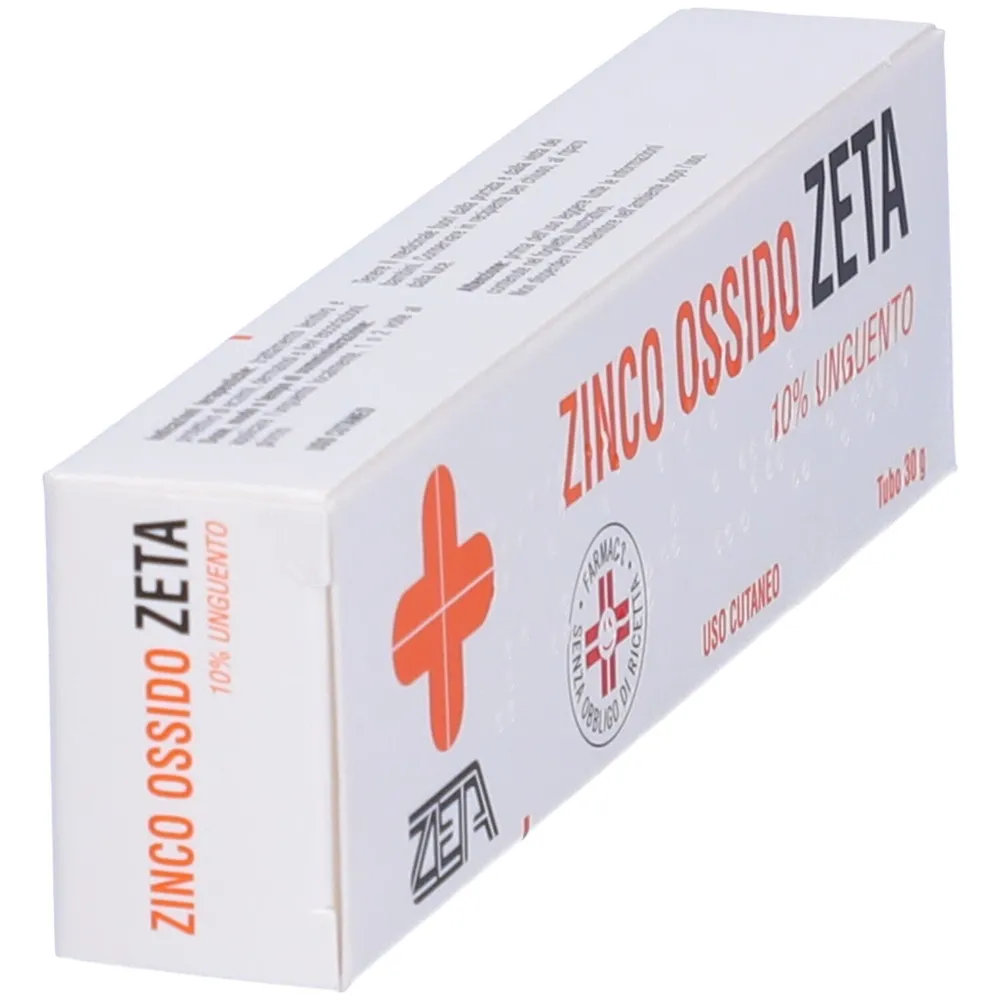
ZINC OXIDE ZETA
ItalyIt is used for the soothing and protective treatment of eczema, dermatosis, and mild excoriations.
Frequently asked questions
How should Zinco ossido Zeta 10% ointment be applied?
The ointment should be applied locally to properly washed and dried skin, 1 or 2 times a day. A light circular massage should be performed on the affected area until partial absorption is achieved, leaving an opaque white residue.
When should the product not be used?
It must not be used in case of hypersensitivity to the active ingredient or to the excipients, on sunburns, or on wounds that could be infected.
What are the side effects of Zinco ossido Zeta 10% ointment?
It may cause allergic reactions (such as rash, hives, itching, or swelling of the face, tongue, throat, and lips), skin irritation, burning, tingling, or dark spots on the skin.
What should be done in case of contact with eyes?
Contact with eyes must be avoided; if it occurs accidentally, it is necessary to rinse thoroughly with water.
Can I take this medication if I am pregnant or breastfeeding?
During pregnancy and breastfeeding, use is generally considered safe if applied to localized areas and for short periods, but it is necessary to seek advice from a doctor or pharmacist.
What happens if the product is accidentally ingested?
Ingestion may cause nausea, vomiting, diarrhea, confusion, fever, mouth irritation, and other disturbances; in case of ingestion, it is necessary to inform a doctor immediately or go to the nearest hospital.
Are there any interactions with other medicines?
No interactions with other medicines are known, but it is always advisable to inform the doctor or pharmacist if you are taking other medications, even without a prescription.
Instructions for use
Table of contents
Zinc Oxide Zeta 10% ointment
Package leaflet
Zeta Farmaceutici S.p.A.
Zinc Oxide Zeta 10% ointment
Pharmacotherapeutic Category
Emollient and Protective
Therapeutic Indications
Soothing and protective treatment of eczema, dermatoses, and minor abrasions.
Contraindications
Hypersensitivity to the active substance or to any of the excipients.
Precautions for use
This medicine is for external use only; it may be harmful if swallowed (see
Overdose).
Avoid contact of the medicine with the eyes; in case of accidental contact, rinse thoroughly with
water.
Do not use the medicine in case of burns or potentially infected wounds.
If the ointment is used for diaper dermatitis, check that the skin rash improves within a few days; otherwise, contact the doctor, as a different treatment may be required.
The use, especially if prolonged, of topical medicines may lead to irritation or sensitization. In such cases, treatment must be discontinued and the doctor consulted to establish appropriate therapy.
If there is no noticeable improvement after a short period of treatment, consult the doctor.
Interactions
Inform your doctor or pharmacist if you have recently taken any other medicines, including those
without a prescription.
No interactions with other medicines are known.
Special Warnings
Pregnancy and Breast-feeding
Ask your doctor or pharmacist for advice before taking any medicine.
Generally, the use of the ointment during pregnancy and breast-feeding is considered safe when applied to limited areas and for short periods.
Pregnancy
For zinc oxide ointment, there are no clinical data available on exposed pregnancies.
When used according to the recommended dosage, this medicine is not absorbed and therefore does not produce systemic effects; however, when applied to damaged skin, minimal absorption may occur.
Breast-feeding
There are no data available on the use of this medicine during breast-feeding, and it is not known whether the active substance passes into breast milk. However, since absorption of the medicine can be considered negligible, it is very unlikely that significant amounts reach breast milk.
Effects on ability to drive vehicles and use of machinery
This medicine does not affect the ability to drive vehicles or use machinery.
Important information about some excipients:
Zinc Oxide Zeta 10% ointment
Package leaflet
Zeta Farmaceutici S.p.A.
Zinc oxide Zeta 10% ointment contains BHA and BHT: it may cause local skin reactions (e.g. contact dermatitis) or eye irritation or irritation of other mucous membranes.
Dosage, method and duration of administration
Apply the ointment locally, once or twice daily, to skin that has been properly washed and dried. Due to its astringent and decongestant properties, it may also be used on irritated skin (e.g. diaper dermatitis).
Apply a layer of ointment sufficient to cover the affected area (especially when used for the treatment of diaper dermatitis); in cases of burns and non-infected skin lesions, it is preferable to apply a thin layer of ointment, using a dressing if necessary.
Perform a gentle circular massage on the affected area to achieve partial absorption of the ointment, after which a white opaque residue may remain.
Zinc oxide reacts slowly with fatty acids from oils and fats to form aggregates of zinc oleate, stearate, etc.
In contact with glycerol and in the presence of light, a dark discoloration may often develop.
Overdose
No cases of overdose have been reported.
The poor percutaneous absorption of the medicinal product makes the occurrence of overdose symptoms and signs unlikely.
In case of accidental ingestion, the following symptoms may occur: diarrhoea, nausea and vomiting, hypoglycaemia, confusion, fatigue, lethargy, bleeding, jaundice, dark urine, cough, chills and fever, irritation of the oral cavity, renal disorders, copper deficiency.
In case of ingestion/ingestion of zinc oxide Zeta, immediately contact a physician or go to the nearest hospital.
If you have any doubts about the use of zinc oxide Zeta, consult your doctor or pharmacist.
Undesirable effects
Like all medicines, zinc oxide Zeta may cause undesirable effects, although not everybody experiences them.
The following are undesirable effects associated with zinc oxide. There are insufficient data available to establish the frequency of the individual effects listed.
Immune system disorders
Allergic/hypersensitivity reaction: rash, urticaria, pruritus and/or swelling (especially of the face, tongue, throat, lips), feeling of tightness in the chest, difficulty breathing.
Skin and subcutaneous tissue disorders
Skin irritation.
Burning, tingling, and dark spots on the skin.
Following the instructions provided in this leaflet reduces the risk of undesirable effects.
If any of the undesirable effects worsens, or if you notice any undesirable effect not listed in this leaflet, inform your doctor or pharmacist.
Expiry date and storage
Expiry date: see the date indicated on the packaging.
Zinc oxide Zeta 10% ointment
Package Leaflet
Zeta Farmaceutici S.p.A.
The expiry date refers to the product in its original packaging, correctly stored.
WARNING: Do not use the medicine after the expiry date stated on the package.
Storage Conditions
Store in a tightly closed container, protected from light.
Medicines should not be disposed of via wastewater or household waste. Ask your pharmacist
how to dispose of medicines no longer required. This will help protect the environment.
Keep the medicine out of the reach and sight of children.
Composition
100 g of ointment contain:
Active substance: zinc oxide 10 g
Excipients: white vaseline, liquid paraffin, glyceryl oleate, BHA, BHT, hexylene glycol, citric acid monohydrate, ascorbyl palmitate.
Pharmaceutical Form and Contents
Ointment
30 g tube
Marketing Authorization Holder
Zeta Farmaceutici S.p.A.
Via Mentana, 38 – 36100 Vicenza
Responsible Person for Batch Release
Zeta Farmaceutici S.p.A.
Via Galvani, 10 – 36066 Sandrigo (VI)
AIFA Decision of 29 July 2011
Similar drugs
| Brand name | Dosage form | Active substance / Dosage | Manufacturer |
|---|---|---|---|
| ZINC OXIDE MARCO VITI | ointment | MARCO VITI FARMACEUTICI S.P.A. | |
| ZINC OXIDE NOVA ARGENTIA | ointment | INDUSTRIA FARMACEUTICA NOVA ARGENTIA S.R.L. | |
| ZINC OXIDE SELLA | ointment | LABORATORIO CHIMICO FARMACEUTICO A. SELLA S.R.L. |
The original data is available in the language of the country of manufacture.
Data source: Italian Medicines Agency (AIFA)
Data last verified: September 21, 2026