VELTASSA
ItalyVeltassa is used to treat adults and adolescents (between 12 and 17 years old) who have excessively high levels of potassium in the blood. The medicine works by binding to potassium in the intestine, preventing it from entering the bloodstream and returning levels to normal values.
Frequently asked questions
How should Veltassa be taken?
The medicine should be taken once daily by mixing the contents of the sachet with a specific amount of water (or other liquids/soft foods such as fruit juice or yogurt) before drinking. The suspension can be taken with or without food, preferably at the same time every day. If other oral medications are being taken, they must be taken at least 3 hours before or 3 hours after using Veltassa.
What are the side effects of Veltassa?
Common side effects may include constipation, diarrhea, abdominal pain, nausea, flatulence, and low magnesium levels. A less common side effect may be vomiting. In case of allergic reactions such as skin rash, hives, or swelling of the lips, tongue, or throat, it is necessary to stop taking the medicine and consult a doctor urgently.
When should the medicine not be taken?
You must not take the drug if you are allergic to patiromer or any of its components. It is important to consult a doctor before use if you have swallowing problems, severe stomach or intestinal problems, or if you have undergone major surgery in that area.
Are there interactions with other drugs?
Yes, Veltassa can reduce the absorption of or interact with certain oral medications, such as ciprofloxacin, levothyroxine, metformin, mycophenolate mofetil, quinidine, telmisartan, bisoprolol, carvedilol, and nebivolol. It is essential to inform your doctor of all medications you are currently taking.
What happens if I forget a dose?
If a dose is forgotten, take it as soon as possible on the same day. Do not take a double dose to make up for the forgotten dose. If multiple doses are forgotten, it is necessary to consult a doctor.
How should the product be stored?
The medicine must be stored in a refrigerator (between 2°C and 8°C). Once received, it can be kept at a temperature below 25°C for a maximum of 6 months.
Instructions for use
Table of contents
- Veltassa 1 g powder for oral suspension, 8.4 g powder for oral suspension, 16.8 g powder for oral suspension, 25.2 g powder for oral suspension
- 1. What Veltassa is and what it is used for
- 2. What you need to know before taking Veltassa
- 3. How to take Veltassa
- 4. Possible side effects
- 5. How to store Veltassa
- 6. Package contents and other information
Patient Information Leaflet
Veltassa 1 g powder for oral suspension, 8.4 g powder for oral suspension, 16.8 g powder for oral suspension, 25.2 g powder for oral suspension
patiromer (as patiromer calcium-sorbitol complex)
Please read all of this leaflet carefully before you or your child takes this medicine because it contains important information for you.
- Keep this leaflet. You may need to read it again.
- If you have any questions, ask your doctor or pharmacist.
- This medicine has been prescribed for you or your child only. Do not give it to other people, even if their symptoms are the same as yours, because it may be harmful.
- If you or your child experience any side effects, including those not listed in this leaflet, tell your doctor or pharmacist. See section 4.
Contents of this leaflet
- What Veltassa is and what it is used for
- What you need to know before taking Veltassa
- How to take Veltassa
- Possible side effects
- How to store Veltassa
- Contents of the pack and other information
1. What Veltassa is and what it is used for
Veltassa is a medicine that contains the active substance patiromer.
This medicine is used to treat adults and adolescents aged 12 to 17 years
who have high levels of potassium in the blood.
Excessively high potassium levels in the blood can affect nerve control of muscles,
leading to weakness or even paralysis. High potassium levels can also cause an
abnormal heartbeat, which may lead to serious disturbances in your or your child's heart rhythm.
This medicine works by binding to potassium in the intestine. This prevents potassium
from entering the bloodstream and reduces potassium levels in the blood back to normal values.
2. What you need to know before taking Veltassa
Do not take Veltassa
- if you or your child are allergic to patiromer or to any of the other ingredients of this medicine (listed in section 6).
Warnings and precautions
Talk to your doctor or pharmacist before using Veltassa if you or your child:
- have swallowing difficulties. If you are unable to swallow this medicine, it will not work.
- have severe stomach or intestinal problems. This medicine may cause constipation or diarrhea in some patients.
- have undergone major surgery on the stomach or intestines. This medicine works as it passes through the intestines, so major surgery in this area may affect the medicine’s effectiveness.
Low magnesium levels may occur while taking this medicine. During treatment with this medicine, your doctor will monitor your magnesium levels for at least 1 month and may prescribe a magnesium supplement if necessary.
Children and adolescents
Do not give this medicine to children under 12 years of age, as it has not been studied in this age group.
Other medicines and Veltassa
Tell your doctor or pharmacist if you or your child are taking, have recently taken, or might take any other medicines.
This medicine may reduce absorption or interact with certain medicines if taken orally and at the same time as Veltassa, such as:
- ciprofloxacin, a medicine used to treat bacterial infections
- levothyroxine, a medicine used to treat thyroid hormone deficiency
- metformin, a medicine used to treat diabetes
- mycophenolate mofetil, a medicine used to prevent rejection of a transplanted organ by the body
- quinidine, a medicine used to treat irregular heart rhythm
- telmisartan, bisoprolol, carvedilol and nebivolol, medicines used to treat high blood pressure and heart problems.
Take all oral medicines at least 3 hours before or after taking Veltassa. Veltassa does not affect certain medicines, so your doctor or pharmacist may provide different instructions depending on the medicines you or your child are taking. If in doubt, consult your doctor or pharmacist.
Pregnancy and breastfeeding
If you are pregnant, think you might be pregnant, planning a pregnancy, or breastfeeding, consult your doctor or pharmacist before taking this medicine.
Use this medicine during pregnancy and breastfeeding only if your doctor considers it necessary.
Driving and using machines
This medicine does not affect or has a negligible effect on the ability to drive or operate machinery.
Veltassa contains sorbitol
The sorbitol content is approximately 4 g (10.4 kcal) per 8.4 g of patiromer and about 0.5 g (1.2 kcal) per 1 g of patiromer. Sorbitol is a source of fructose. If your doctor has diagnosed you or your child with intolerance to certain sugars or hereditary fructose intolerance (HFI), a rare genetic disorder in which patients cannot metabolize fructose, talk to your doctor before using this medicine. Sorbitol may cause gastrointestinal problems and has a mild laxative effect.
Veltassa contains calcium
If your doctor has advised you or your child to limit calcium intake in the diet, talk to your doctor before using this medicine. Your doctor will monitor calcium levels during treatment with this medicine for at least 1 month.
3. How to take Veltassa
Use this medicine exactly as instructed by your doctor or pharmacist. If you have
any doubts, consult your doctor or pharmacist.
This medicine is administered once daily. The recommended initial dose of this
medicine varies depending on age. You may use multiple sachets to achieve the desired dose.
Your doctor may adjust the daily dose depending on your or your child’s blood potassium levels,
up to a maximum of 25.2 g per day.
Adults
Initial dose: 8.4 g of patiromer (the contents of one 8.4 g sachet) once daily.
Adolescents aged 12 to 17 years
Initial dose: 4 g of patiromer (the contents of four 1 g sachets) once daily. Switch to
8.4 g sachets if doses higher than 7 g are required.
Your doctor will determine the duration of treatment based on the potassium level in your or your child’s blood.
Unless otherwise directed by your doctor or pharmacist, take this medicine at least 3 hours before or
after taking any other oral medicines.
Method of administration
Before taking this medicine, it must be mixed with water as described below. The amount of water
depends on your dose:
- 1 g of patiromer: 10 mL (2 teaspoons)
- 2 g of patiromer: 20 mL (4 teaspoons)
- 3 g of patiromer: 30 mL (6 teaspoons)
- 4 g of patiromer: 40 mL (3 tablespoons)
- More than 4 g of patiromer: 80 mL (6 tablespoons)
Prepare the mixture following these steps:
- Pour half of the water into a glass, add the required number of Veltassa sachets, and mix.
- Add the remaining half of the water and stir well. The powder does not dissolve but forms a suspension that may appear granular.
- You may add more water to the mixture to help you swallow the medicine. Note that larger volumes may cause the powder to settle more quickly.
- Drink the mixture within 1 hour of preparation. If any powder remains in the glass after drinking, add more water, stir, and drink immediately. You may need to repeat this step to ensure you have taken all the powder.
If desired, you may use the following liquids or soft foods instead of water to prepare the mixture,
following the same steps described above: apple juice, cranberry juice, pineapple juice, orange juice,
grape juice, pear juice, apricot nectar, peach nectar, yogurt, milk, thickening agent (e.g., cornstarch),
applesauce, vanilla pudding, or chocolate pudding.
When using these liquids or soft foods, follow your or your child’s dietary recommendations regarding potassium intake. If you have any doubts, consult your doctor or pharmacist.
It is recommended to consume only moderate amounts (less than 400 mL/day) of cranberry juice, as it may affect other medicines.
Take the prepared Veltassa suspension with or without food, preferably at the same time each day.
Never heat this medicine or mix it with hot food or liquids.
Do not take this medicine as dehydrated powder.
If you are using a nasogastric tube or a percutaneous endoscopic gastrostomy (PEG) tube, follow the
steps described above to prepare the suspension for oral administration. For doses up to 8.4 g of
patiromer, use the amounts described above. For doses greater than 8.4 g and up to 16.8 g of patiromer,
use a total volume of 160 mL (12 tablespoons). For doses greater than 16.8 g and up to 25.2 g of
patiromer, use a total volume of 240 mL (18 tablespoons). These volumes ensure the suspension flows
easily through the tubes.
Polyurethane, silicone, or polyvinyl chloride tubes may be used. The recommended tube diameter is
2.17 mm (6.5 Fr) or larger. After administering the suspension, flush the tube with water. Follow the
manufacturer’s instructions for tube care.
If you take more Veltassa than you should
Stop taking this medicine and contact your doctor or pharmacist immediately.
If you forget to take Veltassa
If you or your child forgets a dose, take it as soon as possible on the same day. Do not take a double
dose to make up for the missed dose. If more than one dose is missed, consult your doctor.
If you stop taking Veltassa
Do not stop using this medicine without your doctor’s approval, as blood potassium levels may increase.
4. Possible side effects
Like all medicines, this medicine can cause side effects, although not everybody gets them.
Stop taking the medicine and contact your doctor immediately if you notice any of the following side effects:
Not known – frequency cannot be estimated from the available data:
allergic reactions: symptoms include rash, hives, swelling of the lips, tongue or throat.
The following other side effects have also been reported:
Common – may affect up to 1 in 10 people:
- constipation
- diarrhoea
- abdominal pain
- nausea
- flatulence
- low magnesium levels observed in laboratory tests
Uncommon – may affect up to 1 in 100 people:
- vomiting
Constipation, diarrhoea and flatulence have also been reported in children and adolescents aged 6 to 17 years.
Reporting of side effects
If you experience any side effects, including those not listed in this leaflet, talk to your doctor or pharmacist. You can also report side effects directly via the national reporting system listed in Annex V. By reporting side effects, you can help provide more information on the safety of this medicine.
5. How to store Veltassa
Keep this medicine out of the sight and reach of children.
Do not use this medicine after the expiry date stated on the carton after “Exp.”. The expiry date refers to the last day of that month.
Store and transport in a refrigerator (2°C – 8°C).
Once you have received this medicine, it may be stored at a temperature below 25°C for up to 6 months.
Do not dispose of any medicine via wastewater or household waste. Ask your pharmacist how to dispose of medicines you no longer use. This will help protect the environment.
6. Package contents and other information
What Veltassa contains
The active substance is patiromer (as patiromer calcium sorbitol).
- Veltassa 1 g oral suspension powder: each sachet contains 1 g of patiromer.
- Veltassa 8.4 g oral suspension powder: each sachet contains 8.4 g of patiromer.
- Veltassa 16.8 g oral suspension powder: each sachet contains 16.8 g of patiromer.
- Veltassa 25.2 g oral suspension powder: each sachet contains 25.2 g of patiromer.
The other ingredient is xanthan gum (see section 2 for information on sorbitol).
Description of the appearance of Veltassa and contents of the pack
The oral suspension powder is white to light brown in colour, with occasional white particles.
Veltassa 1 g is available in packs containing 60 sachets.
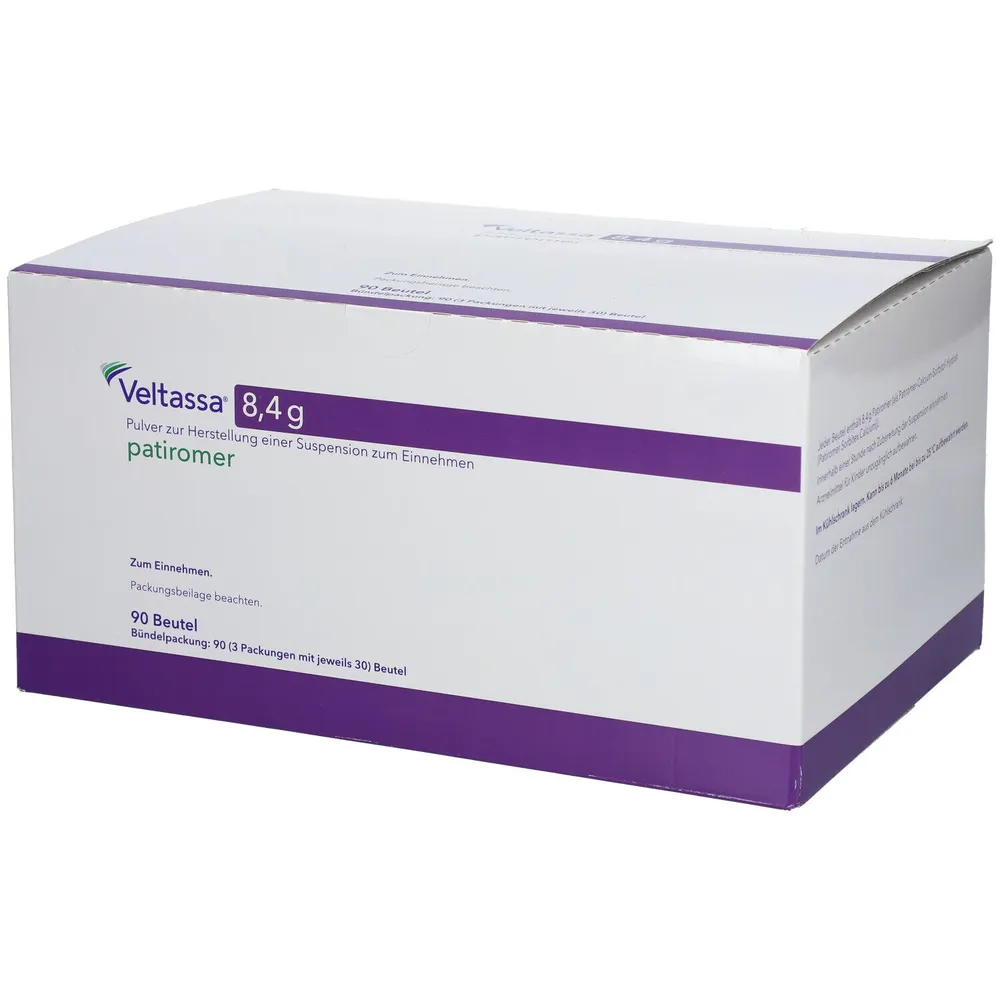
Veltassa 8.4 g is available in packs containing 30, 60 or 90 sachets, and multipacks containing 3 boxes, each with 30 sachets.
Veltassa 16.8 g and 25.2 g are available in packs containing 30, 60 or 90 sachets.
Not all pack sizes may be marketed.
Marketing Authorisation Holder
Vifor Fresenius Medical Care Renal Pharma France
100–101 Terrasse Boieldieu
Tour Franklin La Défense 8
92042 Paris La Défense Cedex
France
Manufacturer
Vifor France
100–101 Terrasse Boieldieu
Tour Franklin La Défense 8
92042 Paris La Défense Cedex
France
More detailed information on this medicine is available on the European Medicines Agency website: http://www.ema.europa.eu
The original data is available in the language of the country of manufacture.
Data source: Italian Medicines Agency (AIFA)
Data last verified: September 21, 2026