TRAVOGEN
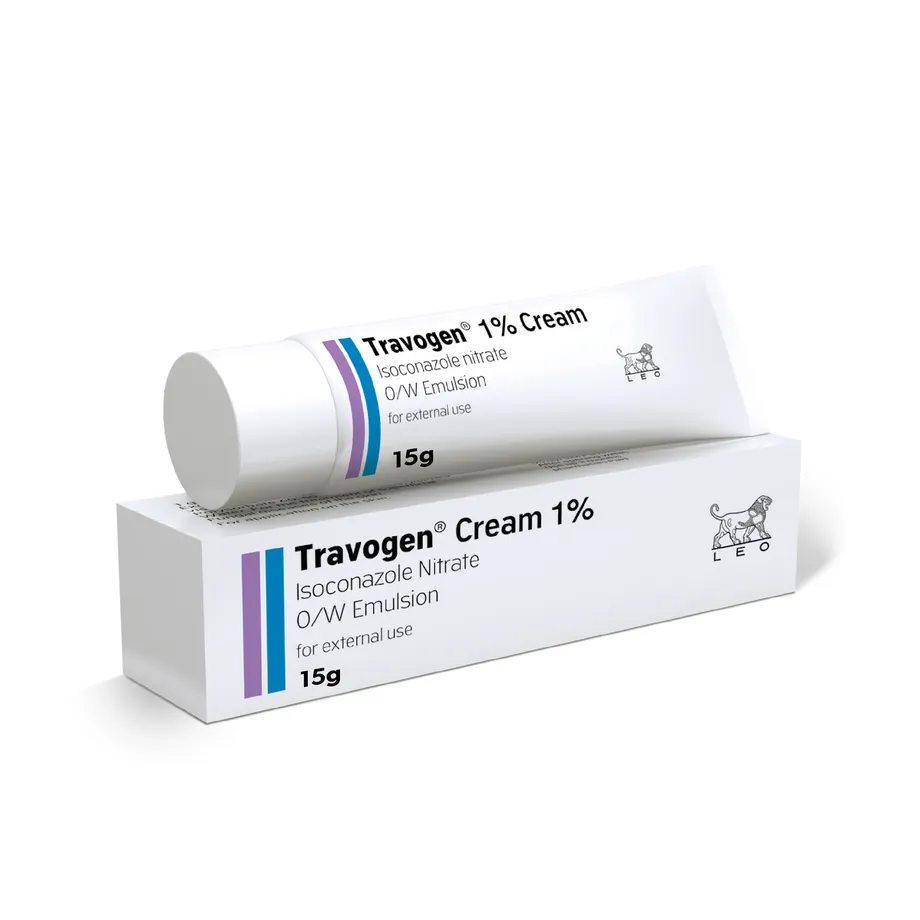
ItalyTravogen is an antifungal used to treat infections caused by fungi. The cream version is used for skin mycoses (such as ringworm, candidiasis, and pityriasis versicolor) and erythrasma. The vaginal version is used to treat vulvovaginal fungal infections and can also be used by the partner for prevention.
Frequently asked questions
How should Travogen be taken?
For the skin cream, the usual dose is one application per day to the affected areas for 2-3 weeks (sometimes 4 weeks in difficult areas such as between the fingers). For the vaginal cream, application should be done once a day for 7 consecutive days, preferably before going to bed. If the partner is using it for prevention, the dose is two applications per day for approximately one week.
When you must not use this medicine?
You must not use the product if you are allergic to isoconazole nitrate or any of the other ingredients. For the vaginal version, it is important to inform the doctor if you are taking anticoagulant drugs (such as warfarin). In case of pregnancy or breastfeeding, it is necessary to consult a doctor first.
What are the possible side effects of Travogen?
Common effects include burning, itching, or irritation at the site of application. Other effects may include dryness, skin rashes, nausea, headache, or dizziness. Rare cases of swelling, blisters, or redness in the treated area have also been reported.
Are there any special precautions during use?
It is important to wash your hands thoroughly after use and avoid contact with the eyes. If using the vaginal cream, the ingredients may damage latex condoms or diaphragms, making them less effective. During vaginal treatment, water douching should be avoided, and underwear and towels should be changed/sterilized regularly.
What to do if you forget a dose?
Do not apply a double dose to make up for the forgotten one; simply apply the next dose following the instructions of the doctor or pharmacist.
Instructions for use
Table of contents
- Travogen 1% cream
- 1. What Travogen is and what it is used for
- 2. What you should know before using Travogen
- 3. How to use Travogen
- 4. Possible side effects
- 5. How to store Travogen
- 6. Package contents and other information
- Package leaflet: information for the user
- Travogen 1% vaginal cream
- 1. What Travogen is and what it is used for
- 2. What you need to know before using Travogen
- 3. How to use Travogen
- 4. Possible side effects
- 6. Package contents and other information
Package leaflet: Information for the user
Travogen 1% cream
isoconazole nitrate
Please read all of this leaflet carefully before you use this medicine because it contains
important information for you.
Use this medicine exactly as described in this leaflet or as your doctor or
pharmacist has told you to.
- Keep this leaflet. You may need to read it again.
- If you need more information or advice, consult your pharmacist.
- If you experience any side effects, including those not listed in this leaflet, consult your doctor or pharmacist. See section 4.
- Consult your doctor if you do not notice any improvement or if you experience worsening of symptoms.
Contents of this leaflet:
- What Travogen is and what it is used for
- What you need to know before using Travogen
- How to use Travogen
- Possible side effects
- How to store Travogen
- Contents of the pack and other information
1. What Travogen is and what it is used for
Travogen is a topical antifungal, i.e. a medicine that acts locally against fungi causing skin infections (fungal infections).
Travogen is used to treat superficial fungal infections (dermatophytoses, ringworm, candidiasis, pityriasis versicolor) and erythrasma (which manifests as brownish skin patches).
Consult your doctor if you do not notice any improvement or if you observe a worsening of symptoms.
2. What you should know before using Travogen
Do not use Travogen
- if you are allergic to isoconazole nitrate or to any of the other ingredients of this medicine (listed in section 6).
Warnings and precautions
Talk to your doctor or pharmacist before using Travogen.
Avoid contact with the eyes.
Wash your hands thoroughly after using the medicine.
In case of lesions between the fingers, insert a piece of gauze soaked with Travogen cream.
To ensure successful treatment, carefully follow these hygiene measures:
- dry thoroughly the spaces between the fingers, in case of fungal infection affecting the feet;
- keep towels and underwear separate and for personal use only, in order to avoid infecting other people;
- change regularly clothing that comes into contact with the infected area to avoid re-infection.
If Travogen is applied to the genital area, some of its components may damage latex products such as condoms or diaphragms, thus making them potentially ineffective.
The use, especially if prolonged, of topical products may lead to sensitization reactions (allergy). In such case, discontinue treatment and consult your doctor to establish an appropriate therapy.
Paediatric population
Use of this medicine is not recommended in infants (0–2 years) unless strictly necessary and under strict medical supervision, as data in this age group are very limited.
The effect of isoconazole if ingested, for example following sucking of the treated area, is unknown.
Other medicines and Travogen
Inform your doctor or pharmacist if you are taking, have recently taken, or might take any other medicines.
Cross-sensitivity reactions between isoconazole, miconazole, econazole, and tioconazole are possible.
Pregnancy, breastfeeding, and fertility
If you are pregnant, think you may be pregnant, are planning to become pregnant, or are breastfeeding, consult your doctor or pharmacist before using this medicine.
If you are breastfeeding and using Travogen on medical advice, do not apply Travogen to the nipples to avoid ingestion by the infant.
Driving and using machines
Travogen does not affect the ability to drive or use machinery.
Travogen contains cetyl stearyl alcohol
This medicine contains cetyl stearyl alcohol which may cause local skin reactions (e.g. contact dermatitis).
3. How to use Travogen
Use this medicine exactly as described in this leaflet or as directed by your doctor or pharmacist. If you have any doubts, consult your doctor or pharmacist.
Unless otherwise prescribed by a doctor, the recommended dose is 1 application per day to the affected areas of the skin.
Topical treatment of fungal infections usually lasts 2–3 weeks and sometimes up to 4 weeks in difficult cases, particularly in the interdigital spaces. Longer treatment durations may be possible on specific medical prescription.
To prevent recurrence, it is advisable to continue treatment for at least 2 weeks after clinical healing has occurred.
Regular hygiene is essential for the success of treatment with Travogen (see section “Warnings and precautions”).
Paediatric population
Dosage adjustment is not required when Travogen is administered to infants, children, and adolescents.
Although clinical experience in the paediatric population is considerably more limited, the medicine may be used in individuals of this age group as directed by a physician.
If you use more Travogen than you should
There are no known risks of acute intoxication following a single excessive application of the medicine (e.g. application over a large surface area under conditions favouring absorption).
In case of accidental ingestion of an excessive dose of Travogen, contact your doctor immediately or go to the nearest hospital.
If you forget to use Travogen
Do not apply a double dose to make up for a missed dose. Simply apply the next dose as scheduled and continue treatment according to your doctor’s instructions.
If you have any doubts about how to use this medicine, consult your doctor or pharmacist.
4. Possible side effects
Like all medicines, this medicine can cause side effects, although not everybody gets them.
The following side effects are listed according to their frequency:
Common: may affect up to 1 in 10 people
- Skin irritation, burning sensation at the application site.
Uncommon: may affect up to 1 in 100 people
- Itching, dryness at the application site; skin rash (eczema) with oozing, fluid-filled blisters (dyshidrosis), skin inflammation (contact dermatitis).
Rare: may affect up to 1 in 1,000 people
- Swelling at the application site, skin cracking.
Frequency not known
- Redness (erythema), blisters at the application site, allergic skin reaction.
Reporting of side effects
If you experience any side effects, including those not listed in this leaflet, talk to your doctor or pharmacist.
You can also report side effects directly via the national reporting system at the following address:
http://www.agenziafarmaco.gov.it/content/come-segnalare-una-sospetta-reazione-avversa.
By reporting side effects, you can help provide more information on the safety of this medicine.
5. How to store Travogen
Keep this medicine out of the sight and reach of children.
Do not use this medicine after the expiry date stated on the packaging. The expiry date refers to the last day of that month. The indicated expiry date applies to the product in its original, unopened packaging, stored correctly.
Do not store above 25°C.
Do not dispose of any medicine via wastewater or household waste. Ask your pharmacist how to dispose of medicines you no longer use. This will help protect the environment.
6. Package contents and other information
What Travogen contains
- The active substance is isoconazole nitrate. 1 g of Travogen contains 10 mg (1%) of isoconazole nitrate.
- The other components are: polysorbate 60, sorbitan stearate, cetostearyl alcohol, white vaseline, liquid paraffin, purified water.
Description of Travogen's appearance and package contents
Cream, tube of 20 g.
Marketing Authorization Holder
LEO Pharma A/S, Industriparken 55, DK-2750 Ballerup, Denmark.
Manufacturer
LEO Pharma Manufacturing Italy S.r.l. - Via E. Schering, 21 - 20090 Segrate (MI), Italy.
Local distributor in Italy:
LEO Pharma S.p.A., Via Elio Vittorini 129 - 00144 Roma.
Package leaflet: information for the user
Travogen 1% vaginal cream
isoconazole nitrate
Please read this leaflet carefully before using this medicine because it contains
important information for you.
Always use this medicine exactly as described in this leaflet or as your doctor or
pharmacist has instructed you.
- Keep this leaflet. You may need to read it again.
- If you need more information or advice, consult your pharmacist, doctor, or nurse.
- This medicine has been prescribed for you only. Do not give it to other people, even if their symptoms are the same as yours, as it may be harmful.
- If any side effects occur, including those not listed in this leaflet, consult your doctor, pharmacist, or nurse. See section 4.
- Consult your doctor if you do not notice any improvement or if your symptoms worsen.
Contents of this leaflet:
- What Travogen is and what it is used for
- What you need to know before using Travogen
- How to use Travogen
- Possible side effects
- How to store Travogen
- Contents of the pack and other information
1. What Travogen is and what it is used for
Travogen is an antifungal (antimycotic) medicine.
Travogen is used to treat vulvovaginal fungal (mycotic) infections.
This medicine may also be used in the partner for prophylactic purposes.
Consult your doctor if you do not notice improvement or if you experience worsening of symptoms.
2. What you need to know before using Travogen
Do not use Travogen
- if you are allergic to nitrate isoconazole, to other antifungal imidazole derivatives, or to any of the other ingredients of this medicine (listed in section 6).
Warnings and precautions
Talk to your doctor, pharmacist, or nurse before using Travogen. When using Travogen, it is important to know:
Avoid contact with the eyes.
Wash your hands thoroughly after using the medicine.
- If the skin around the vagina needs to be treated, or if preventive treatment of your partner is required, use of Travogen cream is recommended.
- During treatment and for several weeks afterwards, avoid vaginal washing with water (irrigations).
- During treatment of vaginal mycosis and in the days immediately following, to prevent reinfection, change and sterilize daily by boiling towels and underwear (preferably cotton).
- For the same reason, consult your doctor about the need for simultaneous local treatment of your partner.
- Use, especially if prolonged, of topical products may lead to sensitization (allergy). In such a case, discontinue treatment and consult your doctor to establish appropriate therapy.
- Some components of Travogen may damage latex products such as condoms or diaphragms. As a result, these may no longer be effective as contraceptives or in preventing sexually transmitted diseases such as HIV infection. Consult your doctor or pharmacist if you need further information.
Other medicines and Travogen
Inform your doctor or pharmacist if you are taking, have recently taken, or might take any other medicines.
No interactions between Travogen and other medicines are currently known. However, it is advisable to inform your doctor if you are taking:
- Medicines to thin the blood (anticoagulants) such as warfarin.
Cross-sensitivity reactions between isoconazole, miconazole, econazole, and tioconazole are possible.
Pregnancy, breastfeeding, and fertility
If you are pregnant, suspect you may be pregnant, planning a pregnancy, or are breastfeeding, consult your doctor or pharmacist before using this medicine.
Pregnancy
Experience with the use of preparations containing isoconazole during pregnancy does not indicate risks of birth defects (teratogenic effects) in humans. If you are pregnant, use the single-use applicator with caution and only as directed by your doctor.
Breastfeeding
It is not known whether the active ingredient of Travogen vaginal cream passes into breast milk. Risk to the infant cannot be excluded.
Fertility
There are no data showing that fertility is impaired by the use of Travogen.
Driving and using machines
Nitrate isoconazole does not affect the ability to drive or use machinery.
Travogen contains cetostearyl alcohol
This medicine contains cetostearyl alcohol which may cause local skin reactions (e.g. contact dermatitis).
3. How to use Travogen
Use this medicine exactly as stated in this leaflet or as directed by your doctor or pharmacist. If you have any doubts, consult your doctor or pharmacist.
The single-use applicator is used to insert the cream deeply into the vagina. It is preferable to do this before going to bed, while lying on your back with your knees slightly bent.
Treatment should not be carried out during menstruation.
If you are pregnant, use the applicator device with caution and only as directed by your doctor.
If your doctor prescribes treatment for your partner as a preventive measure, the cream should be applied to the genital area, especially on the glans and foreskin, twice daily for about one week.
For correct application of Travogen, follow the steps listed below:
- first, remove the cap from the tube and screw the applicator onto the open tube;
- push the plunger gradually until it stops;
- fill the applicator by gently squeezing the tube;
- unscrew the applicator from the tube and close the tube with its cap;
- insert the applicator deeply into the vagina and empty it into the cavity by gently pushing the plunger.
7-day treatment: apply the cream once daily for 7 consecutive days.
If you think that the effect of Travogen is too strong or too weak, contact your doctor or pharmacist.
Use in children or adolescents
Dose adjustment is not necessary when Travogen is used in adolescents (over 15 years of age).
If you use more Travogen than you should
Over-application or accidental ingestion of Travogen is unlikely to be harmful. Contact your doctor or pharmacist immediately if you are concerned.
If you forget to use Travogen:
Do not use a double dose to make up for the missed dose. As soon as you remember, simply use the next dose and continue treatment as prescribed.
If you have any questions about the use of this medicine, consult your doctor or pharmacist.
4. Possible side effects
Like all medicines, this medicine can cause side effects, although not everybody gets them.
The following side effects are listed by their frequency:
Common: may affect up to 1 in 10 people
- Burning, itching or irritation at the application site
Uncommon: may affect up to 1 in 100 people
- Feeling unwell (nausea), dizziness, headache or vaginal discharge
Rare: may affect up to 1 in 1,000 people
- Skin rash at the application site
Not known: frequency cannot be estimated based on available data
- Blisters, pain, swelling (edema), or redness (erythema) in the vagina and external female genital organs; hypersensitivity (allergy) at the application site.
- Pelvic cramps, headache.
Reporting of side effects
If you experience any side effect, including those not listed in this leaflet, please inform your doctor or pharmacist.
You can also report side effects directly via the national reporting system at www.agenziafarmaco.gov.it/it/responsabili. By reporting side effects, you can help provide more information on the safety of this medicine.
Do not store above 25°C.
Keep this medicine out of the sight and reach of children.
Do not dispose of medicines via wastewater or household waste. Ask your pharmacist how to dispose of medicines no longer required. This will help protect the environment.
6. Package contents and other information
What Travogen contains
- The other components are: polysorbate 60, sorbitan stearate, cetyl stearyl alcohol, white vaseline, liquid paraffin, purified water.
Description of the appearance of Travogen and contents of the pack
Vaginal cream, opaque, white to pale yellowish colour, in a 30 g tube with 6 single-use applicators.
Marketing Authorization Holder
LEO Pharma A/S, Industriparken 55, DK-2750 Ballerup, Denmark.
Manufacturer
LEO Pharma Manufacturing Italy S.r.l.
Via E. Schering, 21 - 20090 Segrate (MI), Italy.
Local representative in Italy:
LEO Pharma S.p.A., Via Elio Vittorini 129 - 00144 Rome.
The original data is available in the language of the country of manufacture.
Data source: Italian Medicines Agency (AIFA)
Data last verified: September 21, 2026