TICLOPIDINE DOC GENERICI
ItalyThis medicine is an antiplatelet agent that improves blood circulation by preventing the formation of clots. It is used to prevent blockages of blood flow to the brain and heart (ischemia), to prevent the closure of heart bypasses, during procedures involving artificial circulation, during hemodialysis, in cases of central retinal vein thrombosis, or for those who have had a heart attack and cannot take acetylsalicylic acid.
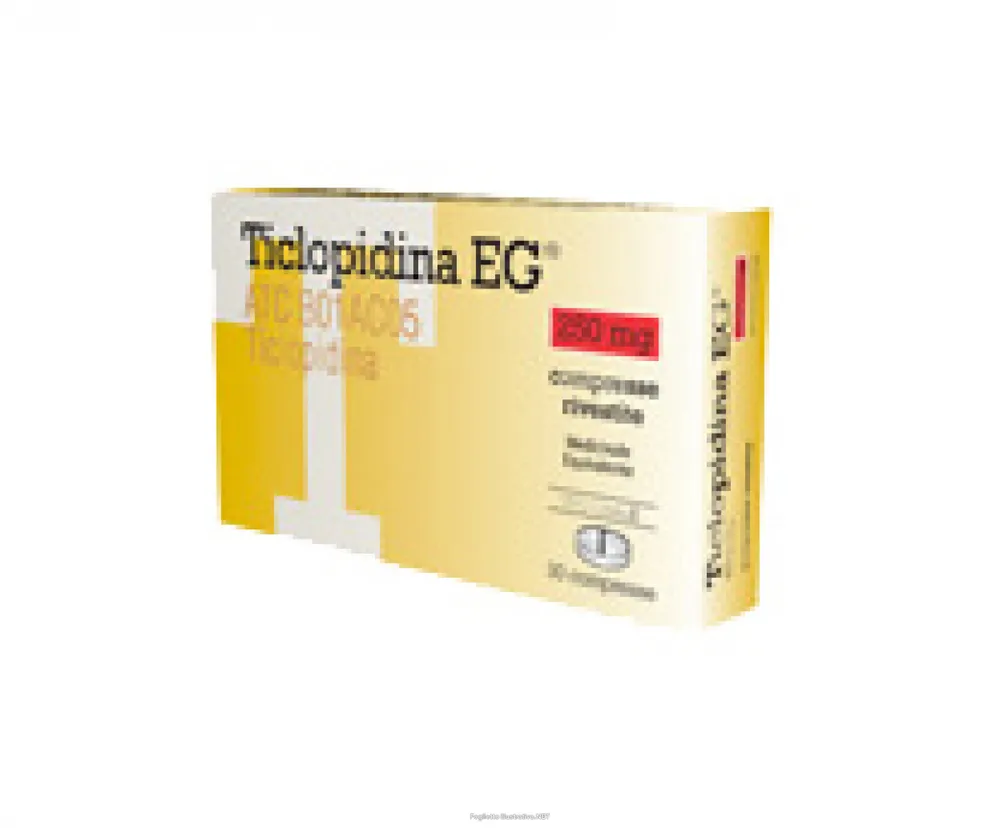
Frequently asked questions
How should TICLOPIDINA DOC Generici be taken?
The medicine must be taken exactly according to the instructions of the doctor or pharmacist. For long-term treatments, the recommended dose is 1 or 2 tablets per day, to be taken during meals.
When should you not take this medicine?
You must not take the medicine if you are allergic to the active substance or any of its components, if you have had blood cell abnormalities (such as leukopenia or thrombocytopenia), if you suffer from coagulation disorders or bleeding, if you have stomach or esophageal lesions with a tendency to bleed, if you have severe liver problems or acute cerebral circulatory disorders, if you are pregnant or breastfeeding, or if you are taking other medications that interfere with bone marrow or other antiplatelets/anticoagulants.
What are the common side effects of TICLOPIDINA DOC Generici?
Common side effects may include a decrease in white blood cells, headache, dizziness, changes in liver function, diarrhea, nausea, skin irritation with itching, and increased cholesterol and triglycerides.
Which symptoms require immediate discontinuation of treatment?
It is necessary to stop the medication immediately and inform your doctor if you experience: sore throat, fever, or mouth sores; bleeding, bruising, dark stools, or skin irritation with bleeding; chest pain; yellowing of the skin, dark urine, or pale stools.
Are there interactions with other medicines?
Yes, it is important to inform your doctor if you are taking medications for depression (serotonin reuptake inhibitors), anti-inflammatories (NSAIDs), anticoagulants, aspirin, pentoxifylline, theophylline, digoxin, epilepsy medications, cimetidine, or cyclosporine. Myelotoxic drugs that alter blood cells should also be avoided.
What should I do in case of a missed dose or overdose?
In case of a missed dose, do not take a double dose to compensate. In case of accidental ingestion of an excessive dose, contact a doctor immediately or go to the emergency room, as the risk of hemorrhage may increase.
Instructions for use
Table of contents
- TICLOPIDINA DOC Generici 250 mg tablets
- 1. What TICLOPIDINA DOC Generici is and what it is used for
- 2. What you need to know before taking TICLOPIDINA DOC Generici
- 3. How to take TICLOPIDINE DOC Generici
- 4. Possible adverse reactions
- 5. How to store TICLOPIDINE DOC Generici
- 6. Package contents and other information
Package leaflet: Information for the patient
TICLOPIDINA DOC Generici 250 mg tablets
Generic Medicine
Please read this leaflet carefully before taking this medicine because it contains important information for you.
- Keep this leaflet. You may need to read it again.
- If you have any questions, ask your doctor or pharmacist.
- This medicine has been prescribed for you only. Do not give it to others, even if their symptoms are the same as yours, because it could be harmful.
- If you experience any side effects, including those not listed in this leaflet, consult your doctor or pharmacist. See section 4.
Contents of this leaflet:
- What TICLOPIDINA DOC Generici is and what it is used for
- What you need to know before taking TICLOPIDINA DOC Generici
- How to take TICLOPIDINA DOC Generici
- Possible side effects
- How to store TICLOPIDINA DOC Generici
- Contents of the pack and other information
1. What TICLOPIDINA DOC Generici is and what it is used for
TICLOPIDINA DOC Generici contains the active substance ticlopidine, which belongs to the class of
antiplatelet agents—medicines that improve blood circulation by preventing the formation of
blood clots (thrombi).
TICLOPIDINA DOC Generici is used
- to prevent blockage of blood flow to the brain and heart (ischaemia) in people who are at high risk of blood clot formation (peripheral arterial occlusive disease, previous myocardial infarction, recurrent or non-recurrent ischaemia, ischaemic stroke, unstable angina);
- to prevent closure of heart bypass grafts (aortocoronary bypasses);
- during surgical procedures requiring artificial circulation (extracorporeal circulation);
- during haemodialysis sessions;
- if you suffer from central retinal vein thrombosis;
- in people who have had a heart attack or ischaemic attacks, but only if they are intolerant to acetylsalicylic acid (ASA), or if treatment with acetylsalicylic acid has proven ineffective.
Due to its side effects, this medicine should only be used in the cases listed above, with the monitoring
specified in the section "Warnings and precautions", and strictly following the instructions reported in the section
"Do not take TICLOPIDINA DOC Generici".
2. What you need to know before taking TICLOPIDINA DOC Generici
Do not take TICLOPIDINA DOC Generici
- if you are allergic to the active substance or to any of the other ingredients of this medicine (listed in section 6);
- if you have or have had abnormalities in blood cell levels (leucopenia, thrombocytopenia, and agranulocytosis);
- if you suffer from coagulation disorders, such as bleeding (hemorrhagic diathesis), even prolonged;
- if you have esophageal or gastric lesions with a tendency to bleed (gastrointestinal ulcers, esophageal varices, etc.);
- if you suffer from cerebrovascular disorders (acute hemorrhagic stroke);
- if you have severe liver problems (severe hepatopathy);
- if you are taking other medicines that may interfere with bone marrow function (myelotoxic drugs);
- if you are pregnant or breastfeeding;
- if you are being treated with antiplatelet and/or anticoagulant medicines used to improve blood flow.
Do not use this medicine for primary prevention if you do not have any of the conditions listed
in section 1.
Warnings and precautions
Talk to your doctor or pharmacist before taking TICLOPIDINA DOC Generici.
Adverse events, sometimes serious, of hematological and hemorrhagic nature may occur. Alterations
in blood components such as agranulocytosis, pancytopenia, and rare cases of leukemia have been
reported after marketing authorization, sometimes with fatal outcome (see section 4).
Such serious events may be associated with:
- inadequate monitoring, delayed diagnosis, and inadequate treatment of side effects;
- concomitant administration of anticoagulants or platelet antiaggregant drugs such as aspirin and non-steroidal anti-inflammatory drugs (NSAIDs). However, in the case of stent implantation, ticlopidine must be associated with aspirin (100–325 mg daily) for about one month after implantation.
It is essential to strictly follow the indications, precautions, and contraindications of ticlopidine.
Treatment must be carried out under close medical supervision, especially during the first three months, to monitor for possible adverse effects.
If you notice any of the following conditions, stop treatment immediately and inform your doctor:
- sore throat, fever, mouth sores (symptoms of neutropenia);
- bleeding, even prolonged, or bruising (hematomas), skin rash associated with bleeding (purpura), dark stools (symptoms of thrombocytopenia and/or coagulation disorders);
- skin rash associated with bleeding and decreased platelets (symptoms of thrombotic thrombocytopenic purpura);
- chest pain due to heart circulation problems (angina);
- yellowing of the skin (jaundice), dark urine, pale stools (symptoms of hepatitis).
If thrombotic thrombocytopenic purpura is suspected, consult a specialist immediately, as there is a
high risk of death. Onset may be sudden, and in most cases has been reported within the first 8 weeks of starting therapy. Symptoms include decreased platelets (thrombocytopenia) and red blood cells (hemolytic anemia), neurological symptoms similar to transient ischemic attack (TIA) or stroke, kidney problems, and fever.
Resumption of treatment with this medicine depends on your clinical condition and blood test results (hematological monitoring), which must be urgently performed.
Perform blood tests at the beginning of treatment and then every 2 weeks during the first 3 months of therapy, and within 15 days of any interruption of TICLOPIDINA DOC Generici, if such interruption occurs within the first 3 months of treatment.
Stop treatment with this medicine if you experience a decrease in white blood cells (neutropenia) or a decrease in platelets (thrombocytopenia).
If you are scheduled for minor surgical procedures, such as tooth extraction, inform your doctor that you are taking this medicine.
Stop treatment at least 10 days before any surgical intervention to avoid the risk of bleeding.
In case of emergency surgery, inform the doctor about ongoing treatment so appropriate precautions can be taken to avoid the risk of bleeding.
Use this medicine with caution if you are at risk of bleeding and if you have liver problems (hepatic dysfunction). Periodically perform liver function tests, especially during the first three months of treatment.
If you suffer from kidney problems (renal insufficiency), consult your doctor, who may reduce the dose or discontinue treatment if bleeding or blood disorders (hematopoietic disorders) occur.
Be cautious when using TICLOPIDINA DOC Generici if you are allergic to other medicines similar to
ticlopidine (thienopyridines), such as clopidogrel and prasugrel, because cross-reactions may occur (see section 4). Taking these medicines may cause allergic reactions ranging from moderate to severe, such as skin rash, facial swelling, especially around eyes and mouth (angioedema or Quincke's edema), changes in platelet and white blood cell levels in the blood (thrombocytopenia and neutropenia).
Patients who have shown allergy to a thienopyridine may have an increased risk of developing the same or another reaction to another thienopyridine. It is recommended to monitor for cross-reactivity and signs of hypersensitivity in patients with known allergy to thienopyridines.
Children and adolescents
The use of this medicine in children and adolescents is not recommended.
Other medicines and TICLOPIDINA DOC Generici
Inform your doctor or pharmacist if you are taking, have recently taken, or might take any other medicine.
Avoid using this medicine together with other medicines that may cause changes in blood cells (myelotoxic drugs).
Specifically inform your doctor if you are taking the following medicines, as they may increase the risk of bleeding:
- a selective serotonin reuptake inhibitor (including, but not limited to, fluoxetine or fluvoxamine), medicines usually used to treat depression;
- non-steroidal anti-inflammatory drugs (NSAIDs);
- platelet antiaggregants, medicines used to increase blood fluidity;
- acetylsalicylic acid (except in cases of stent implantation, where combination is allowed) and its derivatives;
- oral and parenteral anticoagulants (heparin), medicines that improve circulation;
- pentoxifylline, a medicine used for poor blood circulation in arms and legs.
Inform your doctor and be particularly cautious if you are taking any of the following medicines, as specific precautions may be necessary:
- theophylline, a medicine used to treat asthma, because dosage adjustment may be needed;
- digoxin, a medicine used in the treatment of heart rhythm disorders;
- phenobarbital and phenytoin, medicines used to treat epilepsy;
- cimetidine and other medicines used to treat stomach disorders (antacids);
- cyclosporine, an immunosuppressant medicine used in transplant cases.
Pregnancy and breastfeeding
If you are pregnant, suspect you may be pregnant, planning a pregnancy, or breastfeeding, consult your doctor or pharmacist before taking this medicine.
Do not use this medicine if you are pregnant or breastfeeding, except in cases of absolute necessity.
Driving and using machines
This medicine may cause dizziness and other adverse effects that may impair your ability to drive vehicles or operate machinery.
3. How to take TICLOPIDINE DOC Generici
Take this medicine exactly as directed by your doctor or pharmacist.
If you have any doubts, consult your doctor or pharmacist.
For long-term treatment, the recommended dose is 1 or 2 tablets daily, taken during meals.
If you take more TICLOPIDINE DOC Generici than you should
In case of accidental overdose, contact your doctor immediately or go to the nearest hospital.
Overdose with this medicine may increase the risk of bleeding; if severe, platelet transfusion may be required.
In case of serious stomach or intestinal problems, treatment includes inducing vomiting, gastric lavage, and other supportive measures.
If you forget to take TICLOPIDINE DOC Generici
Do not take a double dose to make up for the forgotten tablet.
If you stop taking TICLOPIDINE DOC Generici
If you discontinue treatment with this medicine within the first three months, a complete blood test should be performed two weeks after stopping therapy. Blood parameters must be monitored until they return to normal.
If you have any doubts about using this medicine, consult your doctor or pharmacist.
4. Possible adverse reactions
Like all medicines, this medicine can cause adverse reactions, although not everybody will experience them.
The use of this medicine may cause the following adverse reactions:
Common (may affect up to 1 in 10 people)
- decrease in white blood cells, even severe (neutropenia, agranulocytosis);
- headache, dizziness;
- alteration of liver function (increase in liver enzymes, increase in alkaline phosphatase and transaminases);
- diarrhoea and nausea;
- skin irritations (rash, maculopapular or urticarial eruptions), often accompanied by itching;
- increased cholesterol and triglycerides.
Uncommon (may affect up to 1 in 100 people)
-
decrease in platelets (thrombocytopenia), associated with a decrease in red blood cells (haemolytic anaemia);
-
severe systemic infection (sepsis) and septic shock, which may occur as fatal complications of decreased white blood cells (agranulocytosis);
-
sensory disturbances (peripheral neuropathy);
-
haemorrhagic complications, especially bruising, presence of blood in urine (haematuria), or bleeding in the lower part of the eye (conjunctival haemorrhage), nosebleeds (epistaxis), bleeding during surgery (perioperative haemorrhage) and postoperative haemorrhage, which may be severe and sometimes fatal;
-
formation of lesions in the stomach and intestine (gastroduodenal ulcer);
-
disturbances in liver function (increase in bilirubin);
-
skin irritation associated with peeling (exfoliative dermatitis).
Rare (may affect up to 1 in 1,000 people)
- decrease in all blood cells (pancytopenia), severe reduction in bone marrow activity (bone marrow aplasia), blood disorders (thrombotic thrombocytopenic purpura, leukaemia, and thrombocytosis);
- perception of ringing in the ear (tinnitus);
- bleeding in the brain (intracerebral haemorrhage);
- liver disorders, such as hepatitis (cytolytic and/or cholestatic hepatitis);
- yellowish discoloration of the skin due to liver dysfunction (cholestatic jaundice).
Very rare (may affect up to 1 in 10,000 people)
- immune system disorders, such as allergic manifestations, anaphylaxis (severe allergic reaction), facial swelling, especially around eyes and mouth (Quincke's oedema), increase in white blood cells (eosinophilia), joint pain (arthralgia), inflammation of blood vessels (vasculitis), irritative skin disorders, joint pain and fever (lupus-like syndrome), lung disorders (allergic pneumonitis), kidney disorders (hypersensitivity nephropathy which may be associated with renal failure);
- severe diarrhoea associated with inflammation of the intestine (colitis and lymphocytic colitis). If this effect is severe, stop taking this medicine;
- fatal hepatitis and fulminant hepatitis;
- skin allergic reactions (erythema multiforme, Stevens-Johnson syndrome, Lyell's syndrome);
- fever.
Not known (frequency cannot be estimated from available data)
- cross-reactivity of hypersensitivity reactions between thienopyridines, such as clopidogrel and prasugrel (see section "Warnings and precautions").
Reporting of adverse reactions
If you experience any adverse reaction, including those not listed in this leaflet, talk to your doctor or pharmacist. You can also report adverse reactions directly via the Italian Medicines Agency - Website: http://www.agenziafarmaco.gov.it/it/responsabili. By reporting adverse reactions, you can help provide more information on the safety of this medicine.
5. How to store TICLOPIDINE DOC Generici
Keep this medicine out of the sight and reach of children.
Do not use this medicine after the expiry date which is stated on the packaging after “Exp.”.
The expiry date refers to the last day of that month.
Do not dispose of any medicine via wastewater or household waste. Ask your pharmacist how to dispose of
medicines you no longer use. This will help protect the environment.
6. Package contents and other information
What TICLOPIDINA DOC Generici contains
- The active substance is ticlopidine hydrochloride. Each tablet contains 250 mg of active substance.
- The other components are microcrystalline cellulose, starch, methylcellulose, precipitated silica, magnesium stearate, titanium dioxide, gum arabic.
Description of the appearance of TICLOPIDINA DOC Generici and package contents
Pack containing 30 tablets of 250 mg.
Marketing Authorization Holder
DOC Generici S.r.l. - Via Turati 40 - 20121 Milan, Italy
Manufacturer
Mipharm S.p.A. - Via Bernardo Quaranta, 12 - 20141 Milan (MI)
SPECIAL PRODUCT’S LINE S.p.A. - Strada Paduni, 240 - 03012 Anagni (FR)
Similar drugs
| Brand name | Dosage form | Active substance / Dosage | Manufacturer |
|---|---|---|---|
| CLOX | tablets | I.B.N. SAVIO S.R.L | |
| KLODIN | tablets | I.B.N. SAVIO S.R.L |
The original data is available in the language of the country of manufacture.
Data source: Italian Medicines Agency (AIFA)
Data last verified: September 21, 2026