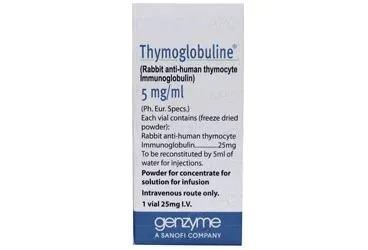
THYMOGLOBULINE
ItalyThis drug is an immunosuppressant used to prevent or treat the rejection of transplanted organs (such as kidney, liver, pancreas, or heart). It is also used to prevent graft-versus-host disease (GvHD) in patients who have received a bone marrow or stem cell transplant, and it can be used to treat aplastic anemia if other treatments have not been effective.
Frequently asked questions
How is the drug administered?
Thymoglobuline is administered by a doctor or nurse in a hospital setting via intravenous infusion (directly into the bloodstream) through a plastic tube. Administration usually takes place over a period of at least 4 hours, but the first dose may last longer. The exact dosage is determined by the doctor based on the patient's weight, the disease being treated, and other medications being taken.
When should Thymoglobuline not be used?
It must not be used if you are allergic to rabbit proteins or to any of the other components of the medicine. It is also contraindicated in cases of active infections, as the drug reduces the body's ability to fight infections.
What are the side effects of Thymoglobuline?
Common side effects include fever, chills, diarrhea, nausea, vomiting, headache, itching, skin rashes, and muscle pain. A reduction in white blood cells and platelets, or anemia, may also occur. In some cases, 'serum sickness' may manifest (skin rashes, joint pain, kidney problems). More serious effects, although less common, may include severe allergic reactions, respiratory, or cardiac problems.
Are there any special warnings regarding vaccines or other drugs?
It is important to inform the doctor if you are taking other immunosuppressant drugs (such as cyclosporine, tacrolimus, or mycophenolate mofetil). Live attenuated vaccines should not be administered during or immediately after treatment without consulting a doctor. Additionally, you should not drive or operate machinery if the drug causes malaise, fatigue, or dizziness.
Can the drug be used during pregnancy or breastfeeding?
Thymoglobuline must not be used during pregnancy, except in cases of absolute necessity, as its effects on the fetus are unknown. Breastfeeding is also not recommended during treatment, as the drug could pass into breast milk and have effects on the child.
Instructions for use
PACKAGE LEAFLET
THYMOGLOBULINE 5 mg/ml, powder for solution for infusion
Rabbit anti-human thymocyte immunoglobulin
Please read this leaflet carefully before you start receiving this medicine.
- Keep this leaflet. You may need to read it again.
- This medicine will be administered to you by a doctor or nurse in a hospital.
- If you have any further questions, ask your doctor or nurse.
- If any of the side effects worsens or becomes troublesome, or if you notice any side effect not listed in this leaflet, inform your doctor.
Contents of this leaflet:
- What Thymoglobuline is and what it is used for
- Before you are given Thymoglobuline
- How Thymoglobuline is given
- Possible side effects
- How to store Thymoglobuline
- Further information
1. WHAT THYMOGLOBULINE IS AND WHAT IT IS USED FOR
Thymoglobuline is supplied as a lyophilized powder for solution for infusion (25 mg – single-dose vial).
Thymoglobuline belongs to a group of medicines called immunosuppressants (anti-rejection drugs). These medicines can help prevent rejection of transplanted organs. They may also be used to treat other unwanted immune reactions.
Thymoglobuline is an anti-human thymocyte immunoglobulin obtained from the blood of rabbits injected with cells derived from the human thymus gland. The immunoglobulins contained in the medicine target and destroy certain cells of your immune system that play a role in organ transplant rejection or in causing unwanted immune reactions.
Kidney, liver, pancreas or heart transplantation:
- Thymoglobuline is used in patients who have received an organ transplant, for the prevention and treatment of rejection of the transplanted organ. It is a type of medicine known as an immunosuppressant (anti-rejection drug). When a patient receives an organ, the body's natural defence system attempts to eliminate it (rejection). Thymoglobuline modifies the body's defence mechanism and helps the body accept the transplanted organ.
Prophylaxis in adults of acute and chronic graft-versus-host disease (GvHD):
Thymoglobuline is used in patients who have undergone bone marrow transplantation or peripheral blood stem cell transplantation (transplantation of cells capable of forming blood cells), in order to prevent graft-versus-host disease (a condition in which the transplanted immune cells from the bone marrow or peripheral blood stem cells recognize the recipient as "foreign" and mount an immune attack).
Aplastic anaemia:
- Thymoglobuline may be used in the treatment of aplastic anaemia when other treatments have not been successful. Aplastic anaemia is a rare blood disorder in which the body does not produce enough blood cells. As a result, you may feel tired and look pale. You may also be prone to infections, bruise easily, or experience frequent nosebleeds.
2. BEFORE RECEIVING THYMOGLOBULINE
Do not use Thymoglobuline
- If you are allergic to rabbit proteins or to any of the excipients of Thymoglobuline (see section 6).
- If you have an active acute or chronic infection, as Thymoglobuline reduces the body's ability to fight infections.
Exercise particular caution with Thymoglobuline
Inform your doctor immediately:
- if you have ever had an allergic reaction to animals or other medicines. Your doctor will monitor you closely and will stop treatment if signs of an allergic reaction to Thymoglobuline occur.
- if you have blood disorders such as thrombocytopenia (platelet count lower than normal) or leukopenia (white blood cell count lower than normal). The dose will depend on your white blood cell or platelet count, which will be checked before, during, and after treatment. During treatment with Thymoglobuline, your doctor will regularly perform blood tests and other examinations to monitor your health status. Because of the way this medicine works, it may affect blood parameters and other organs.
After treatment with Thymoglobuline, immunization with live attenuated vaccines is not recommended
in patients who have recently received therapy (see also “Use of Thymoglobuline with other
medicines”).
Viral safety
When medicines are produced from human plasma or blood, precautionary measures are taken to
prevent infections that could be transmitted to patients. These measures include careful selection of plasma and blood donors to ensure that donors at risk of infection are excluded, and testing each donation and plasma pool for viruses or infections. Manufacturers of these types of medicines also include viral inactivation or removal procedures in the processing of human plasma or blood. Despite these measures, when medicines produced from human plasma or blood are administered, the possibility of transmitting an infection cannot be completely ruled out. This applies to all viruses of unknown origin, emerging viruses, or other types of infections.
The measures taken are considered effective against lipid-enveloped viruses (fatty coating),
such as human immunodeficiency virus (HIV), hepatitis B, and hepatitis C, as well as non-enveloped viruses such as hepatitis A.
The measures taken may have limited effectiveness against non-enveloped viruses such as
Parvovirus B19.
IT IS STRONGLY RECOMMENDED THAT, WHENEVER THYMOGLOBULINE IS ADMINISTERED TO A PATIENT, THE PATIENT’S NAME AND THE PRODUCT BATCH NUMBER BE RECORDED TO MAINTAIN A TRACEABLE LINK BETWEEN THE PATIENT AND THE PRODUCT BATCH.
Use of Thymoglobuline with other medicines
Inform your doctor if you are taking or have recently taken any other medicines, including those without a prescription. It is particularly important to inform your doctor if you have recently taken any of the following immunosuppressive medicines:
- cyclosporine
- tacrolimus
- mycophenolate mofetil
This is because if the body's immune system is overly suppressed, serious infections, reactivation of latent infections, sepsis (a severe infection present in the blood spreading throughout the body), and febrile neutropenia (fever associated with abnormally low levels of certain white blood cells) may occur. In aplastic anemia, immunosuppressive treatment contributes to the risk of infections associated with aplastic anemia itself. The use of immunosuppressive medicines, including Thymoglobuline, may increase the risk of developing tumors in the future, including lymphoma or post-transplant lymphoproliferative disorder.
Vaccinations
Do not receive any vaccination during or immediately after treatment with Thymoglobuline without first discussing it with your doctor. The vaccine may cause adverse effects or may not be effective because your immune system may not be able to respond adequately to the vaccination.
Use of Thymoglobuline with food and drink
It is unlikely that food or drink will affect this medicine.
Pregnancy and breastfeeding
Tell your doctor if you are pregnant or think you might be. Thymoglobuline should not be used during pregnancy unless absolutely necessary, as its effects on the fetus are unknown. Thymoglobuline has not been studied during labor and delivery.
Do not breastfeed while receiving Thymoglobuline, as it may pass into breast milk and could affect the infant.
Fertility
It is not known whether Thymoglobuline may affect reproductive capacity.
Driving and use of machines
Do not drive or operate tools or machinery, as Thymoglobuline may cause malaise, fatigue, or dizziness.
Thymoglobuline contains sodium
This medicine contains 4 mg of sodium (a main component of cooking salt) per vial. This corresponds to 0.2% of the maximum daily recommended dietary intake for an adult.
- HOW TO USE THYMOGLOBULINE
This medicine will be administered to you by a doctor or nurse in a hospital setting. Thymoglobuline is given through a plastic tube (catheter) directly into the bloodstream (intravenous infusion) over a period of at least 4 hours. The first dose may be administered over a longer period.
The dose you receive is variable and depends on your body weight, the medical condition being treated, and concomitant use of other medicines.
Immunosuppression in transplantation
- To prevent organ transplant rejection:
- 1 to 1.5 mg per kilogram of body weight per day for 2–9 days in the case of kidney, pancreas, or liver transplantation, corresponding to a total dose of 2–13.5 mg/kg.
- 1 to 1.5 mg per kilogram of body weight per day for 2–5 days in the case of heart transplantation, corresponding to a total dose of 2–7.5 mg/kg.
- Treatment of episodes of organ transplant rejection: 1.5 mg per kilogram of body weight per day for 3–14 days, corresponding to a total dose of 4.5–21 mg/kg.
To prevent acute and chronic graft-versus-host disease (GvHD):
In stem cell transplantation (from bone marrow or peripheral blood), from relatives with cells having different proteins than your own (non-HLA-identical donors) or from unrelated donors with cells having identical proteins to your own (HLA-identical donors), in adult patients, administration of Thymoglobuline as a pre-treatment is recommended at a dose of 2.5 mg per kilogram of body weight daily, starting 4 days before transplantation and ending 2 or 1 day before transplantation, corresponding to a cumulative dose of 7.5–10 mg/kg.
Aplastic anemia
Between 2.5 mg and 3.5 mg per kilogram of body weight daily for 5 consecutive days, corresponding to a total dose of 12.5–17.5 mg/kg.
Your doctor or nurse will monitor you regularly during the administration of the first dose, as adverse effects are more likely to occur. They will check for skin rashes, pulse, blood pressure, and respiration. Sometimes, your doctor may also request a blood test to monitor blood counts. If your white blood cell count is low, your doctor may administer medicines to prevent or treat infections; if your platelet count is low, your doctor may administer a platelet transfusion.
The dose of Thymoglobuline may be adjusted by your doctor in case of adverse effects.
Children and adolescents:
Currently available information indicates that pediatric patients do not require different dosing compared to adult patients.
Other medicines your doctor may administer to you
Your doctor may administer other medicines before or concurrently with Thymoglobuline. These medicines are intended to prevent or treat possible adverse effects and may include:
- antipyretics (such as paracetamol) to reduce fever
- corticosteroids (e.g., hydrocortisone) to prevent organ rejection and adverse effects
- antihistamines (e.g., cetirizine) to prevent allergic reactions
If you receive more Thymoglobuline than you should
It is unlikely that you will receive more Thymoglobuline than intended, as you will be closely monitored by your doctor or nurse during treatment. If this does happen, you may develop thrombocytopenia (platelet count lower than normal) or leukopenia (white blood cell count lower than normal). This means you may experience fever, chills, sore throat, mouth ulcers, and may bleed or bruise more easily than normal.
4. POSSIBLE ADVERSE REACTIONS
Like all medicines, Thymoglobuline can cause adverse reactions, although not everyone experiences them. Some adverse reactions, such as fever, skin rashes and headache, as well as others affecting heart rate, blood pressure and breathing, and some allergic-type reactions, are more likely with the first or second dose of Thymoglobuline than with subsequent doses.
If you notice:
- itchy raised rash
- difficulty breathing
- stomach pain
- swelling of the face, tongue or throat
inform your doctor immediately, as these could be signs of a potentially life-threatening allergic reaction.
Infusion-associated reactions (IAR):
You must inform your doctor as soon as possible if you experience any of the following symptoms:
- Fever
- Chills/rigors
- Difficulty breathing
- Nausea/vomiting or diarrhea
- Hypotension or hypertension
- Urticaria
- General feeling of malaise
- Skin rash
- Headache
- Irregular or rapid heartbeat
During treatment with Thymoglobuline, a temporary and reversible increase in transaminases (laboratory tests indicating liver function) has been observed in some patients, without other clinical signs or symptoms.
These adverse reactions may be mild and disappear with treatment using other medicines. They may also be reduced by adjusting the dose of Thymoglobuline or by prolonging the infusion time.
After treatment with Thymoglobuline, the following adverse events have been reported. Since these events come from post-marketing surveillance, their true frequency is unknown:
- Severe anaphylactic reactions and, in very rare cases, fatal reactions. Fatalities have been observed in patients who did not receive adrenaline during the event.
- Cytokine Release Syndrome associated with cardiorespiratory dysfunction (hypotension, acute respiratory distress syndrome (ARDS), pulmonary edema, myocardial infarction, tachycardia and/or death).
- Serum sickness
- Immunosuppression due to combination with various immunosuppressive agents (infections, reactivation of infections (particularly CMV), febrile neutropenia and sepsis, malignant neoplasms including, but not limited to, lymphoproliferative disorders (LPD) and other lymphomas (which may be virus-mediated), as well as solid tumors).
Sometimes adverse reactions may appear months after treatment. In patients receiving Thymoglobuline together with other immunosuppressants, delayed adverse reactions may occur, including an increased risk of infections and certain types of cancer.
If any of the adverse reactions worsen, or if you notice any adverse reaction not listed in this leaflet, inform your doctor.
Adverse reactions from clinical studies:
The adverse reactions listed below were recorded during an observational study. This does not necessarily mean that all of them are caused by Thymoglobuline.
Very common adverse reactions (may affect more than 1 in 10 people) include:
- reduced white blood cell count, reduced platelet count
- fever
- infection
- low red blood cell count in the blood (anemia)
Common adverse reactions (may affect up to 1 in 10 people) include:
- diarrhea, difficulty swallowing, nausea, vomiting
- chills
- serum sickness, i.e. a disease caused by antibodies against Thymoglobuline, causing skin rashes, itching, urticaria (itching, red welts), joint pain, kidney problems and swollen lymph nodes, developing within 5–15 days. Serum sickness is usually mild and resolves without treatment or with a short course of steroids
- muscle pain
- malignant tumors
- shortness of breath
- itching, skin rash
- low blood pressure
- increased blood levels of certain liver enzymes
Uncommon adverse reactions (may affect more than 1 in 1,000 people):
- liver injury (hepatic failure)
Frequency not known (frequency cannot be estimated from the available data):
- increased bilirubin in the blood (increase in laboratory parameters)
Children and adolescents:
Currently available data are limited. Available information indicates that the safety profile of Thymoglobuline in pediatric patients is not fundamentally different from that observed in adults.
Reporting of adverse reactions
If you experience any adverse reaction, including those not listed in this leaflet, talk to your doctor, pharmacist or nurse. You can also report adverse reactions directly via the national reporting system at www.aifa.gov.it/content/segnalazioni-reazioni-avverse.
By reporting adverse reactions, you can help provide more information on the safety of this medicine.
5. HOW TO STORE THYMOGLOBULINE
The medicine will be stored in the hospital by a doctor or nurse, out of the reach and sight of
children.
Unopened vials of Thymoglobuline must be stored in a refrigerator (2 – 8 °C) and must not be
frozen. The vial must be kept in the outer carton to protect the medicine from light.
The doctor or nurse will check that the product has not passed the expiry date before
preparation.
Thymoglobuline must not be used if particles are present in the vial that do not disappear when
the vial is rotated.
6. OTHER INFORMATION
What Thymoglobuline contains
Thymoglobuline contains 25 mg of the active substance, rabbit anti-human thymocyte immunoglobulin.
It also contains mannitol (E421), glycine, and sodium chloride (salt).
Description of the appearance of Thymoglobuline and contents of the pack
Thymoglobuline is supplied in a glass vial containing a white or slightly yellow powder.
Before use, it is mixed with 5 millilitres (ml) of sterile water for injections to form a liquid. Each millilitre (ml) contains 5 mg of rabbit anti-human thymocyte immunoglobulin. The reconstituted solution is clear or slightly opalescent, colourless or pale yellow.
This liquid is then further diluted with a sodium chloride or glucose solution and slowly administered (infused) into the bloodstream through a plastic tube (catheter) inserted into a large vein.
Each pack contains one vial.
Marketing Authorisation Holder and Manufacturer
Marketing Authorisation Holder:
Genzyme Europe B.V.
Paasheuvelweg 25
1105 BP Amsterdam
The Netherlands
Manufacturer:
Genzyme Polyclonals S.A.S.
23 boulevard Chambaud de la Bruyère
69007 Lyon
France
Genzyme Ireland Ltd
IDA Industrial Park
Old Kilmeaden Road
Waterford
Ireland
For hospital use only. Not for sale to the public.
This summary of product characteristics was last approved on
The following information is intended for healthcare professionals only:
Thymoglobuline vials are for single use only.
Thymoglobuline must be administered intravenously only after reconstitution with the appropriate volume of sterile water for injections (5 ml) and further dilution with an intravenous infusion solution (e.g., 0.9% sodium chloride solution or 5% glucose solution).
Depending on the daily dose, it may be necessary to reconstitute multiple vials of Thymoglobuline powder. Determine the number of vials required and round up to the nearest vial.
After reconstitution, the solution appears as a transparent or slightly opalescent liquid, colourless or pale yellow. The reconstituted product should be visually inspected for particulate matter and discoloration. Do not use vials containing particles or showing colour changes.
The reconstituted solution contains 5 mg/ml of rabbit anti-human thymocyte immunoglobulin.
Reconstitution
- Reconstitute each vial with 5 ml of sterile water for injections. Avoid directing the water jet directly onto the powder.
- Gently mix by slowly rotating the vial until the powder is completely dissolved, avoiding foam formation.
- The reconstituted product must be visually inspected for particulate matter and colour change. If particulate matter remains, continue gently rotating the vial until no particles are visible. Discard the vial if particulate matter persists.
- Immediate use of the reconstituted product is recommended.
The reconstituted solution must be further diluted.
Dilution
- Depending on the daily dose, reconstitution of multiple vials of Thymoglobuline powder may be required. Determine the number of vials to be used and round up.
- Before further dilution, visually inspect the reconstituted solution from each vial for foreign particles and colour change. Do not use vials showing foreign particles or colour changes.
- Withdraw the reconstituted solution from each vial and combine the extracted volumes.
- Dilute the combined volumes—corresponding to the calculated daily dose—with an intravenous infusion solution (e.g., 0.9% sodium chloride or 5% glucose solution) to achieve a total infusion volume between 50 and 500 ml (typically 50 ml per vial).
- Gently mix the infusion solution by inverting the container.
- It is recommended to administer the diluted solution through a low-protein-binding in-line filter of 0.2 μm to remove any protein particles.
Thymoglobuline does not contain preservatives.
Immediate use after dilution is recommended to prevent microbial contamination.
If the product is not used immediately, the storage time and conditions are the responsibility of the user and should normally not exceed 24 hours at 2–8°C, unless reconstitution and dilution have been performed under controlled and validated aseptic conditions. Microbiological safety depends on whether reconstitution and dilution were carried out aseptically.
Unused product and waste material must be disposed of in accordance with local regulations.
Important warnings
Thymoglobuline has been shown not to interfere with standard laboratory clinical tests using immunoglobulins. However, Thymoglobuline may induce the production of human anti-rabbit antibodies, which can interfere with immunoassays based on rabbit antibodies and with antibody-mediated cytotoxicity assays such as cross-match or antibody reactivity panel tests. Thymoglobuline may interfere with ELISA tests.
The combination of Thymoglobuline, heparin, and hydrocortisone in a glucose-based infusion solution leads to precipitation and is therefore not recommended. The medicinal product must not be mixed with other products, particularly lipid solutions, in the same infusion.
Some serious adverse reactions may be related to the rate of infusion. Patients must be closely monitored during infusion. In case of an adverse reaction, the infusion rate may be reduced or the infusion temporarily stopped until symptoms resolve.
Before administering Thymoglobuline, it is necessary to determine whether the patient is allergic to rabbit proteins.
In case of an anaphylactic reaction, infusion must be stopped immediately and appropriate emergency treatment initiated. Emergency equipment for the treatment of anaphylactic shock must be readily available.
Any further administration of Thymoglobuline in patients with a history of anaphylaxis to Thymoglobuline should only be initiated after careful evaluation.
Dose adjustments
Thrombocytopenia and/or leukopenia (including lymphopenia and neutropenia) have been reported during treatment with Thymoglobuline, which are reversible upon dose adjustment. If thrombocytopenia and/or leukopenia cannot be attributed to the underlying disease or to the condition for which Thymoglobuline is administered, the following dose reductions are recommended:
- Consider dose reduction if platelet count is between 50,000 and 75,000 cells/mm³ or if white blood cell count is between 2,000 and 3,000 cells/mm³;
- Consider discontinuation of Thymoglobuline treatment in case of severe and persistent thrombocytopenia (< 50,000 cells/mm³) or leukopenia (< 2,000 cells/mm³).
Precautions
General
- The correct dosage of Thymoglobuline differs from that of other anti-thymocyte immunoglobulin (ATG) products, as protein composition and concentration vary depending on the source of ATG. Physicians must therefore exercise caution to ensure that the prescribed dose is appropriate for the specific type of ATG being administered.
- Strict adherence to recommended dosage and infusion duration may reduce the incidence and severity of infusion-related reactions (IARs) (see below). Additionally, reducing the infusion rate may minimize many infusion-related reactions. Premedication with antipyretics, corticosteroids, and/or antihistamines may reduce both the incidence and severity of such adverse reactions.
- Close patient monitoring and appropriate anti-infective prophylaxis are recommended.
- White blood cell and platelet counts should be monitored during and after Thymoglobuline therapy. Patients with severe neutropenic aplastic anaemia require very close monitoring, appropriate prophylaxis, prompt treatment of fever and infections, and adequate platelet transfusion support.
The original data is available in the language of the country of manufacture.
Data source: Italian Medicines Agency (AIFA)
Data last verified: September 21, 2026