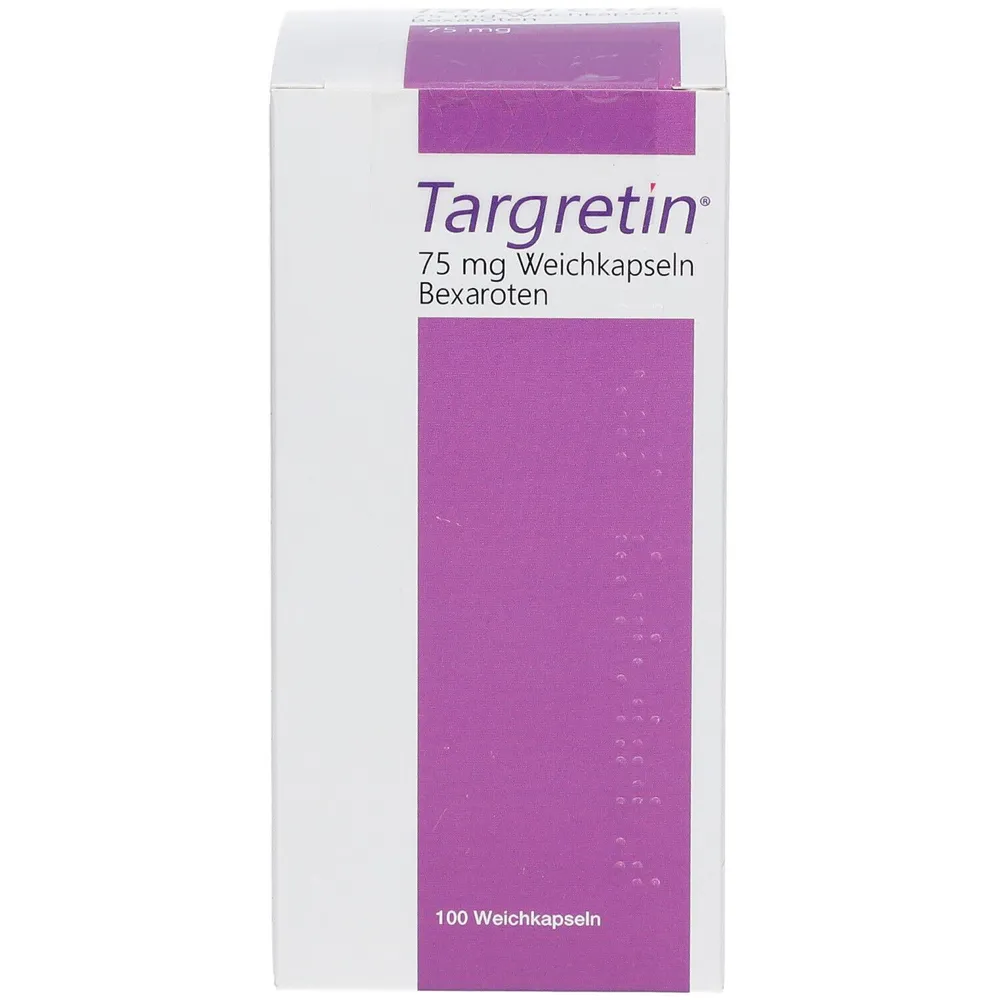
TARGRETIN
ItalyIt is used for the treatment of advanced-stage cutaneous T-cell lymphoma (CTCL) in patients who have not responded to at least one previous systemic treatment.
Frequently asked questions
How should I take Targretin?
The capsules must be swallowed whole, without being chewed, during or immediately after a meal. The dose is determined by the doctor and usually ranges from 4 to 10 capsules once daily, always at the same time.
When should I not take this medicine?
You must not take it if you are allergic to bexarotene or any of its components, if you are pregnant or breastfeeding, if you are of childbearing potential and not using effective contraceptive methods, or if you suffer from pancreatitis, uncontrolled hyperlipidemia, hypervitaminosis A, uncontrolled thyroid diseases, hepatic impairment, or generalized infections.
What are the common side effects of Targretin?
The most frequent side effects reported include: reduction in white blood cells, lowering of thyroid hormones, increased cholesterol and triglycerides, skin reactions (itching, redness, peeling), headache, fatigue, and muscle or joint pain.
Are there interactions with other medicines or foods?
Yes. It is important to inform your doctor if you are taking medicines for infections (fungal or bacterial), for seizures, to reduce blood fats, insulin, or other medicines such as tamoxifen and dexamethasone. Regular consumption of grapefruit or grapefruit juice may also alter the effect of the therapy.
What do I need to know regarding pregnancy and contraception?
The medicine can cause harm to the fetus. Women of childbearing potential must perform a pregnancy test before starting therapy and use two reliable methods of contraception from the month preceding the start of treatment until one month after its completion. Men must also use a condom during therapy and for one month after the last dose if the partner is of childbearing potential.
Are there any particular lifestyle warnings?
It is recommended to expose yourself to the sun as little as possible and to avoid tanning beds. Furthermore, vitamin A supplements should not be taken in doses exceeding 15,000 International Units per day during treatment.
Instructions for use
Package leaflet: Information for the user
TARGRETIN 75 mg soft capsules
bexarotene
Read this leaflet carefully before taking this medicine because it contains
important information for you.
- Keep this leaflet. You may need to read it again.
- If you have any questions, ask your doctor or pharmacist.
- This medicine has been prescribed for you only. Do not give it to other people, even if they have the same symptoms as you, because it could be harmful.
- If you experience any side effects, including those not listed in this leaflet, tell your doctor or pharmacist. See section 4.
Contents of this leaflet
- What Targretin is and what it is used for
- What you need to know before taking Targretin
- How to take Targretin
- Possible side effects
- How to store Targretin
- Contents of the pack and other information
1. What Targretin is and what it is used for
The active substance of Targretin, bexarotene, belongs to a group of medicines called retinoids,
which are similar to vitamin A. Targretin is indicated for the treatment of patients with advanced
cutaneous T-cell lymphoma (CTCL) who have not responded to at least one prior systemic therapy.
Cutaneous T-cell lymphoma is a disease in which certain types of lymphatic system cells called T-lymphocytes become cancerous and affect the skin.
2. What you need to know before taking Targretin
Do not take Targretin:
- if you are allergic to bexarotene or to any of the other ingredients of this medicine (listed in section 6);
- if you are pregnant or breastfeeding, if you are of childbearing age and are not using an effective method of contraception;
- if you have or have had pancreatitis, uncontrolled hyperlipidaemia (high cholesterol or triglycerides in the blood), hypervitaminosis A, uncontrolled thyroid disease, liver dysfunction, or an active systemic infection.
Warnings and precautions
Talk to your doctor before taking Targretin
- if you have a known hypersensitivity to retinoids (substances similar to vitamin A), have liver disease, have hyperlipidaemia (high cholesterol or triglycerides in the blood), or are taking medicines that may increase blood fat levels, have uncontrolled diabetes mellitus, have or have had gallbladder or bile duct disorders, or consume excessive amounts of alcohol;
- if you have previously experienced mental health problems, including depression, aggressive tendencies, or mood changes, as treatment with Targretin may affect mood.
Before starting treatment, you may need to undergo fasting blood tests to measure blood fat levels, which should be repeated weekly at first and then monthly throughout the duration of treatment.
Before starting treatment, blood tests will be performed to assess liver and thyroid function, as well as red and white blood cell counts; these will be monitored during treatment.
If you experience visual disturbances during treatment, periodic eye examinations will be performed.
Minimize exposure to sunlight and avoid sunlamps.
Do not take vitamin A supplements in daily doses exceeding 15,000 International Units during treatment.
Mental health problems
You may not notice certain changes in your mood or behaviour. Therefore, it is very important to inform your friends and family that this medicine may affect mood and behaviour. These people may be able to notice changes and help you identify any problems that you should discuss with your doctor.
Children and adolescents
Targretin must not be used in children or adolescents.
Other medicines and Targretin
Inform your doctor if you are currently taking, have recently taken, or might take any other medicines, such as:
- ketoconazole and itraconazole (for fungal infections);
- erythromycin, clarithromycin, and rifampicin (for bacterial infections);
- phenytoin and phenobarbital (for seizures);
- gemfibrozil (to reduce high levels of fats in the blood, such as cholesterol and triglycerides);
- vitamin A supplements, protease inhibitors (for viral infections);
- tamoxifen (for certain types of cancer);
- dexamethasone (for inflammatory conditions);
- insulin, medicines that promote insulin secretion, or medicines that increase insulin sensitivity (used in the treatment of diabetes mellitus).
This is very important because when several medicines are taken together, their effects may be either weakened or enhanced.
Targretin with food and drink
Targretin should be taken with food (see section 3). If you regularly consume grapefruit or grapefruit juice, you should consult your doctor, as these substances may potentially alter your body's response to Targretin therapy.
Pregnancy and breastfeeding
Targretin may harm the unborn baby. You must not take Targretin if you are pregnant or breastfeeding. If you are pregnant, breastfeeding, think you may be pregnant, or are planning to become pregnant, talk to your doctor before taking this medicine. If you are of childbearing potential, you must have a pregnancy test one week before starting treatment to rule out pregnancy. You must use effective contraception continuously starting one month before beginning Targretin treatment and continuing for at least one month after stopping treatment. The use of two reliable contraceptive methods together is recommended. If you use a hormonal contraceptive method (e.g., oral contraceptive pill), you should consult your doctor.
If you are a man and your partner is pregnant or of childbearing potential, you must always use a condom during sexual intercourse throughout treatment with bexarotene and for at least one month after the last dose.
Driving and using machines
It is not known whether Targretin affects the ability to drive or operate machinery. If you experience visual disturbances or dizziness, you should avoid driving or operating machinery.
Targretin contains Sorbitol and butylated hydroxyanisole
Targretin contains a small amount of sorbitol (a type of sugar). If you have an intolerance to certain sugars, inform your doctor before taking this medicine.
Butylated hydroxyanisole may cause irritation of mucous membranes. Therefore, Targretin capsules must be swallowed whole and not chewed.
3. How to take Targretin
Take this medicine exactly as instructed by your doctor.
If you have any doubts, consult your doctor or pharmacist. The dose prescribed by your doctor is the one suitable for you.
The recommended dose is generally between 4 and 10 capsules taken once daily.
Take the number of capsules prescribed by your doctor every day at the same time, with a meal.
The capsules may be taken either immediately before, during, or immediately after the meal, depending on your preference.
The capsules must be swallowed whole and must not be chewed.
Duration of treatment with Targretin
Although some patients show improvement within the first few weeks, most require several months or more of treatment before improvement occurs.
If you take more Targretin than you should
If you have taken more than the prescribed dose of Targretin, contact your doctor.
If you forget to take Targretin
If you forget to take a dose, take your daily dose at the next mealtime, then continue with your regular schedule the following day.
Do not take a double dose on the same day to make up for a missed dose.
If you stop taking Targretin
Your doctor will determine how long you should continue treatment with Targretin and when it can be stopped.
Do not stop taking this medicine unless your doctor advises you to do so.
If you have any questions about the use of this medicine, consult your doctor or pharmacist.
4. Possible side effects
Like all medicines, this medicine can cause side effects, although not everyone experiences them. If you notice any worsening of your health while taking Targretin, consult your doctor as soon as possible. Sometimes it may be necessary to adjust the dose or stop treatment. Your doctor will advise you on what to do.
The following are side effects reported in patients with cutaneous T-cell lymphoma treated with the recommended starting dose.
Very common (may occur in more than 1 in 10 treated patients):
- Low white blood cell count (leukopenia)
- Decreased thyroid hormone levels
- Increased blood fats (triglycerides and cholesterol)
- Skin reactions (itching, redness, irritation, skin peeling)
- Headache, fatigue, lethargy
Common (may occur in up to 1 in 10 treated patients):
- Low red blood cell count (erythropenia), swollen lymph nodes, worsening of lymphoma
- Thyroid disorders
- Increased liver enzymes, kidney dysfunction, low blood protein levels, weight gain
- Insomnia, dizziness, reduced skin sensitivity
- Dry eyes, hearing loss, abnormal eye sensitivity including irritation and heaviness
- Swelling of arms and legs
- Nausea, diarrhoea, dry mouth, dry lips, loss of appetite, constipation, excessive intestinal gas, abnormal liver function tests, vomiting
- Dry skin, skin disorders, hair loss, sores, acne, skin thickening, skin nodules, increased sweating
- Joint pain, bone pain, muscle pain
- Chills, abdominal pain, allergic reactions, infection
Uncommon (may occur in up to 1 in 100 treated patients):
- Blood abnormalities: eosinophilia, leukocytosis, lymphocytosis, purpura, increased or decreased platelet count
- Overactive thyroid gland
- High blood bilirubin levels, worsening kidney function, gout, decreased HDL cholesterol
- Restlessness, difficulty maintaining balance, depression, increased skin sensitivity to touch, abnormal nerve sensitivity, vertigo
- Vision disturbances, blurred vision, eyelid inflammation, cataract, corneal conjunctivitis, corneal lesion, hearing disorder, visual field defect
- Swelling, bleeding, hypertension, tachycardia, visible vein dilation, blood vessel dilation
- Gastrointestinal disorders, liver failure, pancreatitis
- Changes in body hair (trichosis), herpes (herpes simplex), nail abnormalities (onychosis), pustular erythema, seroma, skin colour changes
- Muscle weakness
- Protein in urine, kidney dysfunction
- Back pain, skin infection, fever, parasitic infection, laboratory parameter abnormalities, mucous membrane disorders, tumour
Rare events that may lead to death include acute pancreatitis, cerebral haemorrhage, and severe liver failure.
Reporting of side effects
If you experience any side effect, including those not listed in this leaflet, talk to your doctor or pharmacist. You can also report side effects directly via the national reporting system detailed in Annex V. By reporting side effects, you can help provide more information on the safety of this medicine.
5. How to store Targretin
Keep this medicine out of the sight and reach of children.
Do not use this medicine after the expiry date stated on the label. The expiry date refers to the last day of that month.
Do not store above 30 °C. Keep the bottle tightly closed.
Do not dispose of any medicine via wastewater or household waste. Ask your pharmacist how to dispose of medicines no longer required. This will help protect the environment.
6. Package contents and other information
What Targretin contains
Each capsule of Targretin contains 75 mg of bexarotene, the active substance. The capsules also contain the following excipients: macrogol, polysorbate, povidone, and butylated hydroxyanisole.
The capsule shell is composed of gelatin, a special sorbitol-glycerin mixture (glycerin, sorbitol, sorbitol anhydrides (1,4-sorbitan), mannitol, and water), titanium dioxide (E171), and printing ink (alcohol SDA 35A (ethanol and ethyl acetate), propylene glycol (E1520), black iron oxide (E172), phthalate polyvinyl acetate, purified water, isopropyl alcohol, macrogol 400, 28% ammonium hydroxide).
Description of the appearance of Targretin and package contents
Targretin is available as soft oral capsules in a white plastic bottle containing 100 capsules.
Marketing Authorization Holder
H.A.C. Pharma
Péricentre 2
43 Avenue de la Côte de Nacre
14000 Caen
France
Manufacturer
Eisai GmbH
Edmund-Rumpler-Straße 3
60549 Frankfurt am Main
Germany
More detailed information on this medicinal product is available on the website of the European Medicines Agency: http://www.ema.europa.eu.
Similar drugs
| Brand name | Dosage form | Active substance / Dosage | Manufacturer |
|---|---|---|---|
| BEXAROTENE CIPLA | capsules, soft gelatin | CIPLA EUROPE NV |
The original data is available in the language of the country of manufacture.
Data source: Italian Medicines Agency (AIFA)
Data last verified: September 21, 2026