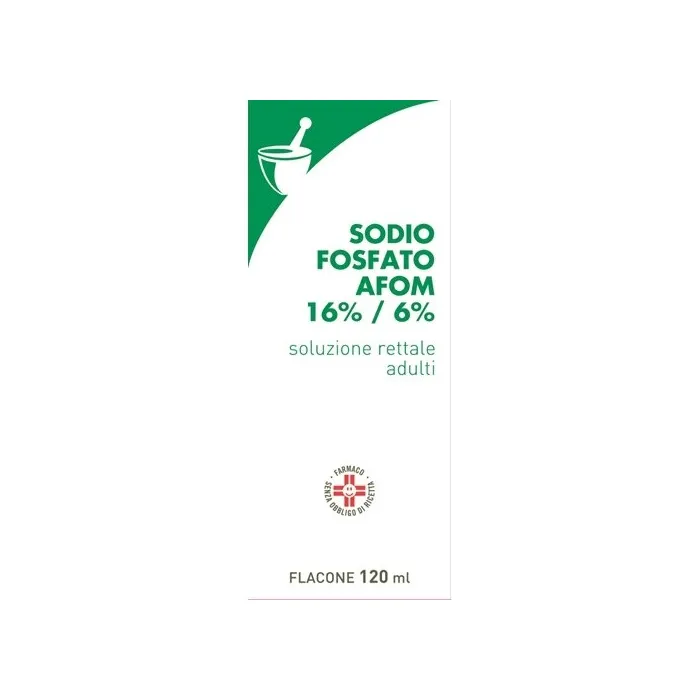
SODIUM PHOSPHATE AFOM
ItalyIt is used as a laxative to soften and lubricate the stool, facilitating evacuation. It is indicated for the treatment of constipation and for bowel cleansing before surgery or certain clinical examinations, such as radiological exams or intestinal explorations.
Frequently asked questions
How should SODIO FOSFATO AFOM be taken?
The recommended dose for adults and adolescents over 12 years of age is 1 bottle of 120 ml per day. The bottle should be used at room temperature and the solution should be gently introduced into the rectum while lying on the left side. After administration, it is advisable to remain lying down for a few minutes; the urge to defecate usually occurs within 5 minutes, but the solution should not be retained for more than 10-15 minutes.
When should you not use this medicine?
It must not be used if you are allergic to the components, if you suffer from acute abdominal pain or pain of unknown origin, nausea, vomiting, intestinal or anorectal obstruction or narrowing, or if you have conditions such as mechanical ileus, intestinal inflammation, rectal bleeding, hemorrhoids, megacolon, or Hirschsprung's disease. It is contraindicated in cases of severe dehydration, serious kidney or heart problems, or if you have high levels of phosphates in the blood. It must not be used by children under 12 years of age.
What are the possible side effects of SODIO FOSFATO AFOM?
Allergic reactions (such as urticaria), abdominal pain, cramps, colic, diarrhea, nausea, vomiting, and rectal irritation may occur. Alterations in blood salt and mineral levels (such as sodium, potassium, calcium, or phosphates) may also occur, which can cause involuntary muscle contractions or other problems.
Are there any interactions with other drugs?
Although interactions are rare, caution is necessary if taking diuretics, corticosteroid drugs, lithium, calcium supplements, or drugs that can affect the heart. Other preparations containing sodium phosphates should not be taken simultaneously.
What should be done in case of overdose?
Excessive use can cause prolonged diarrhea, dehydration, and mineral salt imbalances. In case of accidental ingestion of an excessive dose, it is necessary to inform a doctor immediately or go to the nearest hospital. It is important to drink plenty of fluids, especially fruit juices, to replace those lost.
Instructions for use
Package leaflet: Information for the user
SODIUM PHOSPHATE AFOM
16% / 6% rectal solution
monobasic sodium phosphate and dibasic sodium phosphate
Please read all of this leaflet carefully before you start using this medicine because it contains important information for you.
- Use this medicine exactly as described in this leaflet or as your doctor or pharmacist has instructed you.
- Keep this leaflet. You may need to read it again.
- If you need more information or advice, consult your pharmacist.
- If you experience any side effects, including those not listed in this leaflet, contact your doctor or pharmacist. See section 4.
- Contact your doctor if you do not notice any improvement or if you notice worsening of symptoms after a few days. Contents of this leaflet:
- What SODIUM PHOSPHATE AFOM is and what it is used for
- What you need to know before using SODIUM PHOSPHATE AFOM
- How to use SODIUM PHOSPHATE AFOM
- Possible side effects
- How to store SODIUM PHOSPHATE AFOM
- Contents of the pack and other information
1. What SODIO FOSFATO AFOM is and what it is used for
SODIO FOSFATO AFOM contains the active substances monobasic sodium phosphate and dibasic sodium phosphate, which belong to the group of laxative medicines used to soften and lubricate the stools, facilitating their passage through the intestine and evacuation. This medicine is indicated for the treatment of constipation and for emptying the bowel prior to surgical procedures or certain clinical examinations, such as radiological examinations or intestinal explorations.
Consult your doctor if you do not notice any improvement or if you observe a worsening of symptoms after a few days.
2. What you need to know before using SODIUM PHOSPHATE AFOM
Do not use SODIUM PHOSPHATE AFOM
- if you are allergic to monobasic sodium phosphate, dibasic sodium phosphate, or any of the other ingredients of this medicine (listed in section 6);
- if you have acute or unknown origin abdominal pain;
- if you experience nausea or vomiting;
- if you suffer from intestinal blockage or narrowing of the intestine or anorectum (subocclusion or intestinal stenosis or anorectal stenosis);
- if you have specific intestinal disorders such as mechanical ileus, paralytic ileus, inflammation, or other conditions that may increase absorption of the medicine;
- if you have problems in the terminal part of the intestine such as rectal bleeding, pain, hemorrhoids, or anal perforation;
- if you have congenital or acquired megacolon;
- if you have Hirschsprung's disease;
- if you are severely dehydrated;
- if the person to take the medicine is a child under 12 years of age;
- if you suffer from heart and/or kidney problems (severe renal insufficiency);
- if you have elevated blood phosphate levels (hyperphosphatemia);
Do not take other sodium phosphate preparations at the same time, including oral phosphate solutions or sodium phosphate tablets (see section “Other medicines and SODIUM PHOSPHATE AFOM”).
Warnings and precautions
Talk to your doctor or pharmacist before using SODIUM PHOSPHATE AFOM.
If you use this medicine excessively, frequently, or incorrectly, you may experience prolonged diarrhea, resulting in loss of water, minerals (especially potassium), and other essential nutrients. In more severe cases, you may become dehydrated and develop low blood potassium levels (hypokalemia), which may cause heart, nerve, and muscle problems, especially if you are also taking medicines that stimulate heart function (cardiac glycosides), increase urine production (diuretics), or corticosteroids.
Drink fluids to prevent dehydration, especially if you have conditions that may promote fluid loss, or if you are taking medicines that affect the kidneys, such as diuretics, angiotensin-converting enzyme inhibitors (ACE inhibitors), angiotensin receptor blockers (sartans), or non-steroidal anti-inflammatory drugs (NSAIDs).
Since SODIUM PHOSPHATE AFOM contains sodium phosphates, blood levels of sodium and phosphate may increase (hypernatremia, hyperphosphatemia), and levels of calcium and potassium in the blood may decrease (hypocalcemia and hypokalemia), potentially leading to involuntary muscle contractions (tetany) and kidney problems (renal failure).
If you use this medicine excessively or incorrectly, you may develop dependence (requiring progressively higher doses), chronic constipation, and loss of normal intestinal function (intestinal atony).
Repeated use may lead to tolerance or damage.
Avoid prolonged use of this medicine. If you have constipation lasting more than 2 weeks, if you notice changes in your usual bowel habits or stool characteristics, or if you do not experience improvement after using this medicine, consult your doctor.
Use this medicine with caution and only after consulting your doctor if you are elderly, in poor general health, or suffer from cardiovascular problems (uncontrolled blood pressure, heart disease), ascites, or rectal mucosal disorders (ulcers, fissures). If you encounter resistance when using the medicine, stop immediately, as forced administration may cause injury.
For constipation, first correct your dietary habits by consuming adequate fiber and water (6–8 glasses per day) and engaging in physical activity. In most cases, a balanced diet rich in water and fiber (bran, vegetables, and fruit) can permanently resolve constipation. Many people mistakenly believe they are constipated if they do not defecate daily; in fact, this is often completely normal. True constipation occurs when bowel movements are less frequent than usual and are associated with hard stools. If episodes of constipation recur, consult your doctor.
Children
This medicine must not be used in children under 12 years of age.
Elderly
If you are elderly, consult your doctor before using this medicine.
Other medicines and SODIUM PHOSPHATE AFOM
Inform your doctor or pharmacist if you are taking, have recently taken, or might take any other medicines.
This medicine is only minimally absorbed in the intestine and therefore rarely interacts with other medicines.
Use caution if you are taking the following medicines:
- medicines that may alter electrolyte levels in the body, such as diuretics, corticosteroids, calcium antagonists, and lithium, as they may increase blood levels of phosphates, calcium, and sodium (hyperphosphatemia, hypercalcemia, hypernatremia);
- medicines that may affect certain heart parameters (such as QT interval), as sodium phosphate could increase their toxicity;
- lithium: since hypernatremia is associated with low lithium levels, concomitant use of SODIUM PHOSPHATE AFOM 16% / 6% rectal solution and lithium may reduce serum lithium levels, decreasing its effectiveness;
- calcium-containing medicines (such as antacids) and calcium supplements, as they may increase the risk of calcium accumulation (ectopic calcification).
Do not take other sodium phosphate preparations at the same time, including oral phosphate solutions or sodium phosphate tablets (see section “Do not use SODIUM PHOSPHATE AFOM”).
Pregnancy and breastfeeding
If you are pregnant, suspect you may be pregnant, planning a pregnancy, or breastfeeding, consult your doctor or pharmacist before using this medicine. If you are pregnant or breastfeeding, use this medicine only when absolutely necessary and under direct medical supervision.
Driving and using machines
This medicine does not impair the ability to drive vehicles or operate machinery. However, adverse effects may occur during treatment; therefore, it is advisable to understand your response to the medicine before driving or operating machinery.
SODIUM PHOSPHATE AFOM contains methyl parahydroxybenzoate and propyl parahydroxybenzoate
Methyl parahydroxybenzoate and propyl parahydroxybenzoate may cause allergic reactions (including delayed-type reactions).
3. How to use SODIO FOSFATO AFOM
Use this medicine exactly as directed by your doctor or pharmacist. If you have any doubts, consult your doctor or pharmacist.
Use in adults and adolescents over 12 years of age
The recommended dose is 1 bottle of 120 ml per day.
Do not exceed this dose, and use each bottle for a single administration only, discarding any remaining solution.
Use this medicine at room temperature. If you prefer the medicine to be warm, you may immerse the closed bottle in warm water or hold it under a stream of warm tap water.
For optimal effect, administer while lying on your left side. To enhance the cleansing action, after administration lie on the floor with your knees bent, your buttocks raised, and your chest resting on the floor for a few minutes.
For best results, follow these instructions for use:
- Remove the cap from the single-dose bottle.
- Hold the bottle, lubricate the nozzle with a few drops of the solution, then while lying on your left side, gently insert the nozzle into the rectum and squeeze the bottle completely to empty the solution. A small amount of solution may remain in the bottle.
- Remove the nozzle while keeping pressure on the bottle after administration.
- Remain lying down for a few minutes, preferably on your stomach or with your knees drawn up to your chest, before sitting up. Go to the toilet as soon as you feel the urge to defecate, which usually occurs within 5 minutes. In any case, do not retain the solution for more than 10–15 minutes.
If you use more SODIO FOSFATO AFOM than you should
If you use an excessive dose of this medicine, either by accidental ingestion or rectal administration, the following may occur:
- irritation of the stomach and intestines, abdominal pain, nausea, vomiting, and diarrhea, leading to loss of water, electrolytes (especially potassium), and nutrients. In such cases, drink plenty of fluids to replace those lost;
- increased thirst, weakness, fluid accumulation in various parts of the body (edema), bone pain (osteomalacia), and decreased levels of albumin in the blood (hypoalbuminemia);
- severe dehydration and low blood potassium levels (hypokalemia), potentially causing heart, nerve, and muscle problems, especially if you are also taking medicines that stimulate heart function (cardiac glycosides), increase urine production (diuretics), or corticosteroids;
- increased blood phosphate levels (hyperphosphatemia) and decreased blood calcium levels (hypocalcemia), leading to uncontrolled muscle contractions (tetany), seizures, and heart problems such as bradycardia, QT interval prolongation, arrhythmia, coma, and cardiac arrest;
- increased blood sodium levels (hypernatremia) and decreased blood magnesium levels (hypomagnesemia);
- low blood pressure (hypotension), rapid heart rate (tachycardia), and increased acidity in the body (metabolic acidosis).
See also the information in section 2 “Warnings and precautions” regarding laxative abuse.
Treatment: Drink plenty of fluids, especially fruit juices. If you are elderly, a child, or have reduced kidney function (renal insufficiency), the symptoms listed above may occur more easily. In case of accidental ingestion or overdose of SODIO FOSFATO AFOM, contact your doctor immediately or go to the nearest hospital.
If you forget to use SODIO FOSFATO AFOM
Do not use a double dose to make up for the missed dose.
If you stop treatment with SODIO FOSFATO AFOM
If you have any doubts about using this medicine, consult your doctor or pharmacist.
4. Possible side effects
Like all medicines, this medicine can cause side effects, although not everyone will experience them.
The following side effects may occur.
Frequency not known (frequency cannot be estimated from available data):
- allergic reactions (e.g. urticaria);
- blisters, itching, burning of the skin;
- abdominal pain, such as cramps and colic;
- diarrhoea with loss of salts and water;
- irritation of the lower part of the intestine (rectal irritation);
- increased levels of phosphates in the blood (hyperphosphataemia);
- decreased levels of potassium in the blood (hypokalaemia);
- increased levels of sodium in the blood (hypernatraemia);
- nausea, vomiting;
- decreased levels of calcium in the blood (hypocalcaemia);
- accumulation of calcium in various internal parts of the body (calcification).
Following the instructions provided in this leaflet reduces the risk of side effects.
Reporting of side effects
If you experience any side effect, including those not listed in this leaflet, please contact your doctor or pharmacist. You may also report side effects directly via the national reporting system at https://www.aifa.gov.it/content/segnalazioni-reazioni-avverse. By reporting side effects, you can help provide more information on the safety of this medicine.
5. How to store SODIO FOSFATO AFOM
Keep this medicine out of the sight and reach of children.
Do not use this medicine after the expiry date stated on the pack after “Expiry:”.
The expiry date refers to the last day of that month.
The expiry date applies to the medicine in its original packaging, stored correctly.
This medicine does not require any special storage conditions. Keep the container tightly closed.
Do not dispose of any medicine via wastewater or household waste. Ask your pharmacist how to dispose of medicines you no longer use. This will help protect the environment.
6. Package contents and other information
What SODIO FOSFATO AFOM contains
- The active substances are monobasic sodium phosphate and dibasic sodium phosphate. 100 ml of solution contain 16 g of monobasic sodium phosphate monohydrate (equivalent to 18 g of monobasic sodium phosphate dihydrate) and 6 g of dibasic sodium phosphate heptahydrate (equivalent to 8 g of dibasic sodium phosphate dodecahydrate).
- The other components are: methyl parahydroxybenzoate, propyl parahydroxybenzoate and purified water.
Description of the appearance of SODIO FOSFATO AFOM and contents of the pack
120 ml bottle of rectal solution.
Marketing Authorization Holder and Manufacturer
Marketing Authorization Holder:
AEFFE FARMACEUTICI S.r.l. - via Carlo Porta, 49 - 20064 Gorgonzola (MI)
Manufacturer:
AEFFE FARMACEUTICI S.r.l. - Via Torino, 448 - Brandizzo (TO)
Similar drugs
| Brand name | Dosage form | Active substance / Dosage | Manufacturer |
|---|---|---|---|
| CLISMA LAX | solution, rectal | ALFASIGMA S.P.A. | |
| ENEMAC | solution, rectal | EUROSPITAL S.P.A. | |
| FLEET ENEMA | solution, rectal | CASEN RECORDATI SL | |
| SODIUM PHOSPHATE ALFASIGMA | solution, rectal | ALFASIGMA S.P.A. | |
| SODIUM PHOSPHATE MARCO VITI | solution, rectal | MARCO VITI FARMACEUTICI S.P.A. | |
| SODIUM PHOSPHATE NEW.FA.DEM. | solution, rectal | NEW.FA.DEM. S.R.L. | |
| SODIUM PHOSPHATE NOVA ARGENTIA | solution, rectal | INDUSTRIA FARMACEUTICA NOVA ARGENTIA S.R.L. | |
| SODIUM PHOSPHATE POLIFARMA BENESSERE | solution, rectal | POLIFARMA BENESSERE S.R.L. | |
| SODIUM PHOSPHATE SELLA | solution, rectal | LABORATORIO CHIMICO FARMACEUTICO A. SELLA S.R.L. | |
| SODIUM PHOSPHATE ZETA | solution, rectal | ZETA FARMACEUTICI S.P.A. | |
| ZETALAX ENEMA PHOSPHATE | solution, rectal | ZETA FARMACEUTICI S.P.A. |
The original data is available in the language of the country of manufacture.
Data source: Italian Medicines Agency (AIFA)
Data last verified: September 21, 2026