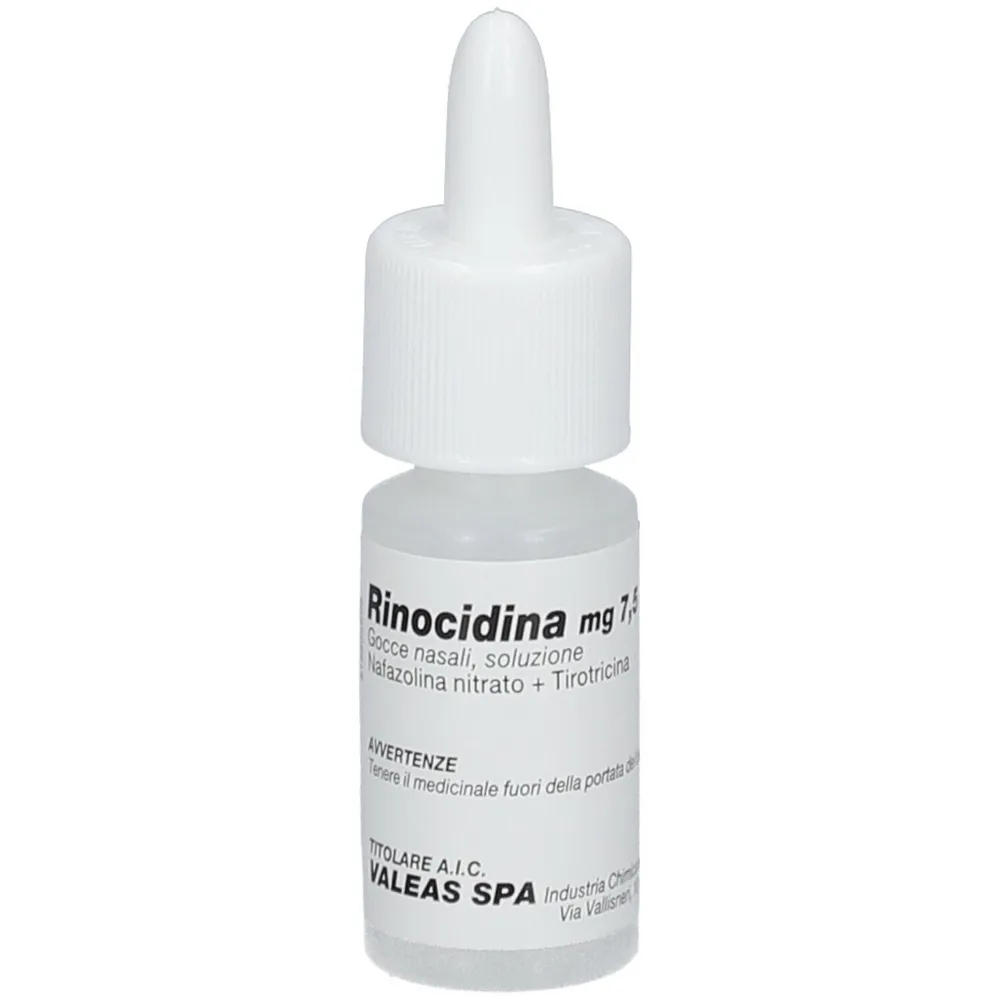
RINOCIDINA
ItalyIt is used for the local treatment of inflammations of bacterial origin of the nasal mucosa (rhinitis) and the paranasal cavities (sinusitis).
Frequently asked questions
How should Rinocidina be taken?
The recommended dose is 3 - 6 drops per nostril, to be repeated three or four times a day. It must not be used for more than one week.
Who must not use this medicine?
It must not be used by those allergic to the ingredients, by those suffering from heart disease, severe arterial hypertension, glaucoma, or hyperthyroidism. It is contraindicated in children under 12 years of age and in those taking or who have discontinued antidepressant drugs called Monoamine Oxidase Inhibitors (MAOIs) less than two weeks ago.
What are the side effects of Rinocidina?
It may cause worsening of nasal congestion, irritation, and swelling of the nasal vessels. Increased blood pressure, slowed heart rate, headache, and urinary disturbances may also occur.
What happens in case of overdose?
Excessive use can cause high blood pressure, rapid heartbeat, excessive sensitivity to light, severe headache, chest discomfort, or severe drowsiness if accidentally ingested. In case of overdose, it is necessary to inform a doctor immediately.
Are there interactions with other drugs?
It is important to inform the doctor or pharmacist if you are taking other medicines, particularly if you are using antidepressant drugs from the Monoamine Oxidase Inhibitors (MAOIs) category.
Can I use the product if I am pregnant or breastfeeding?
In case of pregnancy or breastfeeding, it is necessary to seek advice from a doctor or pharmacist. In pregnant women, the product should only be used if strictly necessary and under medical supervision.
Instructions for use
Patient Information Leaflet
Rinocidina 7.5 mg + 3 mg Nasal Drops, Solution
Naphazoline nitrate + Tyrothricin
Please read all of this leaflet carefully before using this medicine because it contains important information for you.
Use this medicine exactly as described in this leaflet or as your doctor or pharmacist has instructed you.
- Keep this leaflet. You may need to read it again.
- If you need more information or advice, consult your pharmacist.
- If you experience any side effects, including those not listed in this leaflet, talk to your doctor or pharmacist. See section 4.
- Consult your doctor if you do not notice improvement or if your symptoms worsen after 7 days.
Contents of this leaflet:
- What Rinocidina is and what it is used for
- What you need to know before using Rinocidina
- How to use Rinocidina
- Possible side effects
- How to store Rinocidina
- Contents of the pack and other information
1. What Rinocidina is and what it is used for
Rinocidina is a medicinal product containing naphazoline nitrate (a nasal mucosal decongestant) and tyrothricin (an antibiotic effective in the local treatment of nasal infections).
This medicine is used in the topical treatment of bacterial inflammation of the nasal mucosa (rhinitis) and paranasal cavities (sinusitis).
Consult your doctor if you do not feel better or feel worse after 7 days.
2. What you need to know before using Rinocidina
Do not use Rinocidina
- if you are allergic (hypersensitive) to naphazoline nitrate, tyrothricin, substances similar to them, or to any of the other ingredients of this medicine (listed in section 6);
- if you have heart disease;
- if you have very high blood pressure in the arteries (severe arterial hypertension);
- if you have a condition caused by increased pressure inside the eye called "glaucoma";
- if you have overactivity of the gland called thyroid (hyperthyroidism);
- if you are taking certain medicines used to treat depression called "Monoamine Oxidase Inhibitors (MAOIs)";
- if you have stopped treatment with certain antidepressant medicines called "Monoamine Oxidase Inhibitors (MAOIs)" less than two weeks ago;
- in children under 12 years of age.
Warnings and precautions
Talk to your doctor or pharmacist before using Rinocidina
- if you are elderly and/or have an enlarged prostate gland (prostatic hypertrophy), as you may experience difficulty in passing urine (urinary retention);
- if you have heart disease, especially high blood pressure (hypertension); in such cases, use of this medicine must be evaluated by your doctor;
- if sudden symptoms occur such as severe headache, nausea, vomiting, or visual disturbances. Your doctor may decide to discontinue treatment. In most cases, these symptoms improve or resolve within a few days with appropriate treatment;
- in case of loss of smell.
The use, especially prolonged use, of products applied directly to the affected area (topical products) may lead to sensitization reactions. In such cases, treatment must be discontinued and, if necessary, you should consult your doctor who will initiate appropriate therapy.
Prolonged use of vasoconstrictors (the class of medicines to which "Rinocidina" belongs) may alter the normal function of the nasal and paranasal mucosa (paranasal sinuses), potentially leading to dependence on the medicine. Long-term use of this medicine may be harmful.
Children and adolescents
RINOCIDINA is contraindicated in children under 12 years of age (see section "Do not use Rinocidina").
Other medicines and Rinocidina
Tell your doctor or pharmacist if you are taking, have recently taken, or might take any other medicines.
The use of Rinocidina is not recommended if you are currently being treated with, or have discontinued treatment less than two weeks ago, with antidepressant medicines called "Monoamine Oxidase Inhibitors (MAOIs)" (see "Do not use Rinocidina").
Pregnancy and breastfeeding
If you are pregnant, think you might be pregnant, planning to become pregnant, or breastfeeding, consult your doctor or pharmacist before using this medicine.
In pregnant women, this product should be administered only when clearly needed and under direct medical supervision. Use this medicine with caution during the first months of pregnancy.
Driving or operating machinery
No effects on the ability to drive vehicles or operate machinery are known.
Rinocidina contains parahydroxybenzoates (methyl parahydroxybenzoate and ethyl parahydroxybenzoate)
This medicine contains parahydroxybenzoates which may cause allergic reactions (including delayed reactions).
Rinocidina contains ethanol
This medicine contains 0.38 mg (equivalent to 0.0005 ml) of ethanol per dosage unit (1 drop), corresponding to 9.12 mg (equivalent to 0.01 ml) of ethanol in the maximum daily dose of 24 drops per nostril. It may cause a burning sensation on damaged mucosa.
3. How to use Rinocidina
Use this medicine exactly as described in this leaflet, or as directed by your doctor or pharmacist. If you have any doubts, consult your doctor or pharmacist.
The recommended dose is 3 - 6 drops per nostril, three or four times a day.
Strictly adhere to the recommended doses. Exceeding the dosage, even when applied topically and for a short period, may cause serious systemic effects (affecting the entire body).
You may notice a slight deposit of solid material inside the bottle (also known as "sediment"), which does not alter the activity of the preparation. In such cases, simply shake the bottle before using the medicine.
Do not use Rinocidina for longer than one week.
Instructions for use
To prevent the bottle from being easily opened, a dropper has been used that requires a non-instinctive but rational action to open.
To open the bottle, simultaneously press down on the dropper cap and turn it counterclockwise.
To close the bottle, screw the cap clockwise.
If you use more Rinocidina than you should
Strictly follow the recommended dosage. If accidentally ingested or used excessively over a prolonged period, this medicine may cause toxic effects.
Keep it out of the reach of children, as accidental ingestion may cause marked drowsiness (pronounced sedation).
Symptoms of overdose may include: increased blood pressure in the arteries (arterial hypertension), rapid heartbeat (tachycardia), excessive sensitivity to light (photophobia), severe headache (intense cephalalgia), and chest discomfort (thoracic oppression).
If you accidentally take an excessive dose of Rinocidina, contact your doctor immediately or go to the nearest hospital.
If you forget to use Rinocidina
Do not use a double dose to make up for the missed dose.
If you stop using Rinocidina
If you have any questions about using this medicine, consult your doctor or pharmacist.
4. Possible side effects
Like all medicines, this medicine can cause side effects, although not everyone gets them.
This medicine may worsen the sensation of nasal blockage, and cause irritation and swelling of the blood vessels in the inner nasal wall (rebound phenomena of sensitization and mucosal congestion). Rapid absorption of the medicine through the inflamed inner nasal walls (mucosa) may lead to the following effects affecting the whole body (systemic effects):
- increased blood pressure in the arteries (arterial hypertension); excessive slowing of the heartbeat (reflex bradycardia)
- headache (cephalalgia)
- urinary disorders (micturition disorders)
Reporting of side effects
If you experience any side effect, including those not listed in this leaflet, contact your doctor or pharmacist. You may also report side effects directly via the national reporting system at the following website:
https://www.aifa.gov.it/content/segnalazioni-reazioni-avverse By reporting side effects, you can help provide further information on the safety of this medicine.
5. How to store Rinocidina
Keep this medicine out of the sight and reach of children.
Do not use this medicine after the expiry date stated on the packaging after "Exp". The expiry date refers to the last day of that month. The expiry date indicated refers to the product when kept in its original, undamaged packaging and properly stored.
Store below 25°C.
Do not dispose of any medicine via wastewater or household waste. Ask your pharmacist how to dispose of medicines no longer in use. This will help protect the environment.
6. Package contents and other information
What Rinocidina contains
The active substances are naphazoline nitrate and tyrothricin.
Each 15 ml bottle contains 7.5 mg of naphazoline nitrate and 3 mg of tyrothricin.
The other components are: glucose, purified water, methyl p-hydroxybenzoate, ethyl p-hydroxybenzoate, ethanol, polyethylene glycol 300.
Description of the appearance of Rinocidina and contents of the pack
Rinocidina is a nasal drop solution.
15 ml bottle with dropper.
Marketing Authorization Holder
NEOPHARMED GENTILI S.p.A. – Via San Giuseppe Cottolengo 15 – 20143 Milan, Italy
Manufacturer
Valeas S.p.A. - Chemical and Pharmaceutical Industry - Via Vallisneri, 10 - 20133 Milan, Italy
Lachifarma S.r.l. Chemical Pharmaceutical Laboratory Salentino - S.S. 16 – Industrial Zone
73010 Zollino (LE), Italy
The original data is available in the language of the country of manufacture.
Data source: Italian Medicines Agency (AIFA)
Data last verified: September 21, 2026