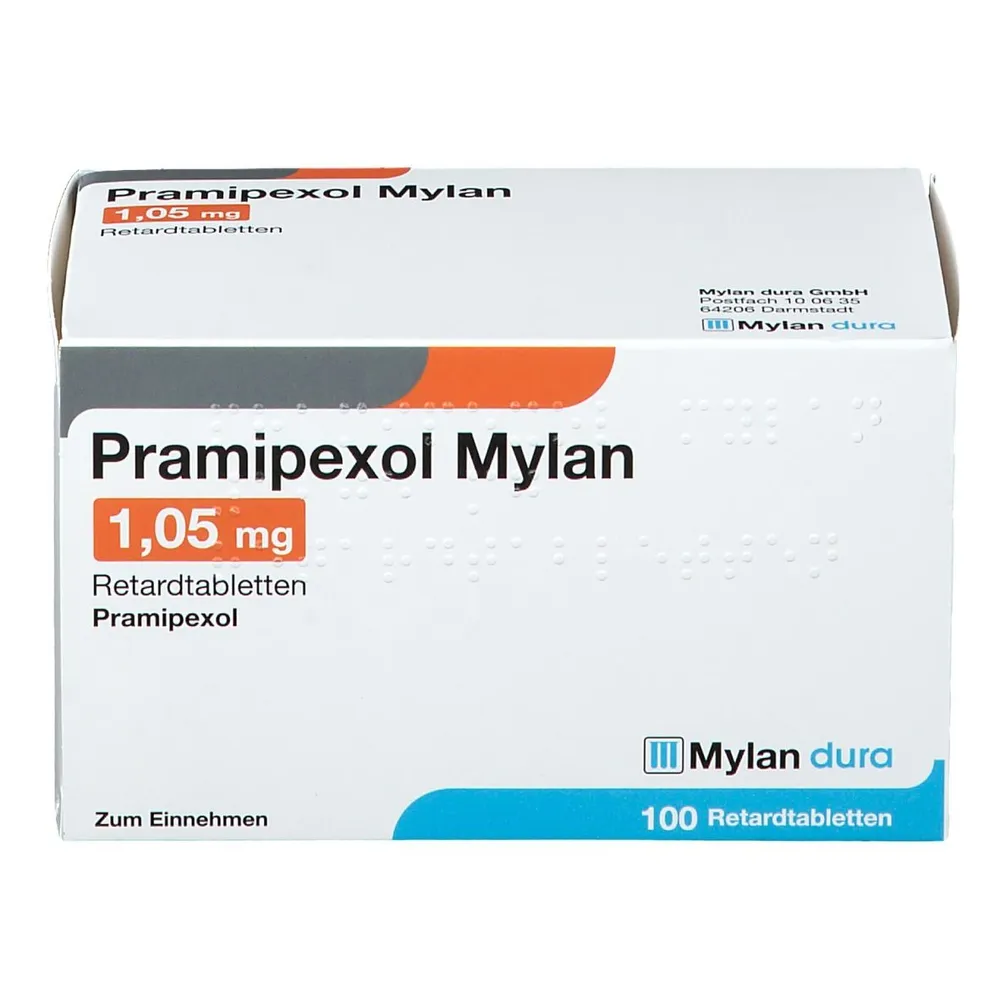
PRAMIPEXOLE MYLAN
ItalyIt is used to treat the symptoms of primary Parkinson's disease in adults (either alone or in combination with levodopa) and for the treatment of moderate to severe idiopathic Restless Legs Syndrome in adults.
Frequently asked questions
How should I take Pramipexolo Mylan?
Tablets should be swallowed with water and can be taken with or without food. For Parkinson's disease, the dose is usually divided into 3 equal doses per day. For Restless Legs Syndrome, the dose is usually taken once a day in the evening, 2-3 hours before going to bed. Always follow your doctor's instructions exactly.
When should I not take this medicine?
You must not take it if you are allergic to the active substance or to any of the other ingredients. Use is not recommended in children and adolescents under 18 years of age. Furthermore, it must not be taken during breastfeeding as it may reduce milk production and pass into the baby's milk.
What are the side effects of Pramipexolo Mylan?
Side effects may include nausea, drowsiness, dizziness, involuntary limb movements (dyskinesia), hallucinations, confusion, fatigue, headache, abnormal dreams, and possible impulse control disorders (such as excessive gambling, binge eating, or abnormal sexual desire). In case of pneumonia, heart failure, or severe allergic reactions, consult a doctor immediately.
Can I drive or use machines while taking this medicine?
Great care is necessary because the drug can cause drowsiness, sudden sleep episodes, or hallucinations. If these effects occur, you must not drive or use machines.
What should I do if I forget a dose or if I take too many?
If you forget a dose, skip the forgotten dose and take the next one at the usual time; do not take a double dose to compensate. If, however, you accidentally take too many tablets, contact a doctor immediately or go to the nearest emergency room.
Can I stop treatment suddenly?
No, you must not stop taking it without first speaking to your doctor. A sudden discontinuation, especially in the case of Parkinson's disease, can cause serious health risks, such as neuroleptic malignant syndrome or dopaminergic agonist withdrawal syndrome (which includes symptoms such as depression, anxiety, and fatigue).
Instructions for use
Table of contents
- Pramipexole Mylan 0.088 mg tablets, 0.18 mg tablets, 0.7 mg tablets
- 1. What Pramipexole Mylan is and what it is used for
- 2. What you should know before taking Pramipexole Mylan
- 3. How to take Pramipexole Mylan
- 4. Possible side effects
- 5. How to store Pramipexole Mylan
- 6. Package contents and other information
Package leaflet: Information for the patient
Pramipexole Mylan 0.088 mg tablets, 0.18 mg tablets, 0.7 mg tablets
pramipexole
Equivalent medicine
Please read all of this leaflet carefully before you start taking this medicine because it contains
important information for you.
- Keep this leaflet. You may need to read it again.
- If you have any questions, ask your doctor or pharmacist.
- This medicine has been prescribed for you only. Do not give it to other people, even if they have the same symptoms as yours, because it could be harmful.
- If you experience any side effect, including those not listed in this leaflet, tell your doctor or pharmacist. See section 4.
Contents of this leaflet:
- What Pramipexole Mylan is and what it is used for
- What you need to know before taking Pramipexole Mylan
- How to take Pramipexole Mylan
- Possible side effects
- How to store Pramipexole Mylan
- Contents of the pack and other information
1. What Pramipexole Mylan is and what it is used for
Pramipexole Mylan contains the active substance pramipexole, which belongs to a group of
medicines known as dopaminergic agonists that stimulate dopamine receptors located in the
brain. Stimulation of dopamine receptors in the brain triggers nerve impulses that
help control body movements.
Pramipexole Mylan is used:
- to treat the symptoms of primary Parkinson's disease in adults. It can be used alone or in combination with levodopa (another medicine for Parkinson's disease).
- to treat moderate to severe idiopathic Restless Legs Syndrome in adults.
2. What you should know before taking Pramipexole Mylan
Do not take Pramipexole Mylan
- if you are allergic to pramipexole or to any of the other excipients of this medicine (listed in section 6).
Warnings and precautions
Tell your doctor or pharmacist before taking Pramipexole Mylan. Inform your doctor if you have (or have had) or develop any medical condition or symptom, especially if listed below:
- Kidney disease.
- Hallucinations (seeing, hearing or sensing things that are not there). Most hallucinations are visual.
- Dyskinesia (e.g. abnormal, uncontrollable movements of limbs). If you suffer from advanced Parkinson’s disease and are also taking levodopa, you may develop dyskinesia during the titration phase of Pramipexole Mylan.
- Dystonia (inability to maintain upright posture of body and neck (axial dystonia)). In particular, forward bending of head and neck (also known as anterocollis), forward bending of the lumbar spine (also known as camptocormia), or lateral curvature of the spine (also known as pleurothotonus or Pisa syndrome) may occur. If any of these symptoms occur, your doctor may decide to modify your treatment.
- Drowsiness and sudden onset of sleep episodes.
- Psychosis (e.g. symptoms similar to schizophrenia).
- Vision disturbances. You should have regular eye examinations during treatment with Pramipexole Mylan.
- Severe heart or blood vessel diseases. Especially at the beginning of treatment, your blood pressure should be monitored regularly to prevent postural hypotension (drop in blood pressure upon standing, which may cause dizziness or loss of consciousness).
- Worsening of symptoms of restless legs syndrome. If you notice that symptoms occur earlier than usual in the evening (or even in the afternoon), are more intense, affect larger areas of the affected limbs, or involve other limbs, your doctor may reduce the dose or discontinue treatment.
Inform your doctor if you, a family member, or caregiver notice the development of impulses or urges to behave in ways that are unusual for you and that you cannot resist the impulse or temptation to carry out certain activities that could harm yourself or others. These are called impulse control disorders and may include behaviours such as pathological gambling, excessive eating or spending, abnormally increased sexual desire, or preoccupation with increased sexual thoughts or feelings. Your doctor may consider it necessary to adjust or stop your dose.
Inform your doctor if you, your family members, or your caregiver notice the development of manic symptoms (agitation, feeling of euphoria, excitement) or delirium (reduced awareness, confusion, loss of touch with reality). Your doctor may consider it necessary to adjust or stop your dose.
Inform your doctor if you experience symptoms such as depression, apathy, anxiety, fatigue, sweating, or pain after stopping or reducing the dose of Pramipexole Mylan. If symptoms persist for more than a few weeks, your doctor may need to adjust your therapy.
Children and adolescents
The use of Pramipexole Mylan is not recommended in children and adolescents under 18 years of age.
Other medicines and Pramipexole Mylan
Tell your doctor or pharmacist if you are taking, have recently taken, or might take any other medicines, including those without a prescription. This includes medicines, herbal preparations, dietary products, or supplements obtained without a prescription.
You should avoid taking Pramipexole Mylan together with antipsychotic medicines (medicines used to treat certain mental and emotional conditions. These help correct chemical imbalances in the brain that cause mental illness).
Be cautious if you are taking any of the following medicines:
- cimetidine (used to treat excess stomach acid and gastric ulcers)
- amantadine (which may be used to treat Parkinson’s disease)
- mexiletine (to treat irregular heartbeats, a condition known as ventricular arrhythmia)
- zidovudine (which may be used to treat HIV infection)
- cisplatin (to treat various types of cancer)
- quinine (which may be used to prevent painful nocturnal leg cramps and to treat a type of malaria known as falciparum malaria (malignant malaria))
- procainamide (for the treatment of irregular heartbeat)
If you are taking levodopa, it is recommended to reduce its dose when starting treatment with Pramipexole Mylan.
Be cautious if you are taking any sedative medicine or consuming alcohol. In such cases, Pramipexole Mylan may impair your ability to drive or operate machinery.
Pramipexole Mylan with food, drinks and alcohol
Be cautious if consuming alcohol during treatment with Pramipexole Mylan, as alcohol may increase the risk of drowsiness and sudden onset of sleep.
Pramipexole Mylan may be taken with or without food.
Pregnancy and breastfeeding
If you are pregnant, think you might be pregnant, or are planning to become pregnant, consult your doctor or pharmacist before taking this medicine. Your doctor will discuss with you whether to continue taking Pramipexole Mylan.
The effect of Pramipexole Mylan on the unborn baby is unknown. Therefore, do not take Pramipexole Mylan during pregnancy unless your doctor specifically tells you to do so.
Pramipexole Mylan must not be taken during breastfeeding. Pramipexole Mylan may reduce milk production. It may also pass into breast milk and reach the baby. If taking Pramipexole Mylan is unavoidable, breastfeeding must be discontinued.
Ask your doctor or pharmacist for advice before taking any medicine.
Driving and using machines
Pramipexole Mylan may cause hallucinations (seeing, hearing or sensing things that are not there). If this occurs, do not drive or use machinery.
Pramipexole Mylan has been associated with drowsiness and sudden onset of sleep episodes, particularly when taken with alcohol or other medicines that have a sedative effect. If these side effects occur, avoid driving or using machinery. Inform your doctor if this happens.
Pramipexole Mylan contains sodium
This medicinal product contains less than 1 mmol of sodium (23 mg) per tablet, which is essentially “sodium-free”.
3. How to take Pramipexole Mylan
Always take this medicine exactly as instructed by your doctor or pharmacist.
If you have any doubts, consult your doctor or pharmacist. Your doctor will advise you on the correct dose.
Pramipexole Mylan may be taken with or without food. The tablets should be swallowed with water.
Parkinson's disease
The recommended daily dose should be taken in three equal doses.
During the first week, the recommended dose is one tablet of Pramipexole Mylan 0.088 mg taken three times a day (equivalent to 0.264 mg per day):
| first week | |
| Number of tablets | One tablet of Pramipexole Mylan 0.088 mg three times a day |
| Total daily dose (mg base) | 0.264 |
This dose will be increased every 5 – 7 days according to the doctor's instructions until symptoms are controlled (maintenance dose).
| second week | third week | |
| Number of tablets | One tablet of Pramipexole Mylan 0.18 mg three times daily or Two tablets of Pramipexole Mylan 0.088 mg three times daily | One tablet of Pramipexole Mylan 0.35 mg three times daily or Two tablets of Pramipexole Mylan 0.18 mg three times daily |
| Total daily dose (mg base) | 0.54 | 1.1 |
The recommended maintenance dose is 1.1 mg daily. However, your dose may be further increased. If necessary, your doctor may increase the tablet dose up to a maximum of 3.3 mg of pramipexole daily. A lower maintenance dose is also possible, consisting of three Pramipexole Mylan 0.088 mg tablets daily.
| Lowest maintenance dose | Highest maintenance dose | |
| Number of tablets | One tablet of Pramipexole Mylan 0.088 mg three times daily | One tablet of Pramipexole Mylan 1.1 mg three times daily |
| Total daily dose (mg base) | 0.264 | 3.3 |
Patients with renal disease
If you have moderate or severe renal disease, your doctor will prescribe a lower dosage. In this
case, you will need to take the tablets only once or twice a day. If you have moderate renal
disease, the recommended starting dose is one tablet of Pramipexole Mylan 0.088 mg twice
daily, up to a maximum of 1.57 mg per day.
In the case of severe renal disease, the recommended starting dose is only one tablet of
Pramipexole Mylan 0.088 mg once daily, up to a maximum of 1.1 mg per day.
Restless Legs Syndrome
The dose is usually taken once daily in the evening, 2 – 3 hours before going to bed.
During the first week, the usual dose is 1 tablet of Pramipexole Mylan 0.088 mg once daily (equivalent to 0.088 mg per day):
| Week 1 | |
| Number of tablets | 1 tablet of Pramipexole Mylan 0.088 mg |
| Total daily dose (mg) | 0.088 |
This dose will be increased every 4–7 days according to the doctor's instructions until symptoms are controlled (maintenance dose).
| Week 2 | Week 3 | Week 4 | |
| Number of tablets | 1 tablet of Pramipexole Mylan 0.18 mg or 2 tablets of Pramipexole Mylan 0.088 mg | 1 tablet of Pramipexole Mylan 0.35 mg or 2 tablets of Pramipexole Mylan 0.18 mg or 4 tablets of Pramipexole Mylan 0.088 mg | 1 tablet of Pramipexole Mylan 0.35 mg and 1 tablet of Pramipexole Mylan 0.18 mg or 3 tablets of Pramipexole Mylan 0.18 mg or 6 tablets of Pramipexole Mylan 0.088 mg |
| Daily total dose (mg) | 0.18 | 0.35 | 0.54 |
The daily dose must not exceed 6 tablets of Pramipexole Mylan 0.088 mg or a dose of 0.54 mg (0.75 mg of pramipexole salt).
If you stop taking the medication for more than a few days and wish to restart treatment, you must begin again with the lowest dose. You can then return to your previous dose as you did the first time. Ask your doctor for advice.
Your doctor will review your treatment after 3 months to decide whether it should continue or not.
Patients with kidney disease
If you have severe kidney disease, treatment with Pramipexole Mylan may not be suitable for you.
If you take more Pramipexole Mylan than you should
If you accidentally take too many tablets:
- contact your doctor immediately or go to the nearest hospital emergency department.
- symptoms such as vomiting, restlessness, or any of the adverse reactions listed in section 4 “Possible side effects” may occur.
If you forget to take Pramipexole Mylan
Do not worry. Simply skip the missed dose completely and take the next dose at the usual time. Do not take a double dose to make up for the forgotten dose.
If you stop taking Pramipexole Mylan
Do not stop taking Pramipexole Mylan without first talking to your doctor. If you need to discontinue treatment with this medicine, your doctor will gradually reduce the dose. This reduces the risk of worsening symptoms.
If you have Parkinson’s disease, you must not stop treatment with Pramipexole Mylan abruptly. Sudden discontinuation could lead to the development of a medical condition called neuroleptic malignant syndrome, which may pose a greater health risk. Symptoms include:
- akinesia (loss of muscular movement)
- muscle rigidity
- fever
- unstable blood pressure
- tachycardia (increased heart rate)
- confusion
- reduced level of consciousness (e.g. coma)
If you stop or reduce treatment with Pramipexole Mylan, you may also develop a medical condition called dopamine agonist withdrawal syndrome. Symptoms include depression, apathy, anxiety, fatigue, sweating, or pain. If you experience these symptoms, you must contact your doctor.
If you have any questions about the use of this medicine, consult your doctor or pharmacist.
4. Possible side effects
Like all medicines, this medicine can cause side effects, although not everybody gets them.
If you notice any of the following side effects, contact your doctor immediately or go to the
nearest hospital emergency department:
- Pneumonia (lung infection which may cause fever, chills, sweating, difficulty breathing, chest pain and a general feeling of being unwell)
- Heart failure (heart problems which may cause shortness of breath, persistent cough, extreme tiredness or swelling of the ankles)*
- Signs of a severe allergic reaction which may cause rash, skin eruption, swelling of the face, lips, tongue or throat, and consequently difficulty in swallowing or breathing, sudden shortness of breath.
- Inappropriate antidiuretic hormone secretion*, a hormone that causes the body to retain water and dilute the blood, reducing sodium levels. You may feel weak and confused, with muscle aches.
The following side effects may also occur:
-
Inability to resist the impulse to carry out actions that could be harmful to you and others, which may include:
- strong urge to gamble excessively, despite serious personal or family consequences.
-
altered or increased sexual interest and behaviour causing significant concern to you or others, for example, increased sexual desire.
-
uncontrolled shopping or excessive spending.
-
uncontrolled eating (eating large amounts of food in a short period of time) or compulsive eating (eating more food than normal and more than needed to satisfy hunger)*.
-
decreased awareness, confusion, loss of touch with reality (delirium)
-
feeling of restlessness, euphoria or excitement (mania)
Tell your doctor if any of these behaviours occur, so that he/she can decide how to manage or reduce the symptoms.
Other possible side effects
You may experience the following side effects if you have Parkinson’s disease:
Very common (may affect more than 1 in 10 people):
- Involuntary, abnormal movements of limbs (dyskinesia)
- Somnolence (sleepiness)
- Dizziness
- Nausea (feeling unwell)
Common (may affect up to 1 in 10 people):
- Seeing, hearing or sensing things that are not real (hallucinations)
- Confusion
- Tiredness (feeling of fatigue)
- Difficulty sleeping (insomnia)
- Fluid retention, usually in the legs (peripheral oedema)
- Headache
- Low blood pressure (hypotension)
- Abnormal dreams
- Constipation
- Vision disorders such as blurred or double vision, or reduced visual acuity
- Vomiting (feeling unwell)
- Loss of body weight including decreased appetite
Uncommon (may affect up to 1 in 100 people):
- Excessive fear for one's own well-being (paranoia)
- Delirium
- Excessive daytime sleepiness and sudden onset of sleep episodes
- Memory disorders (amnesia)
- Increased movement and inability to stay still (hyperkinesia)
- Increase in body weight
- Problems with sexual desire (e.g. increased or decreased libido)
- Rash, itching
- Fainting
- Restlessness
- Difficulty breathing (dyspnoea)
- Hiccups
Rare (may affect up to 1 in 1,000 people):
- Spontaneous penile erection
Not known (frequency cannot be estimated from the available data):
After stopping or reducing the dose of Pramipexole Mylan, symptoms such as depression, apathy, anxiety, feeling of fatigue, sweating or pain may occur (dopamine agonist withdrawal syndrome or DAWS).
For side effects marked with *, a precise frequency estimate is not possible, as these side effects were not observed in clinical studies involving 2,762 patients treated with pramipexole. The frequency category is likely no greater than "uncommon".
If you have Restless Legs Syndrome, you may experience the following side effects:
Very common (may affect more than 1 in 10 people):
- Nausea
- Symptoms occurring earlier than usual, more intense, or involving other limbs (worsening of Restless Legs Syndrome symptoms)
Common (may affect up to 1 in 10 people):
- Sleep disturbances, such as difficulty sleeping (insomnia) and somnolence
- Tiredness (feeling of fatigue)
- Headache
- Abnormal dreams
- Constipation
- Dizziness
- Vomiting
Uncommon (may affect up to 1 in 100 people):
- Involuntary, abnormal movements of limbs (dyskinesia)
- Increased movement and inability to stay still (hyperkinesia)*
- Excessive fear for one's own well-being (paranoia)*
- Delirium*
- Memory disorders (amnesia)*
- Seeing, hearing or sensing things that are not real (hallucinations)
- Confusion
- Excessive daytime sleepiness and sudden onset of sleep episodes
- Increase in body weight
- Hypotension (low blood pressure)
- Fluid retention, usually in the legs (peripheral oedema)
- Fainting
- Restlessness
- Vision disturbances
- Weight loss accompanied by decreased appetite
- Difficulty breathing (dyspnoea)
- Hiccups
Rare (may affect up to 1 in 1,000 people):
- Spontaneous penile erection
Not known (frequency cannot be estimated from the available data):
- After stopping or reducing the dose of Pramipexole Mylan, symptoms such as depression, apathy, anxiety, feeling of fatigue, sweating or pain may occur (dopamine agonist withdrawal syndrome or DAWS).
For side effects marked with *, a precise frequency estimate is not possible, as these side effects were not observed in clinical studies involving 1,395 patients treated with pramipexole. The frequency category is likely no greater than "uncommon".
Reporting of side effects
If you experience any side effect, including those not listed in this leaflet, talk to your doctor or pharmacist. You can also report side effects directly via the national reporting system at: https://www.aifa.gov.it/content/segnalazioni-reazioni-avverse
By reporting side effects, you can help provide more information on the safety of this medicine.
5. How to store Pramipexole Mylan
Keep this medicine out of the sight and reach of children.
Do not use this medicine after the expiry date stated on the packaging after
EXP.
The expiry date refers to the last day of that month.
Do not store above 25 °C.
Blister packs: store in the original packaging to protect the medicine from light.
Bottles: keep the bottle tightly closed to protect the medicine from light.
Do not dispose of any medicine via wastewater or household waste. Ask your pharmacist how to dispose of medicines you no longer use. This will help protect the environment.
6. Package contents and other information
What Pramipexole Mylan contains
The active substance is pramipexole.
Each tablet of Pramipexole Mylan 0.088 mg contains 0.088 mg of pramipexole
base (equivalent to 0.125 mg of pramipexole dihydrochloride monohydrate).
Each tablet of Pramipexole Mylan 0.18 mg contains 0.18 mg of pramipexole
base (equivalent to 0.25 mg of pramipexole dihydrochloride monohydrate).
Each tablet of Pramipexole Mylan 0.7 mg contains 0.7 mg of pramipexole base
(equivalent to 1.0 mg of pramipexole dihydrochloride monohydrate).
The excipients are: mannitol, pregelatinized maize starch, anhydrous sodium citrate, anhydrous colloidal silica, magnesium stearate, hydroxypropylcellulose and crospovidone.
Description of the appearance of Pramipexole Mylan and contents of the pack
Pramipexole Mylan 0.088 mg tablets: white to almost white, round, flat tablets,
with "PX1" engraved on one side and "M" on the other side.
Pramipexole Mylan 0.18 mg tablets: white to almost white, oval tablets,
with "PX2" engraved on one side, "M" and a score line on the other side.
Pramipexole Mylan 0.7 mg tablets: white to almost white, round, flat tablets,
with "M" and "PX4" engraved on one side and a score line on the other side.
Pramipexole Mylan is available in blisters containing 10, 20, 30, 60, 80, 90 and 100 tablets.
Pramipexole Mylan is also available in HDPE bottles containing 30, 90, 100 and 500 tablets.
Not all pack sizes may be marketed.
Marketing Authorization Holder
Mylan S.p.A.
Via Vittor Pisani 20
20124 Milano
Italy
Manufacturer Responsible for Batch Release
McDermott Laboratories Limited c/o Gerard Laboratories
35/36 Baldoyle Industrial Estate, Grange Road, Dublin 13
Ireland
Mylan Hungary Kft.,
Mylan utca 1., Komárom, 2900,
Hungary
This medicinal product is authorised in the European Economic Area Member States and in the
United Kingdom (Northern Ireland) under the following names:
Austria: Pramipexol Viatris 0.088mg, 0.18mg, 0.35mg, 0.7mg & 1.1mg tabletten
Belgium: Pramipexole Viatris 0.088mg, 0.18mg, 0.35mg, 0.7mg & 1.1mg tabletten
Denmark: Pramipexol Viatris 0.088mg, 0.18mg, 0.35mg & 0.7mg tabletter
France: Pramipexole VIATRIS 0.18mg & 0.7mg comprimé
Italy: Pramipexolo Mylan 0.088mg, 0.18mg & 0.7mg compresse
Netherlands: Pramipexol Viatris 0.088mg, 0.18mg, 0.35mg, 0.7mg Tabletten
United Kingdom (Northern Ireland): Pramipexole Mylan 0.088mg, 0.18mg, 0.35mg & 0.7mg tablets
This leaflet was last updated in 09/2025
Similar drugs
| Brand name | Dosage form | Active substance / Dosage | Manufacturer |
|---|---|---|---|
| MIRAPEXIN | tablets | BOEHRINGER INGELHEIM INTERNATIONAL GMBH | |
| OPRYMEA | tablets | KRKA D.D. NOVO MESTO | |
| PRAMIPEXOLE AUROBINDO | tablets | AUROBINDO PHARMA (ITALIA) S.R.L. | |
| PRAMIPEXOLE EG | tablets | EG S.P.A. | |
| PRAMIPEXOLE TEVA | tablets | TEVA B.V. | |
| PRAMIPEXOLE ZENTIVA | tablets | ZENTIVA ITALIA S.R.L. |
The original data is available in the language of the country of manufacture.
Data source: Italian Medicines Agency (AIFA)
Data last verified: September 21, 2026