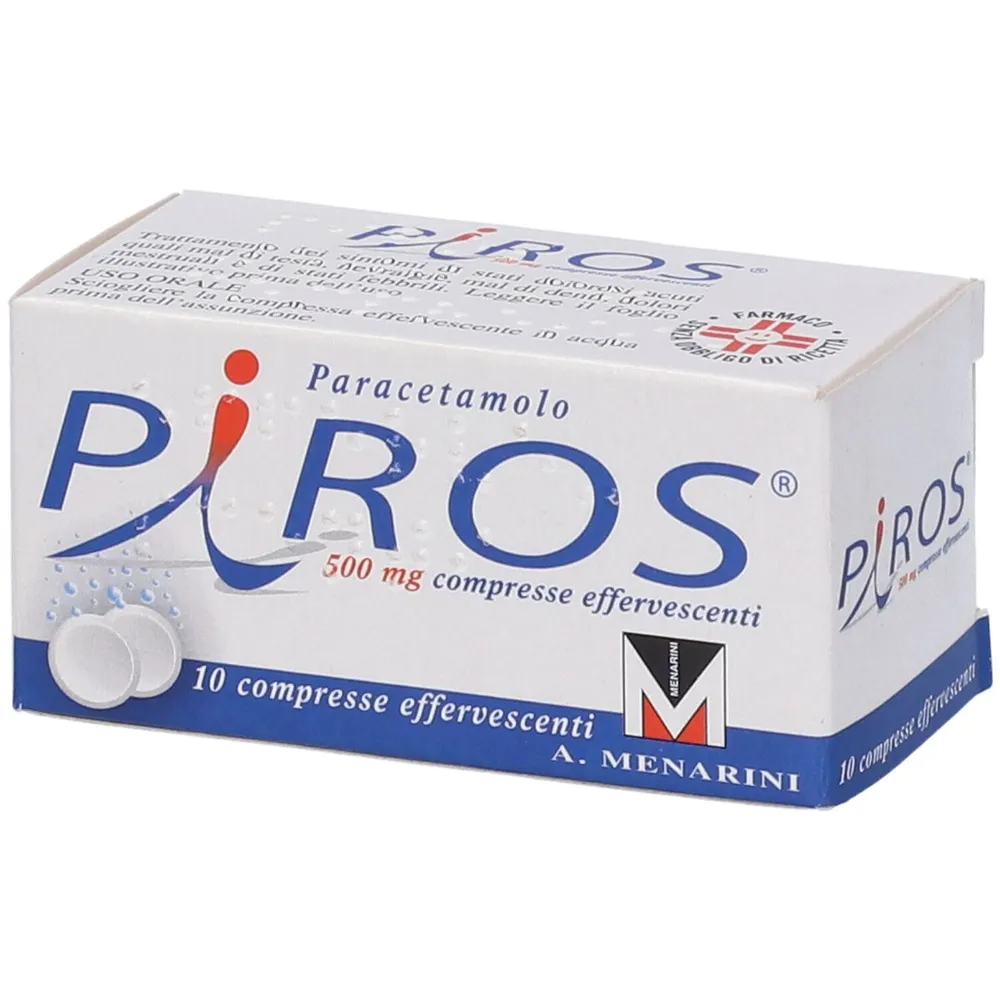
PIROS
ItalyPIROS contains paracetamol and is used to treat fever and for the symptomatic treatment of mild to moderate pain.
Frequently asked questions
Who can take PIROS and in which cases?
The medicinal product is indicated for adults, adolescents, and children with a body weight over 13 kg.
How should PIROS be taken?
Effervescent tablets should be dissolved in a glass of water and taken on a full stomach. The tablet should not be chewed or swallowed whole. For adults, the dose is 1 tablet every 4-6 hours, not exceeding 6 tablets per day. For children, the dose must be determined based on body weight.
When should this medicine not be taken?
You must not take the medicinal product if you are allergic to paracetamol, propacetamol hydrochloride, or any of the other ingredients. It is necessary to consult a doctor before use if you suffer from liver or kidney problems, hemolytic anemia, dehydration, malnutrition, or if you are a chronic consumer of alcohol.
What are the side effects of PIROS?
Skin reactions (such as urticaria, rashes, or redness) and allergic reactions (such as swelling of the face, lips, or throat) may occur. Other effects such as diarrhea, abdominal pain, dizziness, headache, or changes in liver and kidney function have also been reported.
Are there interactions with other medicines?
It is important to inform the doctor if you are taking other medications containing paracetamol, coumarin anticoagulants (such as warfarin), antibiotics (such as flucloxacillin or rifampicin), or drugs that induce liver enzymes. Use with certain anti-inflammatories requires extreme caution under medical supervision.
What to do if an excessive dose of PIROS is taken?
In case of accidental ingestion of an excessive dose, it is necessary to inform a doctor immediately or go to the nearest hospital, as it can cause serious liver damage.
Can it be used during pregnancy or breastfeeding?
During pregnancy, it can be used if necessary, using the lowest possible dose for the shortest possible time. Paracetamol passes into breast milk in small amounts and is considered compatible with breastfeeding, but must be used with caution.
Instructions for use
Package leaflet: Information for the user
PIROS 500 mg effervescent tablets
Paracetamol
Please read this leaflet carefully before taking this medicine because it contains
important information for you.
Always take this medicine exactly as described in this leaflet or as your doctor or
pharmacist has instructed you.
- Keep this leaflet. You may need to read it again.
- If you need more information or advice, consult your pharmacist.
- If you experience any side effect, including those not listed in this leaflet, talk to your doctor or pharmacist. See section 4.
- Talk to your doctor if you do not notice improvement or if you experience worsening of symptoms after 3 days.
Contents of this leaflet:
- What PIROS is and what it is used for
- What you need to know before taking PIROS
- How to take PIROS
- Possible side effects
- How to store PIROS
- Contents of the pack and other information
1. What PIROS is and what it is used for
PIROS contains the active substance paracetamol and is used as an antipyretic (fever reducer) and analgesic (pain reliever).
PIROS is used in adults, adolescents and children with a body weight above 13 kg for the treatment of fever symptoms and for the symptomatic treatment of mild to moderate pain.
Consult your doctor if you do not feel better or feel worse after 3 days of treatment.
2. What you should know before taking PIROS
Do not take PIROS
- If you are allergic to paracetamol or propacetamol hydrochloride (a precursor of paracetamol) or to any of the other ingredients of this medicine (listed in section 6).
Warnings and precautions
Talk to your doctor or pharmacist before taking PIROS.
Take PIROS with caution:
- if you chronically consume alcohol. Alcohol intake during treatment is not recommended
- if you suffer from anorexia (an eating disorder characterized by lack or reduction of appetite)
- if you suffer from bulimia (an eating disorder in which a person ingests excessive amounts of food and then uses various methods to eliminate it to avoid weight gain)
- if you suffer from cachexia (a condition characterized by extreme thinness, reduced muscle mass, and thinning of the skin due to chronic diseases)
- if you suffer from chronic malnutrition
- if you suffer from dehydration (severe loss of water/fluids from the body)
- if you suffer from hypovolemia (reduced blood volume circulating in the body)
- if you have glucose-6-phosphate dehydrogenase deficiency (a substance normally present in the human body; its deficiency may cause hemolytic anemia)
- if you suffer from hemolytic anemia (a blood disorder caused by the destruction of certain blood cells, red blood cells)
- if you have mild to moderate hepatocellular insufficiency (reduced liver function), including Gilbert's syndrome (a condition characterized by excessive production of bilirubin, a substance causing yellowish discoloration of the skin and eyes)
- if you suffer from severe liver problems
- if you have acute hepatitis (acute inflammation of the liver)
- if you are concurrently taking medicines that induce liver enzymes (increase liver activity)
- if you suffer from renal insufficiency (reduced kidney function)
Paracetamol may cause severe skin reactions which may be fatal. The use of PIROS must be discontinued at the first sign of skin rash or any other sign of hypersensitivity/allergy.
Use of high doses and/or prolonged use
Paracetamol may cause hepatotoxic and nephrotoxic effects. High or prolonged doses of paracetamol-containing products may lead to high-risk liver disease and serious adverse effects on the kidneys and blood. In such cases, your doctor will monitor liver and kidney function and blood composition through appropriate tests.
Prolonged use of analgesics (for more than 3 months) in patients with chronic headache, especially if taken frequently and repeatedly, may increase or worsen the headache. In such cases, medical advice should be sought.
Children and adolescents
This medicine can be given to children with a body weight above 13 kg and to adolescents (see section 3 “How to use PIROS”).
Other medicines and PIROS
Inform your doctor or pharmacist if you are taking, have recently taken, or might take any other medicines, including those without a prescription.
In particular, inform your doctor or pharmacist if you are taking:
- other medicines containing paracetamol, because serious adverse effects may occur if paracetamol is taken in high doses
- coumarin anticoagulants, including warfarin (medicines that delay blood coagulation); in this case, your doctor will perform more frequent monitoring of INR values (the time taken for blood to clot)
- flucloxacillin (an antibiotic), due to a serious risk of blood and fluid disorders (metabolic acidosis with high anion gap) requiring urgent treatment, which may particularly occur in cases of severe renal impairment, sepsis (when bacteria and their toxins circulate in the blood, leading to organ damage), malnutrition, chronic alcoholism, and when maximum daily doses of paracetamol are used
- medicines or substances that induce liver enzymes (increase liver activity), for example:
- rifampicin (an antibiotic)
- cimetidine (a medicine used in the treatment of gastric ulcer)
- antiepileptic medicines such as glutethimide, phenobarbital, carbamazepine, and phenytoin (medicines used to treat epilepsy). In case of treatment with phenytoin, do not take high or prolonged doses of paracetamol.
The use of PIROS is not recommended if you are being treated with anti-inflammatory medicines.
The use of these medicines together with PIROS requires extreme caution and should only be done under strict medical supervision:
- probenecid, a medicine used for the treatment of hyperuricemia (high concentration of uric acid in the blood) and gout (joint inflammation due to uric acid deposition): in this case, your doctor may advise reducing the dose of PIROS
- salicylamide (an analgesic and antipyretic medicine)
- chloramphenicol (an antibiotic): may increase the risk of possible adverse effects
- medicines that delay gastric emptying, such as anticholinergics: these medicines delay the effect of PIROS
- zidovudine (a medicine used to treat HIV)
Interference with blood tests
If you need to undergo blood tests, be aware that administration of paracetamol may interfere with the measurement of serum uric acid levels (uricemia) and blood glucose levels (glycemia).
PIROS and alcohol
Use PIROS with caution if you chronically consume alcohol, as there is a risk of toxicity (see sections “Warnings and precautions” and “If you take more PIROS than you should”).
Alcohol consumption during treatment is not recommended.
Pregnancy and breastfeeding
If you are pregnant, think you might be pregnant, planning a pregnancy, or breastfeeding, consult your doctor or pharmacist before taking this medicine.
Pregnancy
If necessary, PIROS may be used during pregnancy. It is advisable to use the lowest possible dose that relieves pain and/or fever, and to take it for the shortest possible time. Contact your doctor if pain and/or fever do not improve, or if you need to take the medicine more frequently.
Breastfeeding
Paracetamol passes into breast milk in small amounts. Skin rash has been reported in breastfed infants. However, paracetamol administration is considered compatible with breastfeeding. Nevertheless, paracetamol should be used with caution in breastfeeding women.
Driving and using machines
PIROS does not affect the ability to drive or operate machinery.
PIROS contains sorbitol, sucrose, and sodium.
This medicine contains 540 mg of sorbitol per dose. Sorbitol is a source of fructose. If your doctor has told you that you (or the child) have an intolerance to certain sugars, or if you have been diagnosed with hereditary fructose intolerance, a rare genetic disorder in which patients cannot metabolize fructose, speak with your doctor before you (or the child) take this medicine.
This medicine contains sucrose. If your doctor has diagnosed you with an intolerance to certain sugars, contact your doctor before taking this medicine.
This medicine contains 333 mg of sodium (the main component of table salt) per dose. This corresponds to 16.7% of the maximum daily dietary intake recommended for an adult.
Talk to your doctor or pharmacist if you need one or more doses per day for a prolonged period, especially if you have been advised to follow a low-sodium diet.
3. How to take PIROS
Take this medicine exactly as stated in this leaflet or as instructed by your doctor or pharmacist. If you have any doubts, consult your doctor or pharmacist.
To avoid the risk of overdose, check that other medicines you are taking (with or without a prescription) do not contain paracetamol.
Accidental overdose of paracetamol may cause severe liver damage and death (see section “If you take more PIROS than you should”).
Adults
The recommended dose is 1 tablet per dose, which may be repeated if necessary after an interval of at least 4 hours, without exceeding 6 tablets per day.
In the case of more severe pain, two tablets may be taken at a time, up to a maximum of 3 times per day, always respecting an interval of at least 4 hours between doses.
Elderly
Dosage in elderly patients must be carefully determined by the doctor, who may consider reducing the doses indicated above.
Use in children and adolescents
In children, it is essential to follow the dose based on their body weight. The table below showing the correspondence between weight and age is only indicative; therefore, consider body weight:
| WEIGHT | APPROXIMATE AGE | DOSE | HOW MANY TIMES A DAY? | MAXIMUM DAILY DOSE (within 24 hours) |
|---|---|---|---|---|
| 13–20 kg | 2–7 years | Half a tablet | Repeat, if necessary, after an interval of at least 6 hours | 3 half tablets for children weighing less than 15 kg and 4 half tablets for children weighing 15 kg or more |
| 21–25 kg | 6–10 years | Half a tablet | Repeat, if necessary, after an interval of at least 6 hours | 5 half tablets per day for children weighing less than 25 kg and 6 half tablets per day for children weighing 25 kg or more |
| 26–40 kg | 8–13 years | 1 tablet | Repeat, if necessary, after an interval of at least 6 hours | 4 tablets |
| Over 40 kg | Over 12 years | 1 tablet | Repeat, if necessary, after an interval of at least 4 hours | 6 tablets |
It is important to take PIROS at regular intervals to avoid fluctuations in pain and/or fever levels.
In children, the interval between doses should preferably be at least 6 hours.
In adults and adolescents, the interval between doses must be at least 4 hours.
Recommended maximum dosage
In adults and adolescents weighing more than 40 kg, the maximum dose is 3 g of paracetamol per day.
Patients with kidney disease
If the person taking the medicine suffers from kidney disease, the interval between doses must be at least 8 hours. Do not exceed 3 g of paracetamol per day, equivalent to 6 tablets.
Patients with liver disease
If the person taking the medicine suffers from reduced liver function, the dose should be reduced or the interval between doses prolonged.
The maximum dose must not exceed 4 tablets per day in the following cases: adult patients weighing less than 50 kg, liver disease, Gilbert's syndrome, chronic alcoholism, chronic malnutrition, or dehydration.
Duration of treatment
Do not administer PIROS for more than 3 consecutive days without consulting a doctor.
Instructions for use
For oral use.
Take the medicine with food.
Dissolve the effervescent tablet in a glass of water, stirring with a teaspoon if necessary. Do not chew or swallow the tablet whole.
If you take more PIROS than you should
In case of accidental ingestion/overdose of PIROS, immediately inform your doctor or go to the nearest hospital.
Taking an excessive dose of paracetamol increases the risk of poisoning and can lead to death, especially if the person taking the medicine:
- suffers from liver disease
- abuses alcohol
- suffers from chronic malnutrition
- is taking medicines or substances that stimulate liver enzymes (increasing liver activity).
Symptoms
In case of accidental ingestion of very high doses of paracetamol, symptoms that may appear within the first 24 hours include: nausea, vomiting, anorexia (lack or reduction of appetite), pallor, malaise, diaphoresis (intense sweating), and abdominal pain.
Cases of acute pancreatitis have been reported.
Furthermore, taking an excessive dose of paracetamol may cause hepatic cytolysis (destruction of liver cells), which may progress to massive and irreversible necrosis (cell death) and serious kidney and blood abnormalities, appearing 12 to 48 hours after ingestion.
In cases of ingestion of 7.5 g or more of paracetamol in adults and 140 mg per kg of body weight in children, severe liver damage may occur, leading to altered results in certain blood tests (AST, ALT, lactate dehydrogenase, bilirubin, prothrombin), coma (deep unconscious state), or death.
Symptoms of liver damage peak after 3–4 days.
Treatment
Depending on the nature and severity of symptoms, the doctor will provide appropriate supportive therapy.
Emergency measures include early gastric emptying (gastric lavage) to remove the ingested product, and possibly forced diuresis and hemodialysis.
As antidotes, conjugating agents such as N-acetylcysteine or cysteamine may be administered promptly by intravenous (into the vein) route.
If you forget to take PIROS
Do not take a double dose to make up for the missed dose.
If you have any doubts about using this medicine, consult your doctor or pharmacist.
4. Possible side effects
Like all medicines, this medicine can cause side effects, although not everybody gets them.
If the person taking this medicine experiences any of the following side effects, STOP using this
medicine immediately and contact a doctor straight away:
-
- Skin reactions which may include:
- urticaria (appearance of itchy skin welts),
- skin rash,
- erythema (redness of the skin),
- erythema multiforme (skin inflammation, appearance of red spots on the skin with a "target-like" appearance associated with itching),
- purpura (appearance of purplish skin patches of various sizes),
- Stevens-Johnson syndrome (a serious skin condition characterized by skin peeling),
- toxic epidermal necrolysis (a severe toxic skin reaction characterized by redness, blistering, skin detachment and skin death),
- generalized pustular eruption (an eruption of hundreds of superficial pustules spread across the entire body).
- Allergic reactions which may include:
- angioedema (swelling of hands, feet, ankles, face, lips, tongue and/or throat),
- laryngeal edema (swelling of the larynx),
- anaphylactic reaction (severe allergic reaction) including hypotension (low blood pressure),
- hypersensitivity,
- anaphylactic shock (severe allergic reaction).
In addition, the following side effects may occur, for which insufficient data are available to determine frequency:
o thrombocytopenia (decreased number of platelets in the blood),
o leucopenia/agranulocytosis/neutropenia (conditions characterized by a reduction in the number of white blood cells and granulocytes in the blood),
o anemia (reduction in hemoglobin in the blood, the substance that carries oxygen in the blood),
o diarrhea,
o abdominal pain,
o stomach and intestinal disturbances,
o changes in liver function,
o hepatitis (inflammation of the liver),
o changes in INR (a value used to express the time it takes for blood to clot),
o increased liver enzymes,
o headache, acute renal failure (reduced kidney function),
o interstitial nephritis (a serious inflammatory kidney disease),
o hematuria (presence of blood in urine),
o anuria (cessation or reduction of urine production by the kidneys).
o dizziness.
These side effects are generally temporary.
Following the instructions provided in this leaflet reduces the risk of side effects.
Reporting of side effects
If you experience any side effect, including those not listed in this leaflet, please contact your doctor or pharmacist. You may also report side effects directly via the national reporting system at https://www.aifa.gov.it/content/segnalazioni-reazioni-avverse . Reporting side effects helps provide more information on the safety of this medicine.
5. How to store PIROS
Keep this medicine out of the sight and reach of children.
Do not use this medicine after the expiry date stated on the packaging. The expiry date refers to the last day of that month and applies to the product in its original, unopened packaging stored under proper conditions.
This medicine does not require any special storage conditions.
Do not dispose of any medicine via wastewater or household waste. Ask your pharmacist how to dispose of medicines you no longer use. This will help protect the environment.
6. Contents of the pack and other information
What PIROS contains
1 effervescent tablet contains:
Active substance: Paracetamol 500 mg.
Other components: Polyvinylpyrrolidone, sorbitol, sucrose monopalmitate, sodium saccharin,
sodium bicarbonate, anhydrous citric acid, orange flavour (see section 2 “What you need to know
before taking PIROS”).
Description of the appearance of PIROS and contents of the pack
PIROS is available as effervescent tablets for oral use.
Pack contents: 10 effervescent tablets.
Marketing Authorization Holder
A. Menarini Industrie Farmaceutiche Riunite s.r.l., via Sette Santi n. 3, Florence.
Manufacturer
E-Pharma Trento S.p.A., Via Provina, 2, Ravina (TN).
Similar drugs
| Brand name | Dosage form | Active substance / Dosage | Manufacturer |
|---|---|---|---|
| ADOLEF | tablets, effervescent | BIOMED PHARMA S.R.L. | |
| EFFERALGAN | tablets, effervescent | UPSA SAS | |
| EFFERAMOL | tablets, effervescent | SO.SE.PHARM S.R.L. SOCIETA' DI SERVIZIO PER L'INDUSTRIA FARMACEUTICA ED AFFINI | |
| PARACETAMOL FARMAKOPEA | tablets, effervescent | FARMAKOPEA S.P.A. | |
| PARACETAMOL MYLAN PHARMA | tablets, effervescent | MYLAN S.P.A. | |
| PARACETAMOL RATIOPHARM | tablets, effervescent | RATIOPHARM GMBH |
The original data is available in the language of the country of manufacture.
Data source: Italian Medicines Agency (AIFA)
Data last verified: September 21, 2026