ORSERDU
ItalyThis medicinal product is used to treat postmenopausal women and adult men with a specific type of advanced or metastatic breast cancer. It is indicated for estrogen receptor (ER)-positive and HER2-negative tumors in patients presenting ESR1 gene mutations who have not responded to other hormonal treatments.
Frequently asked questions
How should ORSERDU be taken?
The recommended dose is 345 mg once daily, but the doctor may prescribe lower doses based on individual needs. Tablets should be swallowed whole, without being chewed or divided, and must be taken with food to reduce nausea and vomiting. It is advisable to take them every day at approximately the same time.
Are there any foods or drinks to avoid during treatment?
Yes, grapefruit and grapefruit juice must be avoided, as they can increase the amount of the drug in the body and increase the risk of side effects.
When should this medicine not be taken?
It must not be used if you are allergic to the active substance or to any of its components. This medicinal product is not intended for children and adolescents under 18 years of age. Furthermore, it must not be taken during pregnancy or breastfeeding.
What are the main side effects of ORSERDU?
Very common side effects include nausea, vomiting, fatigue, diarrhea, constipation, headache, hot flashes, joint or abdominal pain, and reduced appetite. Weakness, cough, dizziness, and difficulty sleeping are also common. In less common cases, risks of blood clots or liver failure have been reported.
Can I take other medicines together with this treatment?
It is important to inform your doctor if you are taking any other medicines, as ORSERDU may affect them or be affected by them. Medicines that should be reported include certain antibiotics, drugs for depression or anxiety, medicines for the treatment of other cancers, blood pressure medications, antifungals, and St. John's Wort.
What should I do if I forget a dose?
If you remember within 6 hours of the scheduled time, you can take the forgotten dose. If more than 6 hours have passed or if vomiting has occurred after taking the dose, you must skip the dose and wait until the next day, never taking a double dose to compensate.
Instructions for use
Package leaflet: Information for the patient
ORSERDU 86 mg film-coated tablets, 345 mg film-coated tablets
elacestrant
This medicinal product is subject to additional monitoring. This will allow for rapid identification of new safety information. You can help by reporting any side effects you experience while taking this medicine. See the end of section 4 for information on how to report side effects.
Please read this leaflet carefully before taking this medicine, as it contains important information for you.
- Keep this leaflet. You may need to read it again.
- If you have any questions, ask your doctor or pharmacist.
- This medicine has been prescribed for you only. Do not pass it on to other people, even if their symptoms are the same as yours, as it may be harmful.
- If you experience any side effect, including those not listed in this leaflet, contact your doctor, pharmacist, or nurse. See section 4.
Contents of this leaflet
- What ORSERDU is and what it is used for
- What you need to know before taking ORSERDU
- How to take ORSERDU
- Possible side effects
- How to store ORSERDU
- Contents of the pack and other information
1. What ORSERDU is and what it is used for
What ORSERDU is
ORSERDU contains the active substance elacestrant, which belongs to a group of medicines called
selective estrogen receptor degraders.
What ORSERDU is used for
This medicine is used to treat postmenopausal women and adult men who have a specific type of advanced or metastatic breast cancer (cancer that has spread to other parts of the body). It may be used to treat estrogen receptor-positive (ER+) breast cancer, meaning that the cancer cells have estrogen hormone receptors on their surface, and human epidermal growth factor receptor 2-negative (HER2-negative) breast cancer, meaning that the cancer cells do not have this receptor on their surface or have only a small amount.
ORSERDU is used as monotherapy (i.e. alone) in patients whose tumour has not responded or has progressed after at least one line of prior hormonal therapy that included a CDK4/6 inhibitor, and who have specific alterations (mutations) in a gene called ESR1.
Your doctor will take a blood sample which will be tested to detect the presence of ESR1 gene mutations. A positive test result is required before starting treatment with ORSERDU.
How ORSERDU works
Estrogen receptors are a group of proteins found inside cells. They are activated when estrogen hormones bind to them. In some cases, estrogens binding to these receptors can stimulate the growth and multiplication of cancer cells. ORSERDU contains the active substance elacestrant, which binds to estrogen receptors in cancer cells, preventing them from functioning. By blocking and destroying estrogen receptors, ORSERDU can reduce the growth and spread of breast cancer and help kill cancer cells.
If you have any questions about how ORSERDU works or why this medicine has been prescribed for you, please consult your doctor, pharmacist, or nurse.
2. What you should know before taking ORSERDU
Do not use ORSERDU
- if you are allergic to elacestrant or to any of the other ingredients of this medicine (listed in section 6).
Warnings and precautions
Talk to your doctor or pharmacist before taking ORSERDU
- if you have a liver disease (such as cirrhosis [scarring of the liver], impaired liver function, or cholestatic jaundice [yellowing of the skin and eyes due to reduced bile flow from the liver]). Your doctor will monitor you closely and regularly to detect any possible adverse reactions.
Since you have advanced breast cancer, you may be at increased risk of developing blood clots in the veins. It is not known whether ORSERDU also increases this risk.
Children and adolescents
ORSERDU must not be given to children and adolescents under 18 years of age.
Other medicines and ORSERDU
Inform your doctor or pharmacist if you are taking, have recently taken, or might take any other medicines. ORSERDU may affect the action of other medicines. In addition, some other medicines may affect the action of ORSERDU.
Inform your doctor if you are taking any of the following medicines:
- antibiotics used to treat bacterial infections (e.g. ciprofloxacin, clarithromycin, erythromycin, rifampicin, telithromycin)
- medicines for low sodium levels in the blood (e.g. conivaptan)
- medicines for depression (e.g. nefazodone or fluvoxamine)
- medicines for anxiety and alcohol withdrawal (e.g. tofisopam)
- medicines for treating other cancers (e.g. crizotinib, dabrafenib, imatinib, lorlatinib, or sotorasib)
- medicines for high blood pressure or chest pain (e.g. bosentan, diltiazem, or verapamil)
- medicines for fungal infections (e.g. fluconazole, isavuconazole, itraconazole, ketoconazole, posaconazole, or voriconazole)
- medicines for HIV infection (e.g. efavirenz, etravirine, indinavir, lopinavir, ritonavir, nelfinavir, saquinavir, or telaprevir)
- medicines for heart rhythm disorders (e.g. digoxin, dronedarone, or quinidine)
- medicines used after organ transplant to prevent rejection (e.g. cyclosporine)
- medicines to prevent cardiovascular events and to treat high cholesterol levels (e.g. rosuvastatin)
- medicines used to prevent epileptic seizures (e.g. carbamazepine, cenobamate, phenobarbital, phenytoin, or primidone)
- medicines for nausea and vomiting (e.g. aprepitant)
- herbal remedies used to treat depression containing St. John’s wort (Hypericum perforatum)
ORSERDU with food and drink
Do not drink grapefruit juice or eat grapefruit during treatment with ORSERDU, as this may alter the amount of ORSERDU in your body and increase the risk of side effects (see section 3 “How to take ORSERDU”).
Pregnancy, breast-feeding and fertility
This medicine should only be used in postmenopausal women and in men.
Pregnancy
ORSERDU may harm the unborn baby. If you are pregnant, suspect you may be pregnant, or are planning to become pregnant, you must not take ORSERDU. If you suspect you may be pregnant or are planning a pregnancy, consult your doctor or pharmacist before using this medicine.
If you are a woman of childbearing potential, you must use an effective method of contraception during treatment with ORSERDU and for one week after stopping treatment with ORSERDU. Ask your doctor which methods are suitable. If you are a woman of childbearing potential, your doctor will exclude pregnancy before starting treatment with ORSERDU. This may involve undergoing a pregnancy test.
Breast-feeding
You must not breast-feed during treatment with ORSERDU and for one week after the last dose of ORSERDU. Your doctor will discuss with you the potential risks of taking ORSERDU during pregnancy or while breast-feeding.
Fertility
ORSERDU may impair fertility in both women and men.
Driving and using machines
ORSERDU does not affect or has a negligible effect on the ability to drive or operate machinery. However, since fatigue, weakness, and difficulty sleeping have been reported in some patients taking elacestrant, patients experiencing these adverse reactions should exercise caution when driving or operating machinery.
3. How to take ORSERDU
Take this medicine exactly as instructed by your doctor or pharmacist. If you
have any doubts, consult your doctor or pharmacist.
ORSERDU must be taken with food, but avoid grapefruit and grapefruit juice during treatment with
ORSERDU (see section 2 “ORSERDU with food and drink”). Taking ORSERDU with food may help reduce
nausea and vomiting.
Take your dose of this medicine at about the same time each day. This will help you remember to take
the medicine.
ORSERDU tablets must be swallowed whole. Do not chew, crush, or divide the tablets before
swallowing. Do not take a broken, cracked, or damaged tablet.
The recommended dose of ORSERDU is 345 mg (one 345 mg film-coated tablet) once daily. Your
doctor will tell you exactly how many tablets to take. In certain situations, such as liver problems,
unwanted side effects, or if you are also taking certain other medicines, your doctor may instruct you
to take a lower dose of ORSERDU, for example 258 mg (three 86 mg tablets) once daily, 172 mg (two
86 mg tablets) once daily, or 86 mg (one 86 mg tablet) once daily.
If you take more ORSERDU than you should
If you think you have accidentally taken more ORSERDU than you should, inform your doctor or
pharmacist, who will decide on the appropriate course of action.
If you forget to take ORSERDU
If you forget to take a dose of ORSERDU, take it as soon as you remember. You may still take the
missed dose if less than 6 hours have passed since the scheduled time. If more than 6 hours have
passed, or if you vomit after taking the dose, skip the missed dose and take the next dose at the usual
time the following day. Do not take a double dose to make up for a missed dose.
If you stop taking ORSERDU
Do not stop using this medicine without first talking to your doctor or pharmacist. If treatment with
ORSERDU is stopped, your condition may worsen.
If you have any questions about how to use this medicine, ask your doctor or pharmacist.
4. Possible side effects
Like all medicines, this medicine can cause side effects, although not everybody gets them.
If you notice any of the following side effects, tell your doctor or nurse:
Very common (may affect more than 1 in 10 people)
- reduced appetite
- feeling unwell (nausea)
- increased levels of triglycerides and cholesterol in the blood
- vomiting
- fatigue
- indigestion (dyspepsia)
- diarrhoea
- decreased levels of calcium in the blood
- back pain
- increased levels of creatinine in the blood
- joint pain (arthralgia)
- decreased levels of sodium in the blood
- constipation
- headache
- hot flushes
- abdominal pain
- low red blood cell count, detected in blood tests (anaemia)
- decreased levels of potassium in the blood
- increased liver function tests, detected in blood tests (increased alanine aminotransferase, increased aspartate aminotransferase)
Common (may affect up to 1 in 10 people)
- pain in hands or legs (limb pain)
- weakness (asthenia)
- urinary tract infection
- cough
- shortness of breath (dyspnoea)
- difficulty falling asleep and staying asleep (insomnia)
- increased liver function tests, detected in blood tests (increased alkaline phosphatase in blood)
- rash
- low lymphocyte count (a type of white blood cells), detected in blood tests (decreased lymphocyte count)
- bone pain
- dizziness
- chest pain involving the muscles and bones of the chest (musculoskeletal chest pain)
- inflammation of the mouth and lips (stomatitis)
- fainting (syncope)
Uncommon (may affect up to 1 in 100 people)
- increased risk of blood clots (thromboembolism)
- liver failure (acute hepatic failure)
Reporting of side effects
If you get any side effects, including ones not listed in this leaflet, talk to your doctor, pharmacist or nurse.
You can also report side effects directly via the national reporting system listed in Annex V. By reporting side effects you can help provide more information on the safety of this medicine.
5. How to store ORSERDU
Keep this medicine out of the sight and reach of children.
Do not use this medicine after the expiry date stated on the carton and on the blister pack after “Exp.”. The expiry date refers to the last day of that month.
This medicine does not require any special storage conditions.
Do not use this medicine if you notice any signs of damage to the packaging or any signs of tampering.
Do not dispose of medicines via wastewater or household waste. Ask your pharmacist how to dispose of medicines you no longer use. This will help protect the environment.
6. Package contents and other information
What ORSERDU contains
- The active substance is elacestrant. * Each ORSERDU 86 mg film-coated tablet contains 86.3 mg of elacestrant. * Each ORSERDU 345 mg film-coated tablet contains 345 mg of elacestrant.
* The other components are:
Tablet core
microcrystalline cellulose (E460)
silicified microcrystalline cellulose
crospovidone (E1202)
magnesium stearate (E470b)
colloidal anhydrous silica (E551)
Film coating
Opadry II 85F105080 blue containing polyvinyl alcohol (E1203), titanium dioxide (E171),
macrogol (E1521), talc (E553b) and Brilliant Blue FCF – aluminium lake (E133)
Description of the appearance of ORSERDU and pack contents
ORSERDU is supplied as film-coated tablets in aluminium blisters.
ORSERDU 86 mg film-coated tablets
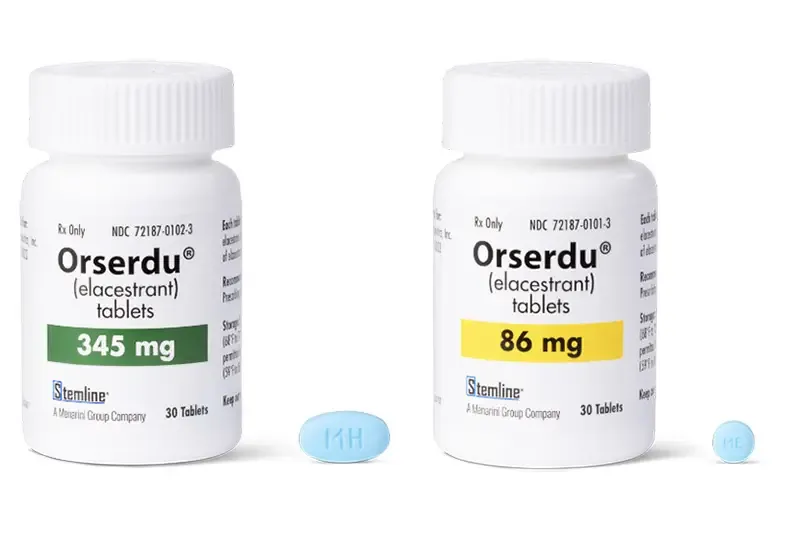
Film-coated, round, biconvex tablet, blue to sky-blue in colour, with "ME" imprinted on one side and plain on the other side. Approximate diameter: 8.8 mm.
ORSERDU 345 mg film-coated tablets
Film-coated, oval, biconvex tablet, blue to sky-blue in colour, with "MH" imprinted on one side and plain on the other side. Approximate dimensions: 19.2 mm (length), 10.8 mm (width).
Each pack contains 28 film-coated tablets (4 blisters containing 7 tablets each).
Marketing Authorisation Holder
Stemline Therapeutics B.V.
Basisweg 10
1043 AP Amsterdam
The Netherlands
Manufacturer
Stemline Therapeutics B.V.
Basisweg 10
1043 AP Amsterdam
The Netherlands
or
Berlin Chemie AG
Glienicker Weg 125
12489 Berlin
Germany
For further information on this medicinal product, please contact the local representative of the Marketing Authorisation Holder:
België/Belgique/Belgien ; България ; Italia ; Česká republika ; Danmark ; Eesti ; Ελλάδα ; Hrvatska ; Ireland ; Ísland ; Κύπρος ; Latvija ; Lietuva ; Luxembourg/Luxemburg ; Magyarország ; Malta ; Nederland ; Norge ; Polska ; Portugal ; România ; Slovenija ; Slovenská republika ; Suomi/Finland ; Sverige
Menarini Stemline Italia S.r.l.
Tel: +39 800776814
[email protected]
Deutschland ; Österreich
Menarini Stemline Deutschland GmbH
Stemline Therapeutics B.V.
Tel: +49 (0)800 0008974
Tel: +43 (0)800 297 649
[email protected]
España
Menarini Stemline España, S.L.U.
Tel: +34 919 490 327
[email protected]
France
Stemline Therapeutics B.V.
Tél: +33 (0)800 991 014
[email protected]
More detailed information on this medicinal product is available on the European Medicines Agency website: http://www.ema.europa.eu/.
The original data is available in the language of the country of manufacture.
Data source: Italian Medicines Agency (AIFA)
Data last verified: September 21, 2026