ONTOZRY
ItalyIt is used in adults to treat a type of epilepsy that manifests with focal onset seizures, in association with other anti-epileptic medicines, when previous treatment has not been sufficient.
Frequently asked questions
When should you not take Ontozry?
You must not take this medicine if you are allergic to cenobamate or any of its other ingredients, or if you suffer from congenital heart problems related to familial short QT syndrome.
How should Ontozry be taken correctly?
The dose should be taken once daily, at approximately the same time, with or without food. The doctor will establish a gradual dosage plan starting at 12.5 mg for the first two weeks, then 25 mg for the following two, until reaching the optimal dose (generally between 200 mg and 400 mg per day). Tablets should be swallowed whole with water; they may also be crushed and mixed with water or administered via a nasogastric tube.
What are the common side effects of Ontozry?
Very common side effects include drowsiness, extreme fatigue, dizziness, lightheadedness, headache, and problems with coordination or balance. Common side effects also reported include nausea, vomiting, constipation, diarrhea, dry mouth, skin rashes, swelling, and possible changes in vision or memory.
Are there serious side effects to be concerned about?
Yes. You must contact a doctor immediately in case of severe skin reactions (which may include fever, rashes on the face or body, and swollen glands) or if you experience thoughts of self-harm or suicide.
Can I take other medicines or drink alcohol while taking this medicine?
It is essential to inform your doctor if you are taking other medicines, such as barbiturates, benzodiazepines, certain anti-epileptics, or oral contraceptives (which may become less effective), as the dose may need to be adjusted. You should not consume alcohol during treatment, as it can increase drowsiness and fatigue.
What should I do if I forget a dose?
If less than 12 hours have passed since the scheduled time, take the forgotten dose. If more than 12 hours have passed, skip the dose and resume the next one at the usual time. Do not take a double dose to make up for it.
Instructions for use
Table of contents
- Ontozry 12.5 mg tablets, 25 mg film-coated tablets, 50 mg film-coated tablets, 100 mg film-coated tablets, 150 mg film-coated tablets, 200 mg film-coated tablets
- 1. What Ontozry is and what it is used for
- 2. What you need to know before taking Ontozry
- 3. How to take Ontozry
- 4. Possible side effects
- 5. How to store Ontozry
- 6. Package contents and other information
Package leaflet: Information for the patient
Ontozry 12.5 mg tablets, 25 mg film-coated tablets, 50 mg film-coated tablets, 100 mg film-coated tablets, 150 mg film-coated tablets, 200 mg film-coated tablets
cenobamate
This medicinal product is subject to additional monitoring. This will allow rapid identification of new safety information. You can help by reporting any adverse reactions you experience while taking this medicine. See the end of section 4 for information on how to report adverse reactions.
Please read this leaflet carefully before taking this medicine, as it contains important information for you.
- Keep this leaflet. You may need to read it again.
- If you have any questions, ask your doctor or pharmacist.
- This medicine has been prescribed for you only. Do not give it to others, even if their symptoms are the same as yours, as it may be harmful.
- If you experience any adverse reaction, including those not listed in this leaflet, consult your doctor or pharmacist. See section 4.
Contents of this leaflet
- What Ontozry is and what it is used for
- What you need to know before taking Ontozry
- How to take Ontozry
- Possible side effects
- How to store Ontozry
- Contents of the pack and other information
1. What Ontozry is and what it is used for
Ontozry contains the active substance cenobamate. It belongs to a group of medicines called
antiepileptics. These medicines are used to treat epilepsy, a condition in which seizures occur due to
abnormal brain activity.
Ontozry is used in combination with other antiepileptic medicines in adult patients with epilepsy who
have not been adequately controlled despite prior treatment with at least two antiepileptic medicines,
to treat a type of epilepsy characterized by focal onset seizures with or without secondary
generalization. Focal onset seizures are those caused by abnormal brain activity starting in one area of
the brain, on one side, while secondary generalization means that the abnormal activity spreads to both
sides of the brain. The medicine can only be used in adults.
2. What you need to know before taking Ontozry
Do not take Ontozry
- if you are allergic to cenobamate or to any of the other ingredients of this medicine (listed in section 6)
- if you have a congenital heart condition with changes in the heart's electrical activity, related to a rare condition called familial short QT syndrome.
Warnings and precautions
Talk to your doctor or pharmacist before taking Ontozry or during treatment if:
- you have any thoughts of self-harm or suicide at any time. Some people treated with antiepileptic medicines such as Ontozry have had thoughts of self-harm or suicide. If you have any such thoughts at any time, contact your doctor immediately
- you develop a serious skin reaction which may include high temperature and flu-like symptoms, rash on the face, rash spreading to other parts of the body, swollen glands (swollen lymph nodes), and blood tests showing increased levels of liver enzymes and of a type of white blood cell (eosinophilia).
Children and adolescents
Ontozry is not recommended in children and adolescents under 18 years of age, as it has not been studied in this age group.
Other medicines and Ontozry
Tell your doctor or pharmacist if you are taking, have recently taken, or might take any other medicines.
Taking Ontozry together with certain other medicines may affect how those medicines work or how Ontozry works. Do not start or stop any other medicines without talking to your doctor or pharmacist.
Tell your doctor if you are taking any of the following medicines, as dose adjustment may be necessary:
- medicines used to help sleep, such as barbiturates and benzodiazepines
- other medicines for treating epilepsy, such as clobazam, phenytoin and phenobarbital, lamotrigine
- medicines for birth control (oral contraceptives), as these may become less effective when taken together with Ontozry. Your doctor may prescribe alternative methods to prevent pregnancy while you are taking this medicine and for up to 4 weeks after stopping it
- medicines known to be metabolized in the body by specific enzyme groups, such as midazolam (a medicine used to stop prolonged, acute (sudden) seizures, for sedation, and for insomnia), bupropion (a medicine used to help stop smoking), omeprazole (a medicine used to treat heartburn or stomach ulcer), baricitinib (a medicine used to treat painful joint inflammation or skin eczema), cefaclor (an antibiotic), empagliflozin (a medicine used to treat high blood sugar in diabetes), penicillin G (an antibiotic), ritobegron (a medicine used to treat overactive bladder), sitagliptin (a medicine used to control high blood sugar in diabetes).
Ontozry and alcohol
Do not take this medicine with alcohol. Ontozry may increase the effects of alcohol, such as feeling tired or drowsy; you should not drink alcohol while taking this medicine.
Pregnancy and breastfeeding
If you are pregnant, think you might be pregnant, planning to become pregnant, or breastfeeding, ask your doctor or pharmacist for advice before taking this medicine.
Take Ontozry during pregnancy only if you and your doctor consider it absolutely necessary.
You must use an effective method of contraception while taking cenobamate and for up to 4 weeks after stopping this medicine. Ask your doctor for advice on effective contraceptive measures.
You must stop breastfeeding while taking Ontozry.
Driving and using machines
- While taking Ontozry, you may experience drowsiness, dizziness, fatigue, or blurred vision.
- These effects are more likely at the beginning of treatment or after an increase in dose.
- Do not drive, ride a bicycle, or operate tools or machinery if your reactions are slowed, and until you know how this medicine affects you.
Ontozry contains lactose
If your doctor has diagnosed you with an intolerance to certain sugars, consult him/her before taking this medicine.
3. How to take Ontozry
Take this medicine exactly as directed by your doctor. If you have any doubts, consult your doctor or pharmacist.
You will take Ontozry together with other medicines to treat epilepsy.
Recommended dose
You will start Ontozry with a daily dose of one 12.5 mg tablet for the first 2 weeks, followed by one 25 mg tablet once daily for the next 2 weeks. Afterwards, your dose will be gradually adjusted every 2 weeks until the dose providing the best effect is reached. Your doctor will determine the correct daily dose for you and may need to modify it over time.
The recommended daily dose ranges from 200 mg to 400 mg taken once daily.
Method of administration
Take the recommended dose once daily, approximately at the same time each day. You may take Ontozry at any time of day or evening, with or without food.
Swallow the tablets whole with a glass of water. Do not break the tablets in half, as they are not suitable to be divided into equal parts.
The tablet may be taken whole or may be crushed. The crushed tablet can be mixed with water and administered orally or via nasogastric tube (NGT).
Administration of crushed tablets via nasogastric tube (NGT)
Crushed Ontozry tablets may be mixed with water and administered via feeding nasogastric tube (NGT) as follows:
- Crush the appropriate number of tablets corresponding to the prescribed dose.
- In a suitable container, mix the crushed tablet(s) with 25 mL of water.
- Shake to obtain a suspension of the crushed tablet(s).
- Ensure no residue remains in the container; administer the suspension via a syringe into the NGT.
- Refill the catheter syringe with 10 mL of water, gently swirl, and administer.
- Visually check that no residue remains in the syringe. If residue is present, repeat step 5.
For further information, contact your doctor.
If you take more Ontozry than you should
Speak to your doctor. You may experience dizziness, fatigue, and somnolence.
If you forget to take Ontozry
Take the missed dose as soon as you remember, provided that less than 12 hours have passed since the scheduled time. If more than 12 hours have passed, skip the missed dose and take the next dose at the usual time. Do not take a double dose to make up for the forgotten dose.
If you stop taking Ontozry
Do not reduce the dose or stop taking Ontozry without consulting your doctor. Your doctor will explain how to discontinue Ontozry by gradually reducing the dose.
If you have any questions about the use of this medicine, consult your doctor or pharmacist.
4. Possible side effects
Like all medicines, this medicine can cause side effects, although not everyone gets them.
Immediately contact your doctor if you experience any of the following serious side effects:
Rare side effects (may affect up to 1 in 1,000 people):
- severe skin reaction which may include fever and other flu-like symptoms, rash on the face, rash spreading to other areas of the body, and swelling of the glands (swollen lymph nodes). Blood tests may show increased levels of liver enzymes and of a type of white blood cells (eosinophilia).
The following side effects may also occur with this medicine. Inform your doctor if you experience any of the following:
Very common side effects (may affect more than 1 in 10 people):
- feeling sleepy, sedated, or extremely tired
- dizziness
- vertigo
- problems with coordination of movement, difficulty walking or maintaining balance (ataxia, gait disturbance, abnormal coordination)
- headache
Common side effects (may affect up to 1 in 10 people):
- reduced memory, confusion
- excitability
- difficulty speaking or forming words
- rapid, involuntary eye movements (nystagmus), blurred vision, double vision
- nausea, vomiting, constipation or diarrhoea
- dry mouth
- skin rash, itching
- swelling of the eyelids, swelling of the limbs
- blood tests showing increased levels of certain liver enzymes
Uncommon side effects (may affect up to 1 in 100 people):
- allergic reactions
- thoughts of self-harm or suicide
Reporting of side effects
If you experience any side effect, including those not listed in this leaflet, talk to your doctor or pharmacist. You can also report side effects directly via the national reporting system listed in Annex V. By reporting side effects, you can help provide more information on the safety of this medicine.
5. How to store Ontozry
Keep this medicine out of the sight and reach of children.
Do not use this medicine after the expiry date stated on the carton and blister after
Exp. The expiry date refers to the last day of that month.
This medicine does not require any special storage conditions.
Do not dispose of medicines via wastewater or household waste. Ask your pharmacist how to
dispose of medicines you no longer use. This will help protect the environment.
6. Package contents and other information
What Ontozry contains
- The active substance is cenobamate. One Ontozry 12.5 mg tablet contains 12.5 mg of cenobamate. One film-coated Ontozry 25 mg tablet contains 25 mg of cenobamate. One film-coated tablet of 50 mg contains 50 mg of cenobamate. One film-coated tablet of 100 mg contains 100 mg of cenobamate. One film-coated tablet of 150 mg contains 150 mg of cenobamate. One film-coated tablet of 200 mg contains 200 mg of cenobamate.
- The other excipients are microcrystalline cellulose (E460), monohydrate lactose, sodium starch glycolate, anhydrous colloidal silica (E551), magnesium stearate (E470b).
Film-coated tablets 25 mg and 100 mg: aluminium lake containing indigo carmine (E132), iron oxide red (E172), iron oxide yellow (E172), macrogol, partially hydrolysed polyvinyl alcohol (E1203), talc (E553b), titanium dioxide (E171).
Film-coated tablets 50 mg: iron oxide yellow (E172), macrogol, partially hydrolysed polyvinyl alcohol (E1203), talc, titanium dioxide (E171).
Film-coated tablets 150 mg and 200 mg: iron oxide red (E172), iron oxide yellow (E172), macrogol, partially hydrolysed polyvinyl alcohol (E1203), talc (E553b), titanium dioxide (E171).
Description of the appearance of Ontozry and package contents
Ontozry 12.5 mg is supplied as round, uncoated tablets, white to off-white in colour, marked with "AV" on one side and "12" on the other side.
Ontozry 25 mg is supplied as round, film-coated tablets, brown in colour, marked with "AV" on one side and "25" on the other side.
Ontozry 50 mg is supplied as round, film-coated tablets, yellow in colour, marked with "AV" on one side and "50" on the other side.
Ontozry 100 mg is supplied as round, film-coated tablets, brown in colour, marked with "AV" on one side and "100" on the other side.
Ontozry 150 mg is supplied as round, film-coated tablets, light orange in colour, marked with "AV" on one side and "150" on the other side.
Ontozry 200 mg is supplied as oval-shaped, film-coated tablets, light orange in colour, marked with "AV" on one side and "200" on the other side.
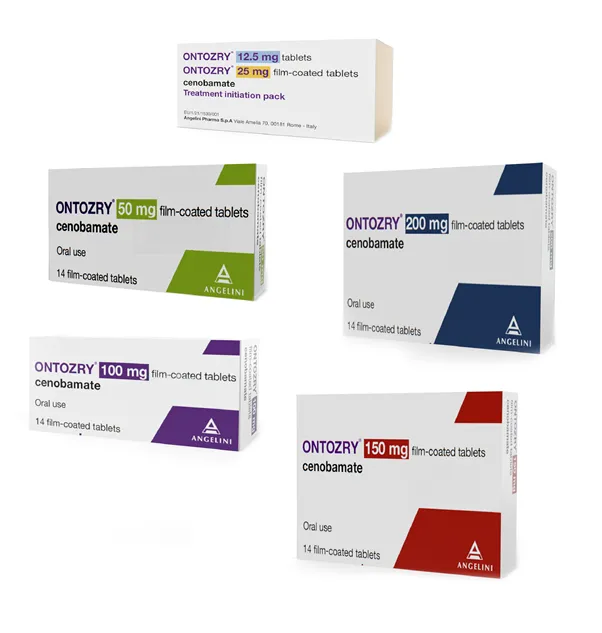
The starter pack of Ontozry contains 14 tablets of 12.5 mg and 14 film-coated tablets of 25 mg.
Ontozry 50 mg, 100 mg, 150 mg and 200 mg film-coated tablets are available in packs of 14, 28 or 84.
Not all pack sizes may be marketed.
Marketing Authorisation Holder
Angelini Pharma S.p.A
Viale Amelia 70, 00181
Rome - Italy
Manufacturer
Aziende Chimiche Riunite Angelini Francesco ACRAF SPA
Via Vecchia del Pinocchio, 22 60131
Ancona (AN), Italy
For further information on this medicinal product, please contact the local representative of the Marketing Authorisation Holder:
België/Belgique/Belgien Lietuva
Angelini Pharma S.p.A. Angelini Pharma S.p.A.
Tél/Tel: +32 (0)80 08 93 39 Tel: +39 06 78 0531
България Luxembourg/Luxemburg
Анджелини Фарма България ЕООД Angelini Pharma S.p.A.
Tel: +359 2 975 13 95 Tél/Tel: 80085530
[email protected] [email protected]
Česká republika Magyarország
Angelini Pharma Česká republika s.r.o. Angelini Pharma Magyarország Kft.
[email protected] [email protected]
Danmark Malta
Angelini Pharma Nordics Angelini Pharma S.p.A.
[email protected] Tel: +39 06 78 0531
Deutschland Nederland
Angelini Pharma Deutschland GmbH Angelini Pharma S.p.A.
Tel: 00800 42762727 Tel: +31 (0)80 00 20 10 77
Eesti Norge
Angelini Pharma S.p.A. Angelini Pharma Nordics
Tel: +39 06 78 0531 [email protected]
Ελλάδα Österreich
Angelini Pharma Hellas Μονοπρόσωπη ABEE Angelini Pharma Österreich GmbH
Tel: +30 210 626 9200 [email protected]
[email protected]
España Polska
ANGELINI PHARMA ESPAÑA, S.L. Angelini Pharma Polska Sp. z o.o.
Tel: +34 932534505 [email protected]
France Portugal
Angelini Pharma France Angelini Pharma Portugal, Unipessoal Lda
Tél: +33 (0)1 88 24 70 98 [email protected]
[email protected]
Hrvatska România
Angelini Pharma S.p.A. Angelini Pharmaceuticals România SRL
Tel: +39 06 78 0531 [email protected]
Ireland Slovenija
Angelini Pharma UK & Ireland Angelini Pharma S.p.A.
Tel: +353 (0)1584 4671 Tel: +39 06 78 0531
Ísland Slovenská republika
Angelini Pharma Nordics Angelini Pharma Slovenská republika s.r.o.
[email protected] [email protected]
Italia Suomi/Finland
Angelini Pharma S.p.A. Angelini Pharma Nordics
Tel: +39 071 809 809
[email protected]
Κύπρος Sverige
Angelini Pharma Hellas Μονοπρόσωπη ABEE Angelini Pharma Nordics
Tel: +30 210 626 9200
[email protected]
[email protected]
Latvija
Angelini Pharma S.p.A.
Tel: +39 06 78 0531
Other sources of information
More detailed information on this medicinal product is available on the website of the European Medicines Agency: http://www.ema.europa.eu
The original data is available in the language of the country of manufacture.
Data source: Italian Medicines Agency (AIFA)
Data last verified: September 21, 2026