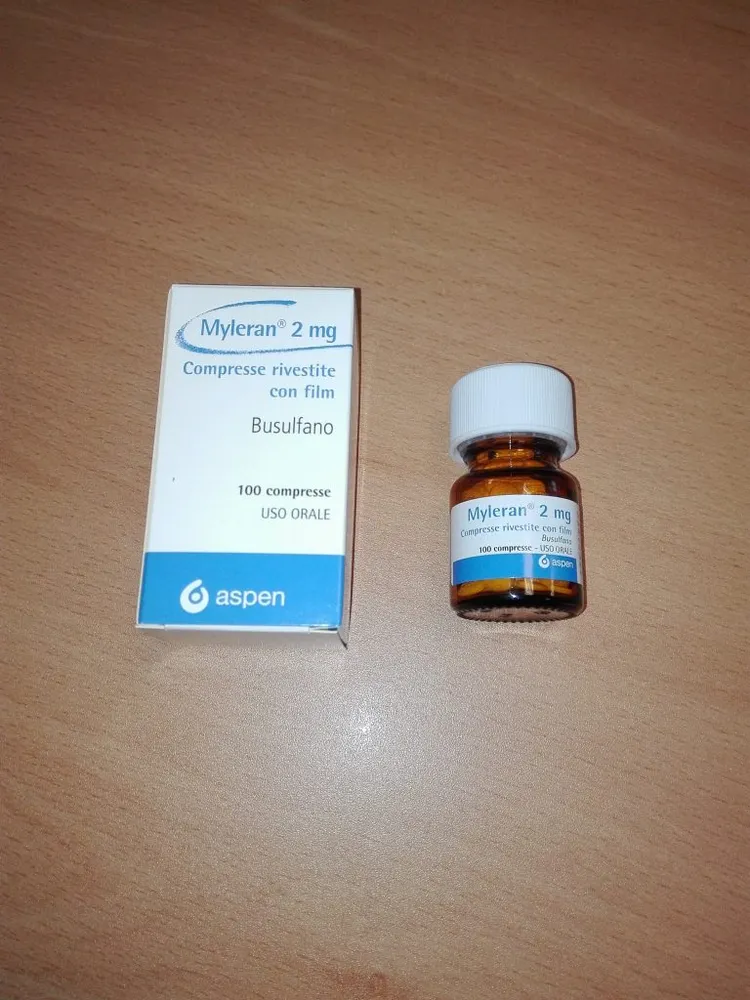
MYLERAN
ItalyThis medicine is used for the treatment of chronic myeloid leukemia and polycythemia vera. It may also be useful in some cases of essential thrombocythemia and myelofibrosis.
Frequently asked questions
When should you not take MYLERAN?
You must not take this medicine if you are allergic to busulfan or any of its components, or if your disease has proven resistant to the drug. Furthermore, it must not be taken if you have undergone radiotherapy, certain chemotherapies, or a stem cell transplant, due to the risk of serious liver problems.
How should you take MYLERAN?
Tablets must be taken following your doctor's instructions exactly, who will determine the dose based on your condition and your blood tests. The tablets must not be divided and the outer coating must be intact.
What are the most common side effects of MYLERAN?
Very common side effects include a reduction in white blood cells and platelets, lung problems, gastrointestinal disorders (nausea, vomiting, diarrhea, mouth ulcers), liver problems (such as jaundice), ovarian disorders or absence of menstruation, and fertility or sterility problems in men and women.
Can MYLERAN affect fertility?
Yes, the drug can cause infertility in both men and women, ovarian problems, absence of menstruation, and problems with sperm formation. It is important to speak with your doctor before starting treatment to evaluate the possibility of sperm banking.
Are there interactions with other medicines?
Yes, it is necessary to inform your doctor if you are taking other medicines, particularly live vaccines, other anticancer drugs, phenytoin, itraconazole, metronidazole, cyclophosphamide, paracetamol, or deferasirox.
What to do in case of pregnancy or breastfeeding?
The use of this drug should be avoided during pregnancy, especially in the first trimester. Mothers taking this medicine must not breastfeed infants.
Instructions for use
Package leaflet: Information for the patient
MYLERAN 2 mg film-coated tablets
Busulfan
Please read this leaflet carefully before taking this medicine because it contains important information for you.
- Keep this leaflet. You may need to read it again.
- If you have any questions, ask your doctor or pharmacist.
- This medicine has been prescribed for you only. Do not give it to other people, even if their symptoms are the same as yours, as it could be harmful.
- If you experience any side effects, including those not listed in this leaflet, contact your doctor or pharmacist. See section 4.
Contents of this leaflet:
- What MYLERAN is and what it is used for
- What you need to know before taking MYLERAN
- How to take MYLERAN
- Possible side effects
- How to store MYLERAN
- Contents of the pack and other information
1. What MYLERAN is and what it is used for
MYLERAN contains the active substance busulfan, which belongs to the group of antineoplastic medicines (medicines that kill tumour cells). Busulfan is an alkylating agent belonging to the alkyl sulfonate group.
MYLERAN is indicated for the treatment of chronic myeloid leukaemia (a tumour of the white blood cell series) and polycythaemia vera (a marked increase in the number of red blood cells in the blood, and sometimes also white blood cells and platelets).
MYLERAN may be beneficial in certain cases of essential thrombocythaemia (increased platelet count in the blood due to undetermined causes) and myelofibrosis (transformation of bone marrow into fibrous tissue).
Chronic myeloid leukaemia is rare in children.
Busulfan may be used to treat Philadelphia chromosome-positive (Ph'-positive) disease, but the Ph'-negative juvenile variant responds poorly.
2. What you should know before taking MYLERAN
Do not take MYLERAN
- if you are allergic to busulfan or to any of the other ingredients of this medicine (listed in section 6).
- if your disease has proven resistant to busulfan.
Warnings and precautions
Talk to your doctor or pharmacist before taking MYLERAN.
MYLERAN is an active cytotoxic agent intended for use only under the supervision of physicians experienced in the administration of such medicines.
Vaccination with a live organism-derived vaccine may potentially cause infection if your immune defenses are low. Therefore, vaccination with live organism-derived vaccines is not recommended.
MYLERAN should generally not be administered to you
- if you have undergone radiotherapy or any other chemotherapy currently or recently, or if you have ever undergone stem cell transplantation. This is because patients taking Myleran may develop severe liver problems (hepatic veno-occlusive disease). The risk of developing hepatic veno-occlusive disease is increased if you have undergone radiotherapy, more than three cycles of chemotherapy, or have had a stem cell transplant.
- if you have recently undergone treatment with cytotoxic agents. Myleran may cause sterility in both men and women. Before starting treatment, you should discuss with your doctor the possibility of preserving your sperm. Treatment with MYLERAN must be discontinued if pulmonary toxicity develops (see section “Possible side effects”). If you have hyperuricaemia (increased uric acid in the blood) and/or hyperuricosuria (increased uric acid in the urine), these conditions must be resolved before starting therapy with MYLERAN.
Treatment with conventional doses
If you are treated with conventional doses of busulfan in combination with itraconazole (an antifungal) or metronidazole (an antibiotic), your doctor will need to monitor you closely for signs of busulfan toxicity. When used in combination with these medicines, your doctor will recommend weekly monitoring of blood cell counts (see section “Other medicines and MYLERAN”).
High-dose treatment
If you are prescribed a high dose of MYLERAN, you will need to undergo prophylactic treatment against seizures (see section “Possible side effects”).
Monitoring
To avoid the possibility of excessive myelosuppression (suppression of bone marrow activity) and the risk of irreversible bone marrow aplasia (complete and permanent suppression of bone marrow activity), your doctor will pay close attention to monitoring your blood values during treatment (see section “Possible side effects”), particularly if you have low initial platelet counts or if platelet counts continue to decline during treatment; your doctor will immediately discontinue administration if sudden drops in platelet counts occur or if purpura (small skin hemorrhages) develops. Chromosomal abnormalities of various types (mutagenesis) and the development of neoplasms (carcinogenesis) may occur in patients treated with busulfan.
Other medicines and MYLERAN
Inform your doctor or pharmacist if you are taking, have recently taken, or might take any other medicines. - Vaccinations.
- Other cytotoxic agents (anticancer drugs) that cause pulmonary toxicity.
- Phenytoin (a medicine for seizures).
- Itraconazole and metronidazole (medicines used to treat infections caused by fungi).
- Cyclophosphamide (an anticancer drug).
- Paracetamol (a medicine to relieve pain and reduce fever).
- In children, administration of melphalan (an anticancer medicine) within 24 hours before the last oral dose of MYLERAN may result in toxicity.
- Deferasirox (a medicine used to remove excess iron from the body).
Pregnancy, breastfeeding, and fertility
If you are pregnant, suspect you may be pregnant, planning to become pregnant, or breastfeeding with breast milk, consult your doctor or pharmacist before taking this medicine.
Pregnancy
As with all other cytotoxic chemotherapeutic treatments, adequate contraceptive precautions must be taken when either partner is receiving MYLERAN.
The use of MYLERAN should be avoided, if possible, during pregnancy, particularly during the first trimester. In each individual case, the expected benefit to the mother must be weighed against the potential risk to the fetus.
A number of cases of congenital malformations have been reported, not necessarily attributable to busulfan, and exposure during the third trimester may be associated with intrauterine growth retardation. However, many cases of apparently normal newborns have been reported following in utero exposure to MYLERAN, even during the first trimester.
Breastfeeding
It is not known whether MYLERAN or its metabolites are excreted in human breast milk.
Mothers receiving treatment with MYLERAN must not breastfeed their infants.
Fertility
MYLERAN may cause ovarian problems and absence of menstruation in women, and problems in sperm formation in men (azoospermia and testicular atrophy). Myleran may prevent the onset of puberty in young and pre-adolescent girls receiving high doses of busulfan. Myleran may cause sterility in both sexes.
Driving and using machines
There are no data on the effects of busulfan on the ability to drive vehicles or use machinery.
MYLERAN contains anhydrous lactose. If your doctor has diagnosed you with an intolerance to certain sugars, contact him before taking this medicine.
3. How to take MYLERAN
Take this medicine exactly as prescribed by your doctor. If you have any doubts, consult your
doctor.
Dosage
MYLERAN tablets are generally administered in cycles or continuously. The dose must be adjusted for each individual patient under close clinical and hematological monitoring. If you require an average daily dose lower than the content available from MYLERAN tablets, this dose can be achieved by introducing one or more treatment-free days within the treatment period (see Method of administration).
Chronic myeloid leukemia
Induction in adults
Treatment is usually started as soon as the disease has been diagnosed.
The recommended dose for the initial phase of therapy is 0.06 mg/kg/day, with a maximum initial daily dose of 4 mg/day given as a single dose.
During the initial phase of therapy, your doctor will monitor your blood count (complete blood count) weekly.
The dose may be increased only if the response is inadequate after three weeks of treatment.
Treatment should be continued until the total leukocyte count has decreased to between 15 and 25x10⁹/L
(typically within 12 to 20 weeks). Treatment may then be discontinued; following discontinuation, a further decline in leukocyte count (a type of white blood cell) may occur over the subsequent two weeks.
Subsequently, or in cases where platelet count falls below 100x10⁹/L, continuing treatment with the dose used in the initial phase of therapy is associated with a significant risk of prolonged (and possibly irreversible) bone marrow aplasia (inadequate production of blood cells in the bone marrow).
Maintenance in adults
Leukemia control can be maintained for long periods without further treatment with MYLERAN; further treatment cycles are generally administered when the leukocyte count rises to 50x10⁹/L, or if symptoms reappear.
The goal is to maintain the white blood cell count at 10–15x10⁹/L, and blood counts should be performed at least every four weeks. The recommended maintenance dose is on average 0.5–2 mg/day, but may be lower depending on the individual patient's needs. If you require an average daily dose lower than the content of one tablet, this maintenance dose can be achieved by including one or more busulfan-free days within the treatment period.
MYLERAN doses should be reduced when administered concomitantly with other cytotoxic agents (see “Possible side effects” and “Other medicines and MYLERAN”).
Polycythemia vera (marked increase in red blood cells and sometimes white blood cells and platelets)
The recommended dose is 4–6 mg/day, continued for 4–6 weeks, with careful monitoring of blood counts, particularly platelet count.
In case of relapse, further treatment cycles may be administered; alternatively, maintenance therapy using approximately half the induction dose may be used.
If polycythemia is initially treated with phlebotomy (surgical removal of blood via venous incision), short courses of MYLERAN therapy may be administered solely to control platelet count.
Myelofibrosis (transformation of bone marrow into fibrous tissue)
The recommended initial dose is 2–4 mg/day.
Due to the extreme sensitivity of the bone marrow in this condition, very careful hematological monitoring is required.
Essential thrombocythemia (increased platelet count in blood due to undetermined cause)
The recommended dose is 2–4 mg/day.
Treatment must be discontinued if the total leukocyte count falls below 5x10⁹/L or the platelet count falls below 500x10⁹/L.
Method of administration
MYLERAN tablets must not be divided, and the outer coating must remain intact.
If you are obese, your doctor will adjust the dose based on your body surface area or by adjusting it according to your ideal body weight.
If you have reduced kidney function, your doctor may adjust your dose.
If you have reduced liver function, your doctor may adjust your dose.
If you take more MYLERAN than you should
The acute, dose-limiting toxicity of MYLERAN in humans is myelosuppression (reduced proliferative activity of the bone marrow) (see “Possible side effects”).
The main effect of chronic overdose is bone marrow depression and pancytopenia (reduction in the number of all blood cells).
If you have any doubts about how to use this medicine, consult your doctor.
4. Possible side effects
Like all medicines, this medicine can cause side effects, although not everyone gets them.
Side effects may vary in their incidence depending on the dose received and whether they are administered in combination with other medicines.
The side effects are listed below in order of frequency:
Very common (may affect more than 1 in 10 people)
- Dose-dependent bone marrow suppression (partial inhibition of bone marrow activity proportional to the administered dose), manifesting as leukopenia (reduced white blood cells) and, in particular, thrombocytopenia (reduced platelets).
- Idiopathic pulmonary syndrome following high-dose use.
- Gastrointestinal effects such as nausea, vomiting, diarrhoea, and mouth ulcers at high doses.
- Hyperbilirubinemia (increased bilirubin, a component of blood), jaundice (yellowing of the skin), veno-occlusive liver disease (blockage of small veins in the liver) (see "Warnings and precautions"), and biliary fibrosis with liver atrophy and liver necrosis.
- Ovarian disorders (lack of ovulation) and amenorrhoea (absence of menstruation) with menopausal symptoms in pre-menopausal patients at high doses; severe and persistent ovarian failure, including failure to reach puberty following administration in girls and pre-adolescents at high doses.
- Infertility, azoospermia (absence of sperm in semen), and testicular atrophy (reduction in testicular volume) with busulfan treatment.
Common (may affect up to 1 in 10 people)
- Secondary acute leukaemia due to chemotherapy (see "Warnings and precautions").
- Cardiac tamponade (compression of the heart) in patients with hereditary anaemia treated with MYLERAN at high doses.
- Interstitial lung disease (inflammation of the spaces between the lung alveoli) following long-term use at conventional doses.
- Alopecia (hair and body hair loss) at high doses.
- Hyperpigmentation (increased skin pigmentation).
- Haemorrhagic cystitis (bladder inflammation with blood in urine) at high doses when used in combination with cyclophosphamide.
Uncommon (may affect up to 1 in 100 people)
- Ovarian disorders (ovulation block) and amenorrhoea (absence of menstruation) with menopausal symptoms in pre-menopausal patients at conventional doses. In very rare cases, recovery of ovarian function (ovulation) has been reported after continuation of treatment.
Rare (may affect up to 1 in 1,000 people)
- Aplastic anaemia (a disease causing deficiency of red blood cells, white blood cells, and platelets).
- Seizures at high doses (see "Other medicines and MYLERAN" and "Warnings and precautions").
- Lens abnormalities and cataracts, even bilateral. Corneal thinning has been reported after bone marrow transplantation preceded by high-dose MYLERAN treatment.
- Gastrointestinal effects such as nausea, vomiting, diarrhoea, mouth ulcers, and dry mouth at conventional doses; these may be minimized as much as possible by administering the daily dose in divided fractions.
- Liver problems and jaundice (yellowing of the skin and mucous membranes due to blocked bile flow) at conventional doses, and biliary fibrosis.
- Alopecia (hair and body hair loss) at conventional doses; skin reactions including urticaria, erythema multiforme (skin redness), erythema nodosum (redness and hardening of the skin, typically on the shins), non-acute porphyria (formation of blisters on sun-exposed skin), allopurinol-like rash (skin redness), excessive dryness and fragility of the skin with complete anhidrosis (absence of sweating), dry mouth and cheilosis (cracks at the corners of the mouth), Sjögren's syndrome (destruction of certain glands leading to lack of saliva and tear production).
- Widespread epithelial dysplasia (abnormal development of the skin and mucous membranes lining certain internal organs).
- Radiation-induced skin injury is increased in patients receiving radiotherapy shortly after a high dose of busulfan.
Very rare (may affect up to 1 in 10,000 people)
- Myasthenia gravis (severe muscle weakness).
- Gynaecomastia (enlargement of the breasts).
Not known (frequency cannot be estimated from the available data)
- Incomplete tooth development
Reporting of side effects
If you experience any side effects, including those not listed in this leaflet, tell your doctor, pharmacist, or nurse. You can also report side effects directly via the national reporting system at http://www.aifa.gov.it/content/segnalazioni-reazioni-avverse
By reporting side effects, you can help provide more information on the safety of this medicine.
5. How to store MYLERAN
Keep this medicine out of the sight and reach of children.
Do not use this medicine after the expiry date stated on the pack. The expiry date refers to the product in its original packaging, when stored correctly.
Store in a dry place and at a temperature not exceeding 25°C.
Do not dispose of any medicine via wastewater or household waste. Ask your pharmacist how to dispose of medicines you no longer use. This will help protect the environment.
6. Package contents and other information
What MYLERAN contains
- The active substance is busulfan. One film-coated tablet contains 2 mg of busulfan.
- The other components are: Tablet core: anhydrous lactose, pregelatinized starch, magnesium stearate. Tablet coating: hypromellose, titanium dioxide, triacetin.
Description of the appearance of MYLERAN and package contents
Film-coated tablets – Bottle containing 100 tablets of 2 mg.
Marketing Authorization Holder
Aspen Pharma Trading Limited
3016 Lake Drive
Citywest Business Campus
Dublin 24, Ireland
Tel. 0039 06 87502429
Manufacturer
Excella GmbH & Co. KG, – Nürnberger Strasse 12 – 90537 Feucht (Germany)
The original data is available in the language of the country of manufacture.
Data source: Italian Medicines Agency (AIFA)
Data last verified: September 21, 2026