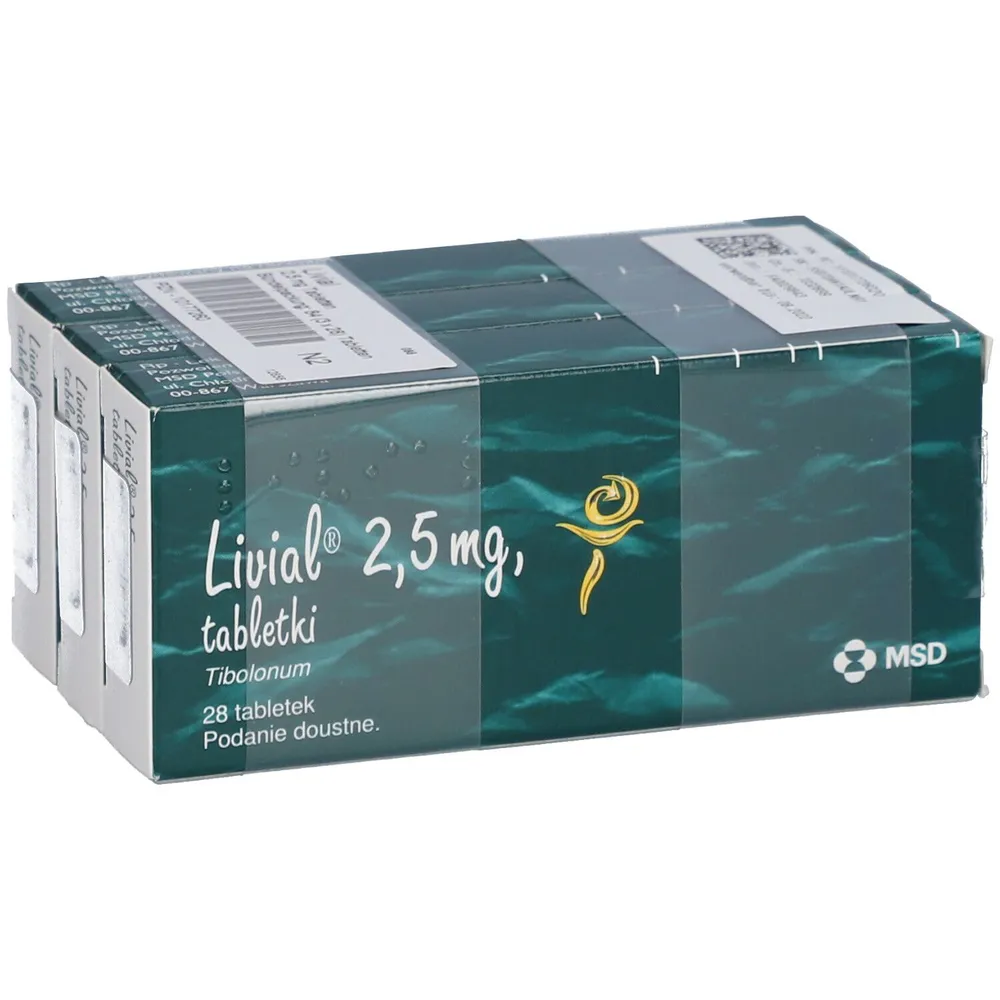
LIVIAL
ItalyThis medicine is a hormone replacement therapy indicated for postmenopausal women (at least 12 months since the last natural menstruation) to relieve symptoms such as hot flashes, night sweats, vaginal dryness, and genitourinary disorders. It may also be prescribed for the prevention of osteoporosis.
Frequently asked questions
How should Livial be taken?
It is taken orally by taking one tablet a day, always at the same time, with a glass of water. It is advisable to follow the days of the week indicated on the blister pack and not to leave any gaps.
What should I do if I forget a dose?
If you realize you have forgotten a tablet within 12 hours of the usual time, take it immediately. If more than 12 hours have passed, skip the forgotten dose and take the next one at the usual time; do not take a double dose to compensate.
When should this medicine not be taken?
You must not take this medicine if you are allergic to tibolone, if you have or suspect breast or uterine cancer, if you have unusual vaginal bleeding, if you have had blood clots (thrombosis or embolism), if you have serious liver problems, or if you are pregnant or breastfeeding.
What are the common side effects of Livial?
Among the most common effects (up to 1 in 10 women), you may experience vaginal bleeding or discharge, abdominal or pelvic pain, weight gain, breast pain, excessive hair growth, and vaginal disturbances such as itching or candidiasis infections.
What are the most serious risks associated with the use of Livial?
Use may increase the risk of breast cancer, endometrial cancer, ovarian cancer, blood clot formation (thrombosis), heart disease, and stroke. The risk of stroke is higher in women over 60 years of age.
Are there interactions with other medicines?
Some drugs may interfere with the effect of the treatment, causing irregular bleeding, including anticoagulants (such as warfarin), epilepsy drugs, tuberculosis drugs, and St. John's Wort preparations.
When is it necessary to contact a doctor immediately?
Contact a doctor immediately if you notice yellowing of the skin or eyes (jaundice), a sharp increase in blood pressure, new headaches or migraines, sudden chest pain, breathing difficulties, or swelling and redness of the legs.
Instructions for use
Patient Information Leaflet: Information for the user
LIVIAL 2.5 mg tablets
Tibolone
Please read this entire leaflet carefully before taking this medicine, as it contains important information for you.
- Keep this leaflet. You may need to read it again.
- If you have any questions, ask your doctor or pharmacist.
- This medicine has been prescribed for you only. Do not give it to others, even if their symptoms are the same as yours, as it could be harmful.
- If you experience any adverse reactions, including those not listed in this leaflet, contact your doctor or pharmacist. See section 4.
Contents of this leaflet:
- What Livial is and what it is used for
- What you need to know before taking Livial
- How to take Livial
- Possible side effects
- How to store Livial
- Contents of the pack and other information
1. What Livial is and what it is used for
Livial is a Hormone Replacement Therapy (HRT). Livial contains the active substance tibolone, which belongs to a group of medicines with oestrogenic activity. Livial is indicated in postmenopausal women, i.e. women who have had at least 12 months since their last natural menstrual period, in the following cases:
-
Relief of symptoms occurring after menopause
During menopause, the amount of hormones (oestrogens) produced by a woman's body decreases. The reduction in hormone levels may cause symptoms such as a feeling of heat in the face, neck, chest and upper body (hot flushes), night sweats, dryness and thinning of the vaginal mucosa, and genitourinary disorders. Livial relieves these postmenopausal symptoms. Your doctor will prescribe Livial only if these symptoms seriously interfere with your normal daily activities. -
Prevention of osteoporosis
After menopause, some women may develop weakened bones, increasing the risk of fractures (osteoporosis). Your doctor may prescribe Livial to prevent postmenopausal osteoporosis after evaluating whether you have an increased risk of fractures due to osteoporosis and determining that other medicinal treatments are not suitable for you.
2. What you should know before taking Livial
Before starting treatment with Livial, your doctor will inform you about the benefits and possible risks associated with treatment with Livial. Both before and during therapy, your doctor will assess whether Livial is suitable for you. Based on your overall health status, your doctor will decide the type and frequency of examinations required. If you have a close relative (mother, sister, grandmother) who has suffered from diseases caused by blood clots (venous thrombosis) or breast cancer, you may be at higher risk. For this reason, inform your doctor about any serious illnesses in your family history, and if you notice any changes in your breasts.
Similarly, inform your doctor if you have experienced premature menopause.
Do not take Livial
If you have any of the following conditions. If you are unsure about any of the points listed below, talk to your doctor before taking Livial.
- If you are allergic to tibolone or to any of the other ingredients of this medicine (listed in section 6).
- If you have or have had breast cancer, or if breast cancer is suspected.
- If you have a cancer sensitive to female hormones (estrogens), such as cancer of the uterine lining (endometrium), or if such cancer is suspected.
- If you have any unusual vaginal bleeding.
- If you have excessive thickening of the uterine lining (endometrial hyperplasia) that has not been treated.
- If you have or have had a blood clot in a vein (thrombosis), for example in the legs (deep vein thrombosis) or in the lungs (pulmonary embolism).
- If you have a blood clotting disorder (such as deficiency of protein C, protein S, or antithrombin).
- If you have or have recently had an arterial disease caused by blood clots, such as heart attack (angina, myocardial infarction), or cerebrovascular accident (stroke).
- If you have or have had liver disease and liver function values have not returned to normal.
- If you have a rare blood disorder called "porphyria", a familial (inherited) disease.
- If you are pregnant or think you may be pregnant.
- If you are breastfeeding.
If any of the conditions listed above occur for the first time while you are taking Livial, stop taking it immediately and consult your doctor without delay.
Warnings and precautions
Talk to your doctor or pharmacist before taking Livial.
Inform your doctor if you have ever had any of the following conditions, as they may recur or worsen during treatment with Livial:
- benign tumours in the uterus (fibroids)
- growth of uterine lining outside the uterus (endometriosis) or a history of abnormal growth of the uterine lining (endometrial hyperplasia)
- risk factors for developing blood clots (see "Blood clots in a vein (thrombosis)")
- increased risk of developing estrogen-sensitive cancer (such as having a mother, sister, or grandmother who had breast cancer)
- high blood pressure (hypertension)
- a liver disorder, such as a benign liver tumour
- high blood sugar levels (diabetes)
- gallstones
- migraine or severe headaches
- an autoimmune disease affecting multiple organs (systemic lupus erythematosus, SLE)
- epilepsy
- asthma
- a disease affecting the eardrum and hearing (otosclerosis)
- very high levels of fats in the blood (hypertriglyceridemia)
- fluid retention due to heart or kidney problems.
For athletes: using this medicine without a therapeutic need constitutes doping and may result in a positive anti-doping test.
Stop taking Livial and consult your doctor immediately if any of the following occur:
- any of the conditions listed in the section "Do not take Livial"
- yellowing of the skin or whites of the eyes (jaundice). These may be signs of liver disease
- a marked increase in blood pressure (symptoms may include headache, fatigue, dizziness)
- a new onset of migraine (headache)
- pregnancy
- signs of blood clotting, such as:
- painful swelling and redness in the legs
- sudden chest pain
- difficulty breathing.
Hormone Replacement Therapy (HRT) may increase the risk of the following clinical conditions:
Excessive thickening of the uterine lining (endometrial hyperplasia) and cancer of the uterine lining (endometrial cancer)
There have been reports and studies showing increased cell growth or cancer of the endometrium in women using Livial. The risk of endometrial cancer increases with the duration of use.
Irregular bleeding
During the first 3–6 months of treatment with Livial, irregular bleeding or spotting may occur.
However, consult your doctor as soon as possible if irregular bleeding:
- continues beyond the first 6 months of treatment with Livial
- occurs after more than 6 months of starting treatment with Livial
- continues after stopping treatment with Livial.
Breast cancer
Evidence shows that taking tibolone increases the risk of breast cancer. The additional risk depends on the duration of tibolone use. In HRT studies, after stopping HRT, the additional risk decreased over time, but this risk may persist for 10 years or more if HRT has been used for more than 5 years. Regarding tibolone, data on the persistence of risk after discontinuation are not available, but a similar pattern cannot be excluded.
Perform regular breast examinations. Consult your doctor immediately if you notice any changes in your breasts, such as:
- skin dimpling or depressions
- nipple changes
- lumps visible or palpable.
Comparative data
Women taking Livial have a lower risk of developing breast cancer compared to those taking combined HRT (estrogens and progestogens, two types of hormones), and a risk comparable to that of women taking estrogen-only HRT.
Ovarian cancer
Ovarian cancer is rare – much rarer than breast cancer. The use of estrogen-only or combined estrogen-progestogen therapy has been associated with a slight increase in the risk of ovarian cancer.
The risk of ovarian cancer varies with age. For example, among women aged 50 to 54 years not using HRT, about 2 out of 2,000 will receive a diagnosis of ovarian cancer within 5 years. For women using HRT for 5 years, there will be about 3 cases per 2,000 women treated (i.e., about 1 additional case).
With the use of Livial, the increase in risk of ovarian cancer is similar to that of other types of HRT.
Effects of HRT on the heart and circulation
Blood clots in a vein (thrombosis)
The risk of developing blood clots in veins is approximately 1.3–3 times higher in women using HRT compared to those not using it, especially during the first year of treatment.
Blood clots can be serious, and if one travels to the lungs, it can cause chest pain, shortness of breath, fainting, or even death.
The likelihood of developing blood clots increases with age and if any of the following conditions are present, which you should inform your doctor about:
- you are pregnant or have recently given birth
- you are taking estrogens
- you are unable to walk for long periods due to major surgery, an accident, or illness (see also section 3, "If you are scheduled for surgery")
- you are significantly overweight (BMI (body mass index) > 30 kg/m²)
- you have had a clotting disorder requiring long-term treatment with a medicine used to prevent clots
- a close relative has had blood clots in the legs, lungs, or other organs
- you have systemic lupus erythematosus (SLE), an autoimmune disease
- you have cancer.
For information on how blood clot formation may manifest in your body, refer to the section "Stop taking Livial and consult your doctor immediately".
Comparative data
For women aged 50 to 59 years not taking HRT, over a 5-year period, a venous blood clot is expected to occur in 4–7 out of 1,000 users.
For women aged 50 to 59 years taking estrogen-progestogen HRT, over a 5-year period, a venous blood clot is expected in 9–12 out of 1,000 users (i.e., 5 additional cases).
With Livial, the increase in the risk of venous blood clot formation is lower than that observed with other types of HRT.
Heart disease (heart attack)
It has not been proven that HRT or Livial prevent heart attack (angina, myocardial infarction).
Women over 60 years of age using estrogen-progestogen HRT have a slightly higher risk of developing heart disease compared to those not using HRT. The risk of heart disease strongly depends on age; therefore, the number of cases of heart disease due to estrogen-progestogen HRT is very low in healthy women near menopause but increases with age.
Based on current clinical knowledge, the risk of myocardial infarction associated with the use of Livial is comparable to that associated with other types of HRT.
Stroke
Recent research suggests that HRT and Livial increase the risk of stroke. The increased risk has been primarily observed in older postmenopausal women over 60 years of age.
Comparative data
For women aged 50 to 59 years not taking Livial, over 5 years, about 3 cases of stroke per 1,000 are expected, and 7 cases per 1,000 for women in the same age group taking Livial (i.e., 4 additional cases).
For women aged 60 to 69 years not taking Livial, over 5 years, about 11 cases of stroke per 1,000 are expected, and 24 cases per 1,000 for women in the same age group taking Livial (i.e., 13 additional cases).
Other conditions
HRT does not prevent memory loss. There is some evidence of an increased risk of memory loss in women who start using HRT after age 65.
Other medicines and Livial
Some of the following medicines may interfere with the effect of Livial, causing irregular bleeding:
- medicines used to prevent excessive blood clotting (such as warfarin)
- medicines used to treat epilepsy (such as phenobarbital, phenytoin, and carbamazepine)
- medicines used to treat tuberculosis (such as rifampicin)
- herbal preparations containing St. John’s wort ( Hypericum perforatum ).
Inform your doctor or pharmacist if you are taking, have recently taken, or might take any other medicines.
Livial with food and drink
Livial can be taken normally with food and drink.
Pregnancy and breastfeeding
If you are pregnant, suspect you may be pregnant, are planning a pregnancy, or are breastfeeding, consult your doctor before taking this medicine. Livial is indicated only for postmenopausal women.
Livial is not a contraceptive. If less than 12 months have passed since your last menstrual period, or if you are under 50 years of age, you may still need to use a contraceptive method to avoid pregnancy. Consult your doctor.
Driving and using machines
Livial has no known effect on the ability to drive or operate machinery.
Livial contains lactose
Livial tablets contain lactose. If your doctor has diagnosed you with an intolerance to certain sugars, consult him or her before taking this medicine.
3. How to take Livial
Take this medicine exactly as directed by your doctor or pharmacist. If you have any doubts, consult your doctor or pharmacist.
Livial must be taken orally. The recommended dose is one tablet daily. Livial tablets should be swallowed with water or another drink. Take the tablet at the same time each day.
The days of the week are marked on the tablet container (blister pack) of Livial. Begin treatment by taking the tablet marked with the day of the week. For example, if it is Monday, take the tablet marked "Monday" in the top row of the blister. Follow the days of the week in sequence until the blister is empty. The next day, start a new blister. Do not leave any empty spaces in the blister.
Livial must not be taken until at least twelve months have passed since your last spontaneous menstrual period. If Livial is taken earlier, the likelihood of irregular vaginal bleeding may increase.
Your doctor will prescribe the lowest effective dose to treat your symptoms for the shortest necessary duration. Consult your doctor if you feel the dose is too strong or too weak.
If you take more Livial than you should
If you have taken an excessive dose of Livial, contact your doctor or pharmacist immediately.
Taking several tablets at the same time is not usually cause for major concern. However, you must inform your doctor immediately. Signs of overdose may include feeling unwell or vaginal bleeding.
If you forget to take Livial
If you forget to take a tablet, take it as soon as you remember, provided that less than 12 hours have passed since the time you were supposed to take the last tablet. If more than 12 hours have passed, do not take the missed tablet; instead, take the next tablet at your usual time.
Do not take a double dose to make up for the forgotten tablet.
If you are scheduled for surgery
If you are scheduled for surgery, inform the anaesthetist that you are currently taking Livial. You may need to stop taking Livial approximately 4–6 weeks before the operation to reduce the risk of blood clot formation (see section 2, “Blood clots in a vein (thrombosis)”). Ask your doctor when you can resume treatment with Livial.
If you stop taking Livial
If you have any doubts about using this medicine, consult your doctor or pharmacist.
4. Possible side effects
Like all medicines, this medicine can cause side effects, although not everyone experiences them.
Most of these side effects are mild.
The following conditions are reported more frequently in women using HRT than in women who do not use it:
- breast cancer
- abnormal growth of the uterine lining (endometrial hyperplasia) or endometrial cancer
- ovarian cancer
- blood clots in the legs or lungs (venous thromboembolism)
- heart disease
- stroke
- possible memory loss if HRT is started after the age of 65.
For further information on these side effects, please refer to section 2.
Common side effects observed in clinical studies (affecting up to 1 in 10 women) are:
- vaginal bleeding or discharge
- abdominal or pelvic pain
- weight gain
- breast pain
- abnormal hair growth
- vaginal symptoms such as discharge, itching, irritation, inflammation (vulvovaginitis), fungal infection (candidiasis).
Uncommon side effects (affecting up to 1 in 100 women) are:
- acne
- nipple pain or breast discomfort
- vaginal infections (vaginal mycosis).
Other side effects observed with Livial during therapeutic use include:
- dizziness, headache, migraine, depression
- skin rash or itching
- visual disturbances
- gastrointestinal disorders
- fluid retention
- joint pain, muscle pain
- altered liver function.
Cases of breast cancer and abnormal cell growth or carcinoma of the uterine lining have been reported in women treated with Livial.
Contact your doctor if you experience vaginal bleeding or discharge, or if any of the above side effects become bothersome or persistent.
The following side effects have been reported with other hormone replacement therapies:
- gallbladder disorders
- various skin disorders:
- skin discoloration, especially on the face or neck, a condition known as chloasma (also called "melasma" or "pregnancy mask")
- painful red nodules on the skin (erythema nodosum)
- skin rash with target-shaped redness or ulcerations (erythema multiforme).
Reporting of side effects
If you experience any side effect, including those not listed in this leaflet, consult your doctor or pharmacist. You may also report side effects directly via the Italian Medicines Agency (Agenzia Italiana del Farmaco) website: https://www.aifa.gov.it/content/segnalazioni-reazioni-avverse.
By reporting side effects, you can help provide more information on the safety of this medicine.
5. How to store Livial
Keep this medicine out of the sight and reach of children.
Do not store above 25°C. Do not freeze.
Store in the original packaging.
Do not use this medicine after the expiry date stated on the pack after "Exp". The expiry date refers to the last day of that month.
Do not dispose of any medicine via wastewater or household waste. Ask your pharmacist how to dispose of medicines you no longer use. This will help protect the environment.
6. Package contents and other information
What Livial contains
- The active substance is: tibolone 2.5 mg.
- The other ingredients are: potato starch, lactose, ascorbyl palmitate and magnesium stearate.
Description of the appearance of Livial and pack contents
Livial 2.5 mg tablets are white, round and flat, with “MK2” imprinted on one side and “Organon*” on the other. They are available in PVC/aluminum blisters of 30 tablets. Each blister is packaged in a carton box.
Marketing Authorisation Holder and Manufacturer
Marketing Authorisation Holder
Organon Italia S.r.l.
Piazza Carlo Magno, 21
00162 Rome, Italy
Manufacturer
N.V. Organon, Kloosterstraat 6, 5349 AB, Oss, The Netherlands
Similar drugs
| Brand name | Dosage form | Active substance / Dosage | Manufacturer |
|---|---|---|---|
| MENEC | tablets | FARMITALIA INDUSTRIA CHIMICO FARMACEUTICA S.R.L. | |
| SHYLA | tablets | GEDEON RICHTER PLC | |
| TIBOCINA | tablets | SANDOZ S.P.A. | |
| TIBOLONE ARISTO | tablets | ARISTO PHARMA GMBH |
The original data is available in the language of the country of manufacture.
Data source: Italian Medicines Agency (AIFA)
Data last verified: September 21, 2026