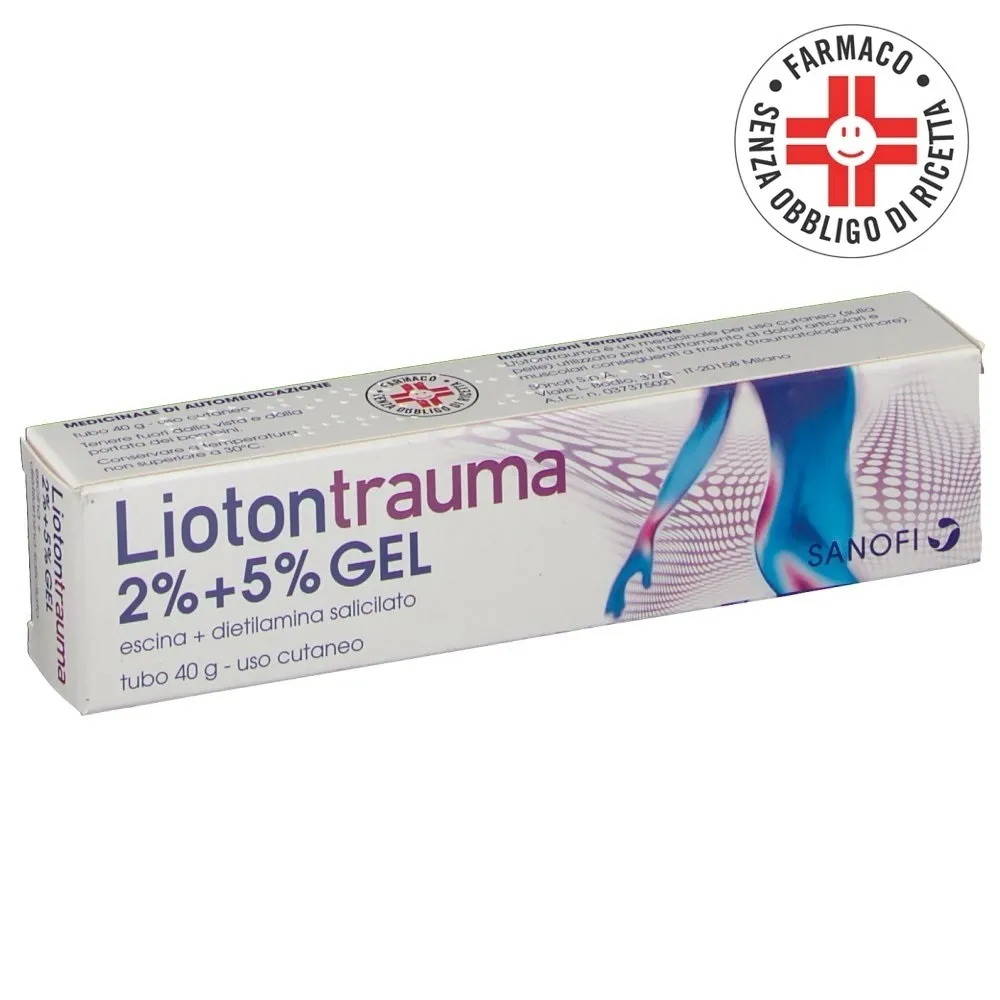
LIOTONTRAUMA
ItalyIt is used for the treatment of muscle and joint pain caused by minor trauma.
Frequently asked questions
How should Liotontrauma be applied?
A thin layer of gel should be applied to the affected area 1 to 3 times daily. After application, hands must be washed thoroughly.
When should the product not be used?
It must not be used if you are allergic to the active ingredients or other components, on open wounds, on mucous membranes, or on areas of skin treated with radiation. It must not be applied together with other medicinal products for topical use and must not be used by children under 12 years of age.
What are the possible side effects of Liotontrauma?
In rare cases, allergic reactions such as redness, scaling, and skin dryness, or contact dermatitis may occur. The product may also cause irritation to the skin, eyes, or mucous membranes.
Are there any interaction problems with other drugs?
No interactions with other medicinal products are known, but the product should not be applied simultaneously with other medicinal products for topical use on the same area.
Can it be used during pregnancy or breastfeeding?
Use is not recommended during pregnancy unless under strict medical supervision; in this case, prolonged use (maximum 3 weeks) on large areas should be avoided. During breastfeeding, it is necessary to consult a doctor and the gel must not be applied to the breast.
What to do in case of overdose?
In case of excessive application, wash the affected area thoroughly. If the product is accidentally ingested, inform a doctor immediately or go to the emergency room.
Instructions for use
Package leaflet: Information for the patient
Liotontrauma 2%+5% gel
aescin + diethylamine salicylate
Please read this leaflet carefully before using this medicine because it contains
important information for you.
Always use this medicine exactly as described in this leaflet or as your doctor or
pharmacist has instructed you.
- Keep this leaflet. You may need to read it again.
- If you need more information or advice, consult your pharmacist.
- If you experience any side effects, including those not listed in this leaflet, contact your doctor or pharmacist. See section 4.
- Contact your doctor if you do not notice improvement or if your symptoms worsen after a short period of use.
Contents of this leaflet:
- What Liotontrauma is and what it is used for
- What you need to know before using Liotontrauma
- How to use Liotontrauma
- Possible side effects
- How to store Liotontrauma
- Contents of the pack and other information
1. What Liotontrauma is and what it is used for
Liotontrauma is a topical medicine (for use on the skin) containing the active substances escin and diethylamine salicylate, used for the treatment of joint and muscle pain resulting from injuries (minor trauma).
2. What you need to know before using Liotontrauma
Do not use Liotontrauma
- if you are allergic to escin and salicylic acid diethanolamine salt or to any of the other ingredients of this medicine (listed in section 6);
- on open lesions (wounds), mucous membranes, or areas of skin treated with radiation; apply only on intact skin;
- simultaneously in the same area with other topical medicines;
- in children under 12 years of age. Do not use Liotontrauma for prolonged periods without consulting your doctor.
Warnings and precautions
Talk to your doctor or pharmacist before using Liotontrauma.
There is no risk of habituation (reduced effectiveness) or dependence (need to continue taking the medicine beyond what is necessary).
Since this is a topical preparation, it must be used externally only (on the skin only).
Prolonged or repeated use of topical products may lead to allergic reactions (sensitization).
Avoid contact of Liotontrauma with the eyes.
Children and adolescents
Liotontrauma must not be used in children under 12 years of age.
Other medicines and Liotontrauma
Inform your doctor or pharmacist if you are taking, have recently taken, or might take any other medicines.
No interactions with other medicines are known.
This medicine should not be applied together with other topical products.
Pregnancy and breastfeeding
There are no data available regarding the use of Liotontrauma in pregnant women.
If you are pregnant, suspect you may be pregnant, planning a pregnancy, or are breastfeeding, consult your doctor or pharmacist before using this medicine.
The use of Liotontrauma during pregnancy is not recommended unless under strict medical supervision. It is advisable to avoid prolonged use (maximum 3 weeks) of the medicine on large areas of skin during pregnancy.
Avoid applying the gel on the breast during breastfeeding.
Driving and using machines
Liotontrauma does not affect the ability to drive or operate machinery.
Liotontrauma contains propylene glycol and butylated hydroxytoluene (or butylated hydroxytoluene)
Liotontrauma contains propylene glycol, which may cause skin irritation.
Liotontrauma contains butylated hydroxytoluene (or butylated hydroxytoluene), which may cause local skin reactions (e.g. contact dermatitis) or irritation of the eyes and mucous membranes.
3. How to use Liotontrauma
Use this medicine exactly as described in this leaflet or as directed by your doctor or pharmacist. If you have any doubts, consult your doctor or pharmacist.
Adults and adolescents (12-18 years)
Apply Liotontrauma 1 to 3 times a day to the affected area.
The amount to apply depends on the size of the area to be treated.
Apply a thin layer of Liotontrauma directly to the skin of the affected area.
After each application, wash your hands thoroughly.
Caution: Do not exceed the recommended doses and use only for short treatment periods.
Consult your doctor if symptoms recur or if you have noticed any recent changes in their characteristics.
If you use more Liotontrauma than you should
No cases of overdose have been reported.
If an excessive amount of Liotontrauma has been applied, wash the affected area thoroughly.
In case of accidental ingestion/overdose, contact your doctor immediately or go to the nearest hospital.
If you stop treatment with Liotontrauma
If you have any doubts about using this medicine, consult your doctor or pharmacist.
4. Possible side effects
Like all medicines, this medicine can cause side effects, although not everybody gets them.
In rare cases, allergic reactions (hypersensitivity reactions) such as redness, peeling, and dryness (dehydration) of the skin may occur.
This medicine may cause contact dermatitis (allergic skin inflammation caused by contact).
Following the instructions in the package leaflet reduces the risk of side effects.
Reporting of side effects
If you experience any side effect, including those not listed in this leaflet, talk to your doctor or pharmacist.
You can also report side effects directly via the national reporting system at the following address:
www.agenziafarmaco.gov.it/content/come-segnalare-una-sospetta-reazione-avversa .
By reporting side effects, you can help provide more information on the safety of this medicine.
5. How to store Liotontrauma
Keep this medicine out of the sight and reach of children.
Do not use this medicine after the expiry date stated on the packaging after "Exp".
The expiry date refers to the last day of that month.
Do not store above 30°C.
Do not dispose of any medicine via wastewater or household waste. Ask your pharmacist how to
dispose of medicines you no longer use. This will help protect the environment.
It is important to always keep the medicine information available; therefore, keep both the
packaging and the leaflet.
6. Contents of the package and other information
What Liotontrauma 2% + 5% contains
100 g of gel contain 2 g of aescin and 5 g of diethylamine salicylate.
The other components are:
lavender essence, nerolen essence, carbomer, meglumine, propylene glycol, ethyl alcohol,
sodium edetate, isodecanol and hexyldecyl laurate, ethoxydiglycol, butylhydroxytoluene, titanium dioxide,
purified water.
Description of the appearance of Liotontrauma and contents of the pack
Liotontrauma 2% + 5% is a gel for topical use.
The pack contains one 40 g tube of gel.
Marketing Authorization Holder
VEMEDIA MANUFACTURING B.V.
Verrijn Stuartweg 60, 1112 – AX DIEMEN (The Netherlands)
Manufacturer
ISTITUTO BIOCHIMICO ITALIANO GIOVANNI LORENZINI S.p.A.
Production site in Aprilia (LT), via Fossignano, 2 - Italy
Or
Sanofi Winthrop Industrie
Production site in Amilly, 196, rue du Maréchal Juin - France
Similar drugs
| Brand name | Dosage form | Active substance / Dosage | Manufacturer |
|---|---|---|---|
| EDEVAN C.M. | gel | ISTITUTO BIOCHIMICO ITALIANO GIOVANNI LORENZINI S.P.A. | |
| REPARIL | gel | COOPER CONSUMER HEALTH B.V. | |
| VIAMAL TRAUMA | gel | POLIFARMA BENESSERE S.R.L. |
The original data is available in the language of the country of manufacture.
Data source: Italian Medicines Agency (AIFA)
Data last verified: September 21, 2026