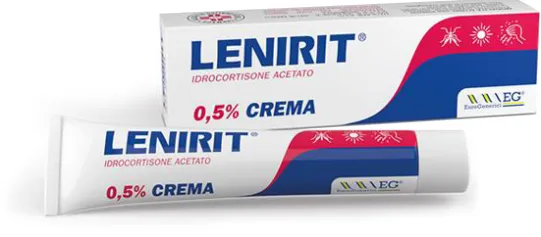
LENIRIT
ItalyIt is used to treat insect bites, itching, erythema, localized burns, and eczema (inflammatory skin reactions that cause itching).
Frequently asked questions
How should Lenirit be applied?
A thin layer of cream should be applied to the affected area twice a day, rubbing in lightly. It is important not to exceed the recommended doses and not to stop treatment abruptly, but to proceed gradually.
When should you not use this medicine?
It must not be used if you are allergic to hydrocortisone or any of the components of the cream, in case of skin infections caused by viruses, bacteria, or fungi, on ulcers, wounds, or skin tumors, on the face, on the anogenital area, or on large lesions. It is contraindicated for treating acne, pustular psoriasis, herpes, chickenpox, or post-vaccination reactions, and must not be used in infants and children under 2 years of age.
What are the possible side effects of Lenirit?
Possible side effects include acne, dry skin, thinning of the skin, appearance of striae (stretch marks), increased hair growth, skin discoloration, itching, blurred vision, and dilation of capillaries. Prolonged use may also cause hypercortisolism, swelling, increased blood pressure, or growth disturbances in children.
Are there any special precautions to follow?
Contact with the eyes must be avoided to prevent risks such as glaucoma or cataracts. The treated area should not be covered with non-breathable bandages, and the cream should not be applied to the diaper area in children. If you are pregnant or breastfeeding, it is necessary to consult a doctor before use.
Can there be interactions with other medicines?
No interactions with other medicines are known, but it is always advisable to inform your doctor or pharmacist if you are taking other products.
Instructions for use
Package leaflet: Information for the patient
Lenirit 0.5% Cream
Hydrocortisone acetate
Please read all of this leaflet carefully before using this medicine because it contains important information for you.
- Use this medicine exactly as described in this leaflet or as your doctor or pharmacist has instructed you.
- Keep this leaflet. You may need to read it again.
- If you need more information or advice, consult your pharmacist.
- If you experience any side effects, including those not listed in this leaflet, contact your doctor or pharmacist. See section 4.
- Consult your doctor if you do not notice improvement or if your symptoms worsen after 7 days.
Contents of this leaflet:
- What Lenirit is and what it is used for
- What you need to know before using Lenirit
- How to use Lenirit
- Possible side effects
- How to store Lenirit
- Contents of the pack and other information
1. What Lenirit is and what it is used for
Lenirit contains the active substance hydrocortisone acetate, a corticosteroid with anti-inflammatory, antiallergic and antipruritic properties.
Lenirit is used to treat insect bites, itching, erythema or localized burns, and eczema (inflammatory skin reactions accompanied by itching).
Consult your doctor if you do not feel better or if you feel worse after 7 days.
2. What you need to know before using Lenirit
Do not use Lenirit
- if you are allergic to hydrocortisone or to any of the other ingredients of this medicine (listed in section 6);
- if you have a skin infection or skin disease caused by viruses, bacteria, or fungi;
- on skin ulcers, wounds, or skin tumours;
- on facial skin, anogenital area, or extensive skin lesions;
- to treat infectious diseases (such as syphilis), viral infections (such as herpes or chickenpox), skin rashes around the mouth or nose, acne, rosacea, skin reactions following vaccination, pustular psoriasis;
- in newborns and children under 2 years of age.
Warnings and precautions
Talk to your doctor or pharmacist before using Lenirit if you:
- are elderly (especially if you suffer from osteoporosis, high blood pressure, low potassium levels in the blood, or diabetes mellitus);
- have subcutaneous atrophy (thinning of the underlying skin tissues);
- have liver or kidney impairment.
The use, especially if prolonged, of topical medicines may cause irritation or allergic reactions. In this case, stop treatment and consult your doctor.
Contact your doctor if you experience blurred vision or other visual disturbances.
Avoid contact of the cream with areas near the eyes, as penetration of the medicine into the eyes may cause glaucoma (increased internal eye pressure) or cataracts. If this occurs, rinse the affected area thoroughly with water.
Avoid prolonged use, as it may cause dilation of blood vessels and thinning of the skin.
Avoid prolonged use of the cream, particularly over large areas of skin or on broken skin, as the medicine may be absorbed into the bloodstream and cause systemic effects (which may therefore affect various parts of the body).
Do not cover treated areas with occlusive (non-breathable) dressings, as this may enhance absorption of the medicine into the bloodstream, leading to unwanted effects similar to those seen with systemic administration (e.g. oral or intravenous) of corticosteroids. For the same reason, avoid applying the cream to the diaper area in children.
Children
Do not use Lenirit in newborns and children under 2 years of age.
Particular caution is recommended when using this medicine in children due to the higher risk, compared to adults, of systemic effects induced by corticosteroids (e.g. Cushing's syndrome).
Prolonged use of corticosteroids in children may cause disturbances in growth and development.
Other medicines and Lenirit
No interactions with other medicines are known.
Nevertheless, inform your doctor or pharmacist if you are taking, have recently taken, or might take any other medicines.
Pregnancy and breastfeeding
If you are pregnant, think you may be pregnant, planning to become pregnant, or breastfeeding, consult your doctor or pharmacist before using this medicine. Use Lenirit only on medical advice and under medical supervision.
Lenirit contains parahydroxybenzoates
Parahydroxybenzoates may cause allergic reactions (including delayed reactions).
3. How to use Lenirit
Use this medicine exactly as stated in this leaflet or as instructed by your doctor or pharmacist. If you have any doubts, consult your doctor or pharmacist.
Apply a thin layer of cream to the affected area twice daily, gently rubbing it in. Do not exceed the recommended doses.
Use in children
Do not use Lenirit in newborns or children under two years of age.
Use Lenirit with caution in children over the age of 2 years and keep the duration of treatment as short as possible.
If you use more Lenirit than you should
There are no known cases of overdose with topical use of hydrocortisone at the concentration contained in Lenirit.
If you accidentally apply too much cream, wash the treated area thoroughly with running water.
If you stop treatment with Lenirit
Do not stop the therapy abruptly. Discontinue treatment gradually, for example by applying intermittently before stopping completely.
If you have any doubts about the use of this medicine, consult your doctor or pharmacist.
4. Possible adverse reactions
Like all medicines, this medicine can cause adverse reactions, although not everybody gets them.
The adverse reactions reported below have occurred; their frequency is unknown.
During application of the cream, acne, bruise-like lesions due to rupture of capillaries beneath the skin surface, reduced skin thickness, dry skin, increased hair growth, skin discoloration, striae (stretch marks), dilation of capillaries appearing on the skin as fine red or bluish lines, dermatitis affecting areas around the mouth and nose, infection involving the upper part of the hair follicle (folliculitis), itching, blurred vision may occur.
Measures that enhance absorption of the cream (e.g. use of an occlusive dressing) may cause systemic adverse effects such as swelling (edema), increased blood pressure, and impairment of the immune system.
Prolonged use, especially over large areas, of corticosteroid-containing creams may lead to the development of hypercortisolism (excessive increase in certain hormones).
Prolonged use of corticosteroids in children may cause disturbances in growth and development.
Application of the cream around the eyelid area has occasionally caused increased intraocular pressure (glaucoma) or cataract.
Reporting of adverse reactions
If you experience any adverse reaction, including those not listed in this leaflet, contact your doctor or pharmacist. You may also report adverse reactions directly via the national reporting system at https://www.aifa.gov.it/content/segnalazioni-reazioni-avverse. By reporting adverse reactions, you can help provide more information on the safety of this medicine.
5. How to store Lenirit
Keep this medicine out of the sight and reach of children.
Do not use this medicine after the expiry date stated on the packaging after "Exp". The expiry date refers to the last day of that month.
This medicine does not require any special storage conditions.
Do not dispose of any medicine via wastewater or household waste. Ask your pharmacist how to dispose of medicines you no longer use. This will help protect the environment.
6. Package contents and other information
What Lenirit contains
- The active substance is hydrocortisone acetate. 100 g of cream contain 0.5 g of hydrocortisone acetate.
- The other components are polyglycolic ester of C-C fatty acids, self-emulsifying glyceril monodistearate, squalane, cetyl palmitate, methyl parahydroxybenzoate, ethyl parahydroxybenzoate, propyl parahydroxybenzoate, perfume, purified water.
Description of the appearance of Lenirit and package contents
Lenirit is a white dermatological cream, available in a 20 g aluminium tube.
Marketing Authorization Holder
EG S.p.A., Via Pavia, 6 – 20136 Milan
Manufacturer
DOPPEL Farmaceutici S.r.l., Via Martiri delle Foibe, 1 - 29016 – Cortemaggiore (PC)
Lachifarma S.r.l. Laboratorio Chimico Salentino, S.S. 16 Zona Industriale - 73010 Zollino (LE)
Similar drugs
| Brand name | Dosage form | Active substance / Dosage | Manufacturer |
|---|---|---|---|
| CORTIDRO | cream | SUBSTIPHARM | |
| DERMIRIT | cream | DOC GENERICI SRL | |
| DERMOCORTAL | cream | LABORATORIO FARMACEUTICO SIT SPECIALITA IGIENICO TERAPEUTICHE S.R.L. | |
| FOILLE INSETTI | cream | VEMEDIA MANUFACTURING B.V. | |
| SINTOTRAT | cream | DOMPE' FARMACEUTICI S.P.A. |
The original data is available in the language of the country of manufacture.
Data source: Italian Medicines Agency (AIFA)
Data last verified: September 21, 2026