LAEVOLAC EPS
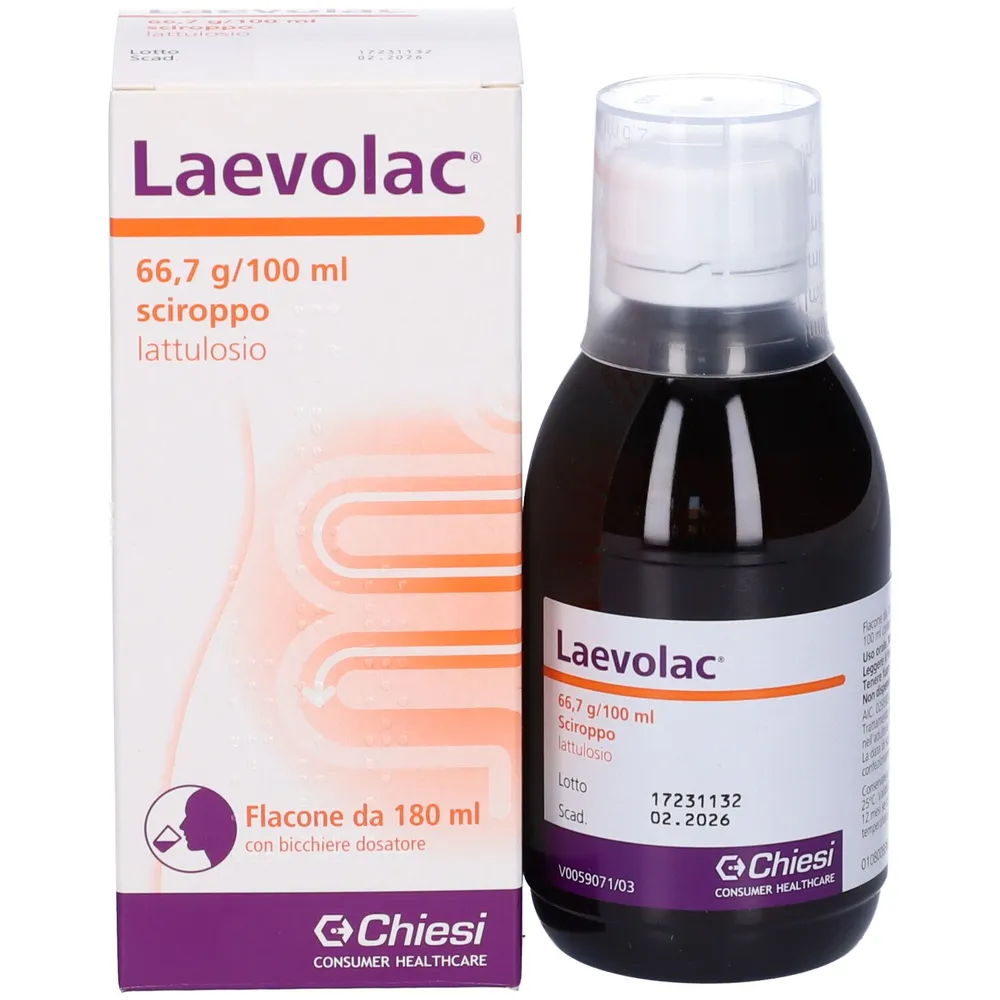
ItalyThis medicine is used in adults to treat portosystemic encephalopathy (a liver disease that causes mental confusion, drowsiness, and disorientation) and hepatic cirrhosis.
Frequently asked questions
When should you not take Laevolac EPS?
You must not take this drug if you are allergic to lactulose or any of its other components, if you suffer from galactosemia, or if you experience abdominal pain, nausea, or vomiting.
What is the recommended dosage of Laevolac EPS for adults?
The recommended dose for adults ranges from 90 ml to 190 ml per day, to be divided into 2 or 3 administrations.
What are the possible side effects of Laevolac EPS?
The most common side effects relate to the stomach and intestines, such as abdominal cramps, diarrhea, bloating (meteorism), and gas. In exceptional cases, prolonged use may cause loss of electrolytes in the blood. Allergic reactions, skin rashes, itching, or hives may also occur.
Are there interactions with other medicines?
It is important to inform your doctor if you are taking antibiotics or antacids, as lactulose may reduce their effectiveness. It may also increase the risk of side effects with digitalis glycosides or have a combined effect with neomycin.
What should you do in case of overdose?
If an excessive dose is taken, diarrhea and abdominal cramps may occur; in this case, it is necessary to discontinue treatment and immediately contact a doctor or the Emergency Room.
Can it be taken during pregnancy or breastfeeding?
There are no contraindications to use during pregnancy or breastfeeding, but it is always advisable to seek advice from a doctor or pharmacist before proceeding.
Instructions for use
Table of contents
- Laevolac EPS 66.7 g/100 ml syrup
- 1. What LAEVOLAC EPS is and what it is used for
- 2. What you need to know before taking LAEVOLAC EPS
- 3. How to take LAEVOLAC EPS
- 4. Possible side effects
- 5. How to store LAEVOLAC EPS
- 6. Package contents and other information
- Patient Information Leaflet
- Laevolac EPS 66.7 g/100 ml syrup
- 1. What LAEVOLAC EPS is and what it is used for
- 2. What you should know before taking LAEVOLAC EPS
- 3. How to take LAEVOLAC EPS
- 4. Possible side effects
- 5. How to store LAEVOLAC EPS
- 6. Package contents and other information
Patient Information Leaflet
Laevolac EPS 66.7 g/100 ml syrup
Lactulose
Please read all of this leaflet carefully before taking this medicine because it contains important information for you.
- Keep this leaflet. You may need to read it again.
- If you have any questions, ask your doctor or pharmacist.
- This medicine has been prescribed for you only. Do not give it to others, even if their symptoms are the same as yours, as it could be harmful.
- If you experience any side effects, including those not listed in this leaflet, contact your doctor or pharmacist. See section 4.
Contents of this leaflet:
- What Laevolac EPS is and what it is used for
- What you need to know before taking Laevolac EPS
- How to take Laevolac EPS
- Possible side effects
- How to store Laevolac EPS
- Contents of the pack and other information
1. What LAEVOLAC EPS is and what it is used for
Laevolac EPS contains lactulose, a sugar that helps facilitate the elimination of ammonia, a toxic substance when produced in excess by the body (anti-hyperammonaemics).
Laevolac EPS is indicated in adults for the treatment of:
- portosystemic encephalopathy (PSE), a disease caused by impaired liver function and characterized by mental confusion, drowsiness, and disorientation;
- severe liver disease (hepatic cirrhosis).
Consult your doctor if you do not feel better or if you feel worse.
2. What you need to know before taking LAEVOLAC EPS
Do not take LAEVOLAC EPS
- if you are allergic to lactulose or to any of the other ingredients of this medicine (listed in section 6);
- if you have galactosemia, a genetic disorder that prevents the digestion of certain sugars.
Warnings and precautions
Talk to your doctor or pharmacist before taking LAEVOLAC EPS.
If you have a condition that makes it difficult or prevents you from ingesting
sugars, you may still take LAEVOLAC EPS.
Do not use LAEVOLAC EPS if you have abdominal pain, nausea or vomiting.
This medicine may also contain other types of sugars; therefore, contact your
doctor if you are intolerant to certain sugars such as lactose and galactose, and consider
the intake of medicines containing fructose (or sorbitol) as well as dietary
consumption of fructose (or sorbitol).
Use in children and adolescents
The safety and efficacy of LAEVOLAC EPS in children and adolescents has not
yet been established.
Other medicines and LAEVOLAC EPS
Tell your doctor or pharmacist if you are taking, have recently taken, or might take
any other medicines.
In particular, inform your doctor if:
- you are taking antibiotics, medicines used to treat infections, which, when taken orally together with lactulose, may reduce its effectiveness;
- you are taking antacids, medicines used to reduce stomach acidity, which, when taken orally together with lactulose, may reduce its effectiveness;
- you are taking digitalis glycosides, medicines used to improve heart function, as LAEVOLAC EPS might increase the risk of adverse effects;
- you are taking neomycin, a medicine used to treat infections, due to a possible synergistic effect with LAEVOLAC EPS (increased activity of both medicines).
Pregnancy and breastfeeding
If you are pregnant, suspect you may be pregnant, planning a pregnancy, or are
breastfeeding, consult your doctor or pharmacist before taking this medicine.
However, there are no contraindications to the use of LAEVOLAC EPS during
pregnancy and breastfeeding.
Driving and using machines
LAEVOLAC EPS has no effect on the ability to drive vehicles or operate machinery.
3. How to take LAEVOLAC EPS
Take this medicine exactly as directed by your doctor or pharmacist. If you have any doubts, consult your doctor or pharmacist.
Adults
The recommended dose may range from 90 ml to 190 ml daily, taken in 2 or 3 divided doses.
If you suffer from bloating (intestinal meteorism), your doctor will initially prescribe treatment starting with the lowest recommended doses; these may then be gradually increased according to your response to treatment.
Use in children and adolescents
The safety and efficacy of LAEVOLAC EPS in children and adolescents have not yet been established.
If you take more LAEVOLAC EPS than you should
If you have taken an excessive dose of LAEVOLAC EPS or if you think a child may have taken this medicine, contact your doctor immediately or go to the nearest hospital Emergency Department.
In case of overdose, you may experience diarrhoea and abdominal cramps. If you notice these symptoms, stop treatment.
If you forget to take LAEVOLAC EPS
Do not take a double dose to make up for the forgotten dose.
If you stop taking LAEVOLAC EPS
If you have any doubts about using this medicine, consult your doctor or pharmacist.
4. Possible side effects
Like all medicines, this medicine can cause side effects, although not everybody gets them.
Effects related to the stomach and intestine
- stomach cramps
- diarrhoea
- gas in the stomach (flatulence)
- passing gas (flatulence). These symptoms are usually mild; if they do not disappear spontaneously after the first few days of treatment, your doctor will reduce your dose.
Effects related to blood tests
In rare cases, after prolonged treatment, you may experience loss of electrolytes (substances present in the blood).
Effects related to the immune system
Allergic reactions (frequency not known)
Effects related to the skin and subcutaneous tissue
Rash, itching, hives (frequency not known)
Reporting of side effects
If you experience any side effect, including those not listed in this leaflet, talk to your doctor or pharmacist. You can also report side effects directly via the national reporting system at the website
http://www.aifa.gov.it/content/segnalazioni-reazioni-avverse .
By reporting side effects, you can help provide more information on the safety of this medicine.
5. How to store LAEVOLAC EPS
Store below 25°C.
Keep this medicine out of the sight and reach of children.
Do not use this medicine after the expiry date stated on the packaging after
Exp. The expiry date refers to the last day of that month.
Shelf life after first opening of the bottle: 30 days if stored below 25°C.
Do not use this medicine if you notice any obvious signs of damage or tampering with the bottle.
Do not dispose of any medicine via wastewater or household waste. Ask your pharmacist how to dispose of medicines you no longer use. This will help protect the environment.
6. Package contents and other information
What LAEVOLAC EPS contains
The active substance is lactulose. 100 ml of syrup contain 66.7 g of lactulose.
Description of the appearance of LAEVOLAC EPS and contents of the pack
Laevolac EPS is a syrup.
It is available in a 180 ml syrup bottle.
Marketing Authorization Holder and Manufacturer
Chiesi Italia S.p.A. – Via G. Chiesi, 1 – 43122 Parma
Manufacturer
Fresenius Kabi Austria GmbH - Estermannstraße 17 - 4020 Linz – Austria.
Patient Information Leaflet
Laevolac EPS 66.7 g/100 ml syrup
Lactulose
Please read this leaflet carefully before taking this medicine because it contains
important information for you.
- Keep this leaflet. You may need to read it again.
- If you have any questions, ask your doctor, pharmacist, or nurse.
- This medicine has been prescribed for you only. Do not give it to others, even if their symptoms are the same as yours, as it could be harmful.
- If you experience any side effects, including those not listed in this leaflet, contact your doctor, pharmacist, or nurse. See section 4.
Contents of this leaflet:
- What Laevolac EPS is and what it is used for
- What you need to know before taking Laevolac EPS
- How to take Laevolac EPS
- Possible side effects
- How to store Laevolac EPS
- Contents of the pack and other information
1. What LAEVOLAC EPS is and what it is used for
Laevolac EPS contains purified lactulose, a sugar that helps eliminate ammonia, a toxic substance when produced in excess by the body (anti-hyperammonaemics).
Laevolac EPS is indicated in adults for the treatment of:
- portosystemic encephalopathy (PSE), a disease caused by impaired liver function, characterized by mental confusion, drowsiness, and disorientation;
- severe liver disease (hepatic cirrhosis).
Consult your doctor if you do not feel better or if you feel worse.
2. What you should know before taking LAEVOLAC EPS
Do not take LAEVOLAC EPS
- if you are allergic to lactulose or to any of the other ingredients of this medicine (listed in section 6).
- if you have galactosemia, a genetic disorder that prevents the proper digestion of certain sugars.
Warnings and precautions
Talk to your doctor, pharmacist, or nurse before taking LAEVOLAC EPS.
If you have a condition that makes it difficult or impossible for you to tolerate
sugars, you may still take Laevolac EPS.
Do not use Laevolac EPS if you have stomach pain, nausea, or vomiting.
This medicine may contain other types of sugars; therefore, consult your
doctor if you are intolerant to certain sugars such as lactose and galactose, and consider
the intake of medicines containing fructose (or sorbitol) as well as dietary intake of fructose (or sorbitol).
Children and adolescents
The safety and efficacy of LAEVOLAC EPS in children and adolescents has not
yet been established.
Other medicines and LAEVOLAC EPS
Inform your doctor or pharmacist if you are taking, have recently taken, or might
take any other medicines.
In particular, inform your doctor if:
- you are taking antibiotics, medicines used to treat infections, which, when taken orally together with lactulose, may reduce its effectiveness;
- you are taking antacids, medicines used to reduce stomach acidity, which, when taken orally together with lactulose, may reduce its effectiveness;
- you are taking digitalics, medicines used to improve heart function, as LAEVOLAC EPS could increase the risk of adverse effects;
- you are taking neomycin, a medicine used to treat infections, due to a possible synergistic effect with LAEVOLAC EPS (increased activity of both medicines).
Pregnancy and breastfeeding
If you are pregnant, suspect you may be pregnant, are planning a pregnancy, or are
breastfeeding, consult your doctor or pharmacist before taking this
medicine.
However, there are no known contraindications to the use of Laevolac EPS during
pregnancy and breastfeeding.
Driving and operating machinery
Laevolac EPS has no effect on the ability to drive vehicles or operate machinery.
Laevolac EPS contains potassium
This medicine contains potassium, less than 1 mmol (39 mg) per 100 ml, i.e.,
essentially ‘potassium-free’.
3. How to take LAEVOLAC EPS
Take this medicine exactly as directed by your doctor,
pharmacist, or nurse. If you have any doubts, consult your doctor, pharmacist, or nurse.
Adults
The recommended dose may range from 90 ml to 190 ml per day, taken in 2 or 3
divided doses.
If you suffer from bloating (intestinal meteorism), your doctor will initially prescribe the treatment starting with the lowest recommended doses; these may then be gradually increased according to your response to treatment.
Use in children and adolescents
The safety and efficacy of LAEVOLAC EPS in children and adolescents have not yet been established.
If you take more LAEVOLAC EPS than you should
If you have taken an excessive dose of LAEVOLAC EPS or if you think a child may have taken this medicine, inform your doctor immediately or go to the nearest hospital emergency department.
In case of overdose, you may experience diarrhoea and abdominal cramps. If you notice these symptoms, stop the treatment.
If you forget to take LAEVOLAC EPS
Do not take a double dose to make up for the forgotten dose.
If you stop treatment with LAEVOLAC EPS
If you have any doubts about how to use this medicine, consult your doctor, pharmacist, or nurse.
4. Possible side effects
Like all medicines, this medicine may cause side effects, although not everyone experiences them.
Effects concerning the stomach and intestine
- abdominal cramps
- diarrhoea
- gas in the stomach (flatulence)
- passing wind (flatulence). These symptoms are usually mild; if they do not resolve spontaneously within the first few days of treatment, your doctor will reduce your dose.
Effects concerning blood tests
In rare cases, after prolonged treatment, you may experience loss of electrolytes (substances present in the blood).
Effects concerning the immune system
Allergic reactions (frequency not known)
Effects concerning the skin and subcutaneous tissue
Rash, itching, hives (frequency not known)
Reporting of side effects
If you experience any side effects, including those not listed in this leaflet, talk to your doctor, pharmacist, or nurse. You may also report side effects directly via the national reporting system at the website http://www.aifa.gov.it/content/segnalazioni-reazioni-avverse.
By reporting side effects, you can help provide more information on the safety of this medicine.
5. How to store LAEVOLAC EPS
This medicine does not require any special storage conditions.
Keep this medicine out of the sight and reach of children.
Do not use this medicine after the expiry date stated on the bottle after "Exp.".
The expiry date refers to the last day of that month.
Do not use this medicine if you notice any obvious signs of damage or tampering with the bottle.
Do not dispose of any medicine via wastewater or household waste. Ask your pharmacist
how to dispose of medicines no longer required. This will help protect the environment.
6. Package contents and other information
What LAEVOLAC EPS contains
- The active substance is lactulose. 100 ml of syrup contain 66.7 mg of lactulose. The other ingredients are potassium sorbate, purified water.
Description of the appearance of LAEVOLAC EPS and contents of the pack
Laevolac EPS is a syrup.
It is available in a 450 ml bottle.
Marketing Authorisation Holder and Manufacturer
Chiesi Italia S.p.A. – Via G. Chiesi, 1 – 43122 Parma
Manufacturer
Patheon France S.A.S. – Bourgoin-Jallieu-Cedex site - 40 Boulevard de Champaret -
38307 France.
The original data is available in the language of the country of manufacture.
Data source: Italian Medicines Agency (AIFA)
Data last verified: September 21, 2026