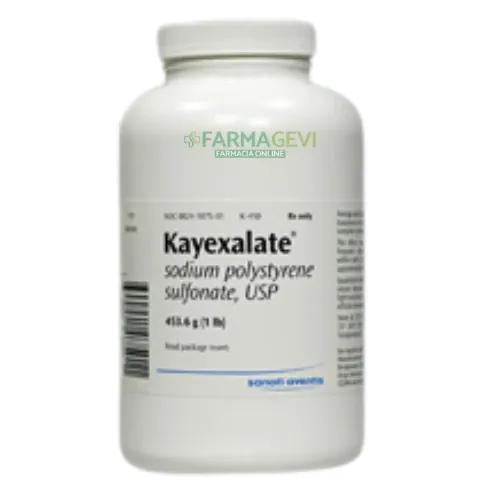
KAYEXALATE
ItalyIt is used for the treatment of hyperkalemia, i.e., to lower the amount of potassium in the blood.
Frequently asked questions
When should you not take Kayexalate?
It must not be taken if you are allergic to the active substance or any of the components, if the potassium level in the blood is lower than 5 mEq/l, or if you suffer from bowel function problems (obstructive bowel disease).
How should the medicine be taken correctly?
The drug can be taken orally or rectally following the doctor's instructions. For oral administration, the adult dose is 15 g (one scoop) 1 to 4 times daily, dissolved in a small amount of water or in water and sugar. For rectal administration, the dose is 30 g dissolved in 150-200 ml of water or 10% dextrose as an enema. The powder must be dissolved in water shortly before use and must not exceed 37°C.
What are the interactions with other drugs?
Kayexalate must not be taken at the same time as other oral medicines; it is necessary to wait at least 3 hours before or after taking other drugs (6 hours in the case of gastroparesis). Use together with sorbitol is dangerous. Attention must also be paid to the use of antacids (aluminum hydroxide or magnesium hydroxide), heart medicines (digitalis), lithium, and thyroid medications (thyroxine).
What are the side effects of Kayexalate?
Possible side effects include changes in blood levels of sodium, potassium, calcium, and magnesium; stomach irritation, nausea, vomiting, constipation, or diarrhea; risk of intestinal obstruction or formation of compact masses; and, in severe cases (especially with the use of sorbitol), intestinal lesions that can lead to bowel perforation.
What happens if an excessive dose is taken?
Excessive intake can cause a sharp decrease in blood potassium with symptoms such as irritability, confusion, muscle weakness, cardiac arrhythmias, or respiratory problems, as well as a possible decrease in calcium with involuntary muscle contractions.
Instructions for use
Patient Information Leaflet
Kayexalate oral and rectal suspension powder
sodium polystyrene sulfonate
Please read all of this leaflet carefully before taking this medicine because it contains important information for you.
- Keep this leaflet. You may need to read it again.
- If you have any questions, ask your doctor or pharmacist.
- This medicine has been prescribed for you only. Do not give it to other people, even if they have the same symptoms as yours, because it could be harmful.
- If you experience any side effect, including those not listed in this leaflet, talk to your doctor or pharmacist. See section 4.
Contents of this leaflet:
- What Kayexalate is and what it is used for
- What you need to know before taking Kayexalate
- How to take Kayexalate
- Possible side effects
- How to store Kayexalate
- Contents of the pack and other information
1. What Kayexalate is and what it is used for
Kayexalate contains the active substance sodium polystyrene sulfonate and belongs to a class of
medicines called "medicines for the treatment of hyperkalemia".
Kayexalate is indicated for the treatment of hyperkalemia, meaning it works by lowering the amount of
potassium in the blood.
2. What you should know before taking Kayexalate
Do not take Kayexalate
- if you are allergic to sodium polystyrene sulfonate or to any of the other ingredients of this medicine (listed in section 6);
- if your blood potassium level is below 5 mEq/l;
- if you have intestinal motility disorders (intestinal obstructive disease).
Kayexalate must not be administered orally to newborns or infants with reduced intestinal function (following surgery or drug-induced).
Warnings and precautions
Take this medicine exactly as prescribed by your doctor or pharmacist.
Talk to your doctor or pharmacist before taking Kayexalate:
- If you are taking other oral medicines, because Kayexalate may reduce their absorption and effectiveness. Avoid concomitant use of Kayexalate with other oral medications. Take Kayexalate at least 3 hours before or 3 hours after taking any other oral medicine. If you have gastroparesis (a stomach disorder causing food to remain in the stomach much longer than normal), consider a 6-hour interval.
- If you have low blood potassium levels; especially if you are taking heart medications belonging to the "digitalis" class, treatment with Kayexalate may lead to a marked decrease in blood potassium levels. For this reason, your doctor may perform regular monitoring during treatment. Therapy should be discontinued as soon as blood potassium levels fall below 5 mEq/l (see "Do not take Kayexalate").
- If you have electrolyte imbalances; Kayexalate may increase the elimination of magnesium and calcium from the blood. Your doctor may decide to monitor you during treatment.
- If your blood potassium level is very high, because Kayexalate alone may not be sufficient to lower this concentration, and your doctor may decide to modify the treatment (e.g., glucose and insulin or intravenous sodium bicarbonate). In cases of severe hyperkalemia caused by rapid tissue breakdown (e.g., burns or renal failure), your doctor may opt for dialysis (peritoneal dialysis or hemodialysis).
- If you are taking sorbitol, because when taken with Kayexalate it may cause intestinal narrowing (gastrointestinal stenosis), severe reduction of blood flow to the intestine (intestinal ischemia), severe intestinal damage (necrosis), which may lead to intestinal perforation.
- If you are taking Kayexalate orally and experience significant constipation (clinically significant constipation), stop taking it immediately until intestinal function returns to normal. Do not take laxatives containing magnesium or sorbitol (see "Other medicines and Kayexalate").
- If you are taking the medicine orally, ensure you are in the correct position to prevent the medicine from entering the airways (aspiration), which may cause bronchopulmonary complications.
- If you are at risk of high blood sodium levels or if you have heart disease (severe congestive heart failure), severe high blood pressure (severe hypertension), kidney problems, or swelling in the lower limbs due to fluid retention (marked edema), take Kayexalate with caution. In some cases, your doctor may require monitoring tests, adjust your therapy, or modify your diet.
- If you have severe impairment of kidney function (chronic uremia) or have gastric or intestinal lesions, take Kayexalate with caution.
- If you have severe kidney dysfunction (uremia), recent burns, gastrointestinal lesions, or reduced gastrointestinal motility, your doctor may choose alternative medications to reduce blood potassium levels.
- If you are taking calcium carbonate or aluminum hydroxide, because in the presence of sodium polystyrene sulfonate, these may be absorbed, altering blood acidity, which in extreme cases could trigger seizures. In particular, the use of antacids (aluminum hydroxide) may require increased resin dosage, leading to gastric accumulation and formation of solid masses.
Children
Do not give Kayexalate orally to a newborn. If administering Kayexalate rectally to a child or newborn, pay close attention to how you dilute the powder and to the dosage, as it may form a single solid mass (impaction).
If you need to give Kayexalate to a premature infant or a low-birth-weight newborn, exercise extreme caution, as this may increase the risk of severe gastrointestinal bleeding, severe stomach and intestinal damage (colonic necrosis), and increased blood sodium concentration (sodium overload).
Other medicines and Kayexalate
Inform your doctor or pharmacist if you are taking, have recently taken, or might take any other medicines.
Combinations not recommended (see "Warnings and precautions"):
- Do not take this medicine simultaneously with other oral medicines because Kayexalate may bind to them, reducing their gastrointestinal absorption and effectiveness. Kayexalate administration must be separated from that of other oral medicines (see section "Warnings and precautions").
- Do not use sorbitol because, when taken with Kayexalate, it may cause severe intestinal damage and serious gastrointestinal reactions that could be fatal. The combination of these two medicines should therefore be avoided.
Combinations requiring caution:
- Be particularly careful if you take antacids ("non-absorbable cation donor antacids" such as magnesium hydroxide and calcium carbonate) or laxatives with Kayexalate, as this may cause a change in blood acidity known as "systemic alkalosis."
- Other medicines known as "cation donors": the effect of Kayexalate may be reduced.
- Exercise great caution if taking aluminum hydroxide-based antacids together with Kayexalate, as intestinal blockage (intestinal obstruction) due to formation of solid masses may occur.
- It is not advisable to take digitalis-based medicines while taking Kayexalate, because low potassium levels in the blood may increase the risk of digitalis-related heart toxicity, particularly disturbances in heart rhythm (ventricular arrhythmias) and other cardiac function abnormalities (AV nodal dissociations).
- If you are taking lithium-based medicines, be cautious, as concomitant use with Kayexalate may reduce lithium absorption.
- If you are taking thyroid medications containing thyroxine, be cautious, as concomitant use with Kayexalate may reduce thyroxine absorption.
Pregnancy and breastfeeding
If you are pregnant, suspect you may be pregnant, are planning pregnancy, or are breastfeeding, consult your doctor or pharmacist before taking this medicine.
Kayexalate is not absorbed through the stomach or intestine. Although there are no data on the use of Kayexalate during pregnancy and breastfeeding, its use is not recommended during the first trimester of pregnancy. Kayexalate should be administered during later stages of pregnancy only if clearly needed and under strict medical supervision.
Kayexalate oral and rectal suspension powder contains sodium
This medicine may contain up to 1.7 g of sodium (the main component of table salt) per dosing scoop (15 g of oral and rectal suspension powder). This is approximately equivalent to 85% of the maximum daily dietary intake recommended for an adult.
Talk to your doctor or pharmacist if you need to take one or more scoops per day over a prolonged period, especially if you have been advised to follow a low-sodium diet.
3. How to take Kayexalate
Take this medicine exactly as directed by your doctor or pharmacist. If you have any doubts, consult your doctor or pharmacist.
Kayexalate is primarily taken orally, but it may also be administered rectally if you have difficulty taking Kayexalate by mouth (due to vomiting or gastrointestinal problems involving the stomach and upper intestine). Your doctor may prescribe Kayexalate both orally and rectally to achieve faster initial results. If both routes are used initially, rectal administration may no longer be necessary once the orally administered resin has reached the rectum.
The duration of treatment depends on the severity and duration of hyperkalemia.
The resin must be dissolved in water just before use and must not be stored dissolved in water for more than 24 hours. Heat may alter the properties of the resin (do not exceed 37°C).
This medicine must not be mixed with other medicines.
Your doctor may decide to adjust the dosage based on laboratory test results.
Adults and elderly
Oral route
Recommended dose:
15 g (one measuring spoon) 1–4 times daily.
Take the powder after mixing it into a paste or suspension with a small amount of water. To improve palatability, it may be mixed with water and sugar (not fruit juices, which contain potassium). Use only a small amount of water (use 3–4 ml per gram of powder), especially if you have impaired kidney function (renal insufficiency).
Your doctor may decide to administer Kayexalate via a nasogastric tube (directly into the stomach) or may instruct you to take the powder mixed with food.
- Take Kayexalate at least 3 hours before or 3 hours after other oral medications. If you have gastroparesis (a stomach disorder causing prolonged food retention in the stomach), consider a 6-hour interval.
Rectal route
Recommended dose:
30 g of powder (two measuring spoons) dissolved in 150–200 ml of water or 10% dextrose solution, administered 1–2 times daily. The powder suspended in liquid should be given as a retention enema and retained in the rectum for the recommended time.
Before administering Kayexalate rectally, perform a cleansing enema.
Try to retain the Kayexalate enema, if possible, for 10–12 hours, followed by a cleansing enema to remove the medication.
The Kayexalate suspension should be gently shaken during administration.
The Kayexalate suspension should be administered at body temperature, not exceeding 37°C, as heating may alter the medicinal properties.
The cleansing enema should be performed using a sodium-free solution, warmed to body temperature; up to two liters of cleansing solution may be required.
Children
Experience with the use of KAYEXALATE in children is limited.
Oral route
Recommended initial dose:
1 g/kg body weight per day, divided into several doses.
For maintenance, the dose may be reduced to 0.5 g/kg body weight per day.
Dosage in younger children should be proportionally lower.
For administration instructions, refer to "Adults and elderly."
Rectal route
Recommended dose:
At least equivalent to the recommended oral dose, suspended in a proportionally adequate amount of water and 10% dextrose solution.
Administration follows the same procedures described under "Adults and elderly." Extreme caution is advised in children or neonates, as excessive dosage or inadequate dilution may lead to Kayexalate compaction and possible intestinal obstruction due to very hard stools (fecaloma).
Neonates
Experience with the use of KAYEXALATE in neonates is limited, and administration should be performed only via the rectal route.
Rectal route
Recommended dose:
Between 0.5 g/kg and 1 g/kg (the minimum effective dose).
Administration follows the same procedures described under "Adults and elderly." Extreme caution is advised in children or neonates, as excessive dosage or inadequate dilution may lead to Kayexalate compaction and possible intestinal obstruction due to very hard stools (fecaloma).
If you take more Kayexalate than you should
In case of accidental ingestion/overdose of Kayexalate, contact your doctor immediately or go to the nearest hospital.
If you take an excessive dose of Kayexalate, you may experience a marked decrease in blood potassium levels, leading to irritability, confusion, slowed mental function, muscle weakness, reduced reflexes (hyporeflexia), and possibly paralysis (flaccid paralysis). Severe hypokalemia may result in prolonged respiratory pauses (apnea), electrocardiogram changes, and disturbances in heart rhythm (cardiac arrhythmias). An overdose of Kayexalate may also cause decreased blood calcium levels, resulting in involuntary muscle contractions (tetany).
If you forget to take Kayexalate
Do not take a double dose to make up for the missed dose.
4. Possible side effects
Like all medicines, this medicine can cause side effects, although not everyone gets them.
The following side effects may occur:
- increase in sodium levels in the blood (sodium retention), decrease in potassium levels in the blood (hypokalaemia), and decrease in calcium levels in the blood (hypocalcaemia);
- decrease in magnesium levels in the blood (hypomagnesaemia);
- stomach irritation (gastric irritation), loss of appetite (anorexia), nausea and vomiting, reduced intestinal function (constipation), and diarrhoea;
- intestinal blockage due to hardened faeces (fecal impaction), in elderly patients treated with a high dose or in children after rectal administration;
- narrowing of the stomach and intestine (gastrointestinal stenosis) and intestinal obstruction, due to a pre-existing condition (stomach or intestinal problems), concomitant use of aluminium hydroxide-containing medicines, or inadequate dilution of the resin;
- formation of solid masses of the medicine in the stomach and intestine (gastrointestinal bezoar) leading to intestinal obstruction, or formation of medicine "crystals" adhering to the stomach and intestinal mucosa (gastrointestinal);
- severe reduction of blood flow to the intestine (gastrointestinal ischaemia), intestinal pain due to reduced blood flow (ischaemic colitis), lesions in the stomach and intestine (gastrointestinal ulceration), or severe intestinal damage (necrosis), which may lead to intestinal perforation (intestinal perforation), sometimes fatal, particularly after use of sorbitol;
- acute bronchitis and/or bronchopneumonia associated with inhalation of the powder.
Following the instructions provided in this leaflet reduces the risk of side effects.
Reporting of side effects
If you experience any side effect, including those not listed in this leaflet, talk to your doctor or pharmacist.
You can also report side effects directly via the national reporting system at the following website: http://www.aifa.gov.it/content/segnalazioni-reazioni-avverse. By reporting side effects, you can help provide more information on the safety of this medicine.
5. How to store Kayexalate
Keep this medicine out of the sight and reach of children.
This medicine does not require any special storage conditions.
Do not use this medicine after the expiry date stated on the carton after “Exp”. The expiry date refers to the last day of that month.
Do not dispose of medicines via wastewater or household waste. Ask your pharmacist how to dispose of medicines you no longer use. This will help protect the environment.
6. Package contents and other information
What Kayexalate contains
- The active substance is sodium polystyrene sulfonate. Each bottle contains sodium polystyrene sulfonate 453.7 g.
- The other components are vanillin, saccharin.
Description of the appearance of Kayexalate and contents of the pack
Kayexalate is a golden-yellow powder supplied in a bottle containing 454 g of powder for oral and rectal suspension, with a 15 g dosing scoop.
Marketing Authorization Holder
Sanofi S.r.l. – Viale L. Bodio, 37/B - Milan
Manufacturer
Astrea Amilly - 196, Avenue du Marechal Juin - Amilly (France)
The original data is available in the language of the country of manufacture.
Data source: Italian Medicines Agency (AIFA)
Data last verified: September 21, 2026