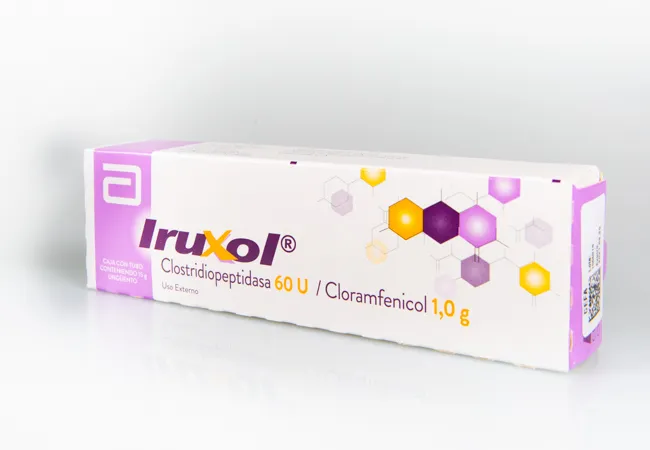
IRUXOL
ItalyIt is used for the cleaning of wounds, ulcers (leg, diabetic, or pressure ulcers), burns, and sores. The contained enzymes help to remove crusts and dead tissue, while the antibiotic fights infections to accelerate healing.
Frequently asked questions
How should Iruxol be applied?
After disinfecting the wound with saline solution or sterile distilled water, apply a thin layer of approximately 2 mm directly onto the lesion or onto a dressing, ensuring it is in contact with the wound and covers it. Application should be done once a day, or twice if advised by a physician.
When should this product not be used?
It must not be used if you are allergic to its components, if you are pregnant or breastfeeding, or if the patient is a child or an adolescent. It should not be used together with antiseptics, disinfectants (such as hydrogen peroxide or alcohol), heavy metals, medicated soaps, or other topical antibiotics that could block its action.
What are the side effects of Iruxol?
Common effects include skin allergic reactions (pain, itching, burning, redness), pain or a burning sensation at the application site, and contact dermatitis. Very rarely, the absorption of the antibiotic may cause serious alterations to blood cells.
What to do if irritation is noticed or if there is no improvement?
If signs of sensitization appear (such as itching or redness), discontinue treatment immediately and consult a physician. If no improvement is noted after 14 days of treatment, it is necessary to consult a doctor or a pharmacist.
Are there any particular precautions for diabetics?
Yes, in diabetic patients with gangrene, the excessive moisture caused by the product may promote infections; in these cases, the wound must be monitored carefully and regularly.
Instructions for use
Table of contents
- Iruxol 1g (1%)/60 U.I. Ointment
- 1. What Iruxol is and what it is used for
- 2. What you need to know before using Iruxol
- 3. How to use Iruxol
- 4. Possible side effects
- 5. How to store Iruxol
- 6. Contents of the pack and other information
- The following information is intended exclusively for physicians or healthcare professionals
Package leaflet: Information for the patient
Iruxol 1g (1%)/60 U.I. Ointment
Chloramphenicol/Collagenase (Clostridiopeptidase A)
Please read this leaflet carefully before using this medicine because it contains important information for you.
- Keep this leaflet. You may need to read it again.
- If you have any questions, ask your doctor or pharmacist.
- This medicine has been prescribed for you only. Do not give it to others, even if their symptoms are the same as yours, as it could be harmful.
- If you experience any adverse reaction, including those not listed in this leaflet, contact your doctor or pharmacist. See section 4.
Contents of this leaflet:
- What Iruxol is and what it is used for
- What you need to know before using Iruxol
- How to use Iruxol
- Possible side effects
- How to store Iruxol
- Contents of the pack and other information
1. What Iruxol is and what it is used for
Iruxol ointment contains Clostridiopeptidase A (collagenase enzyme) and other proteases, and chloramphenicol. Collagenase and proteases are used for wound debridement because they are able to remove (clean) dry or moist crusts and eschars (necrotic, fibrinous tissue) typically present on wounds, leg ulcers, pressure ulcers, diabetic ulcers, burns, and chronic sores (e.g., post-operative, radiation-induced, or trauma-related). Chloramphenicol is an antibiotic used in local applications to combat infections in such lesions. By removing crusts and eschars and fighting infections, Iruxol accelerates wound healing. Consult your doctor if you do not notice improvement or if you feel worse after 14 days of treatment.
2. What you need to know before using Iruxol
Do not use Iruxol
- if you are allergic to clostridiopeptidase, proteases, proteolytic enzymes, chloramphenicol, or to any of the other ingredients of this medicine (listed in section 6).
- if you are pregnant or breastfeeding.
- in pediatric patients.
Warnings and precautions
Talk to your doctor or pharmacist before using Iruxol if:
- you are diabetic and have been diagnosed with gangrene, as excessive moistening of the lesion may promote infections; in such cases, the lesion must be carefully and regularly monitored.
Rare cases of bone marrow hypoplasia have been reported following prolonged use of topical chloramphenicol; therefore, this product should be used only for short periods unless otherwise directed by a physician.
Prolonged use of topical (skin-applied) products may cause sensitization reactions such as local pain, itching, burning, and erythema; if this occurs, discontinue treatment immediately and consult your doctor or pharmacist.
Prolonged use of topical products containing an antibiotic may lead to bacterial resistance; if symptoms persist or worsen, discontinue treatment and consult your doctor.
Avoid contact with eyes and mouth. Do not ingest.
Children and adolescents
This medicine is not indicated for use in children and adolescents.
Other medicines and Iruxol
Inform your doctor or pharmacist if you are currently using, have recently used, or might use any other medicines, and/or other local treatments, e.g., dressings.
Iruxol ointment should not be used if you are applying other products to the wound that may interfere with its enzymatic activity, such as:
- antiseptics or disinfectants (e.g., denatured alcohol, hydrogen peroxide, quaternary ammonium salts)
- heavy metals
- detergents
- medicated soaps
- topical antibiotics (tyrothricin, gramicidin, tetracyclines)
- other deproteinizing agents
Iruxol with food, drink, and alcohol
No effects of food, drink, or alcohol on the use of Iruxol are known.
Pregnancy, breastfeeding, and fertility
If you are pregnant, think you may be pregnant, plan to become pregnant, or are breastfeeding, consult your doctor or pharmacist before using this medicine.
No data are available on the use of Iruxol during pregnancy or breastfeeding; therefore, as a precautionary measure, avoid using Iruxol during pregnancy and breastfeeding.
Driving and using machines
It is unlikely that Iruxol will affect your ability to drive or operate machinery.
3. How to use Iruxol
Use this medicine exactly as directed by your doctor or pharmacist. If in doubt, consult your doctor or pharmacist.
-
Before application, disinfect the lesion with physiological saline solution (0.9% NaCl) or sterile distilled water.
-
Apply this medicine only to the skin. Avoid contact with eyes and mouth (mucous membranes).
-
Apply a thin layer of Iruxol (approximately 2 mm) directly onto the wound or onto a dressing which is then placed on the wound. Ensure the ointment is in close contact with the wound and cover it with a dressing.
-
Apply the ointment once daily; your doctor may advise twice-daily application if a stronger wound-cleaning effect is needed.
-
Before reapplying the product, ensure that any detached dead tissue (necrotic tissue) is removed using sterile forceps, spatula, swab, or curettes, and with baths.
-
It is advisable to protect the periwound skin with zinc oxide paste or similar preparations, regardless of whether irritation is present.
-
Discontinue Iruxol application once the wound is clean and adequate granulation has started. Continue treatment with ointments that promote granulation and re-epithelialization.
-
Dry, hard crusts may be softened by applying a moist dressing (e.g., gauze or moist bandage) prior to Iruxol application, as moisture enhances the product's effectiveness.
-
In the treatment of varicose and post-phlebitic ulcers, the use of compressive bandages may be beneficial alongside Iruxol; in cases of arterial circulation disorders, specific medications may also be used.
In diabetic ulcers with gangrene, excessive moisture induced by the medicine may increase the risk of infection; in such cases, the lesion must be carefully and regularly monitored.
If no improvement is observed after a maximum of 14 days of treatment, consult your doctor or pharmacist.
Occasionally, especially with prolonged use of topical preparations, irritative or sensitization reactions may occur. In such cases, discontinue treatment promptly (even before 14 days) and consult your doctor.
If you use more Iruxol than you should
No problems related to overdose of the active ingredients in this preparation have been reported to date. If you think you have applied too much Iruxol, contact your doctor or pharmacist.
4. Possible side effects
Like all medicines, this medicine can cause side effects, although not everybody gets them. The adverse reactions associated with Iruxol, classified by frequency, are listed below:
Common (may affect up to 1 in 10 people)
- Hypersensitivity reactions including allergic skin reactions (with symptoms such as local pain, itching, erythema, burning)
- Pain at the application site
- Burning sensation
- Localized skin reactions, including eczematous reactions (contact dermatitis)
Uncommon (may affect up to 1 in 100 people)
- Erythema
- Itching
Very rare (may affect up to 1 in 10,000 people)
Blood cell production disorders (haematological dyscrasias) due to absorption of chloramphenicol, up to and including idiosyncratic, irreversible, and potentially fatal aplastic anaemia.
In case of serious adverse reactions, your doctor will decide whether treatment should be discontinued.
Reporting of side effects
If you experience any adverse reaction, including those not listed in this leaflet, contact your doctor or pharmacist. You can also report side effects directly via the national reporting system at: https://www.aifa.gov.it/content/segnalazioni-reazioni-avverse
Reporting side effects helps provide more information on the safety of this medicine.
5. How to store Iruxol
Keep this medicine out of the sight and reach of children.
Store Iruxol at a temperature not exceeding 25°C.
Do not use this medicine after the expiry date stated on the carton and tube after "Exp". The expiry date refers to the last day of that month.
Do not dispose of medicines via wastewater or household waste. Ask your pharmacist how to dispose of medicines no longer required. This will help protect the environment.
6. Contents of the pack and other information
What Iruxol contains
The active ingredient is a mixture of enzymes consisting of Clostridiopeptidase and proteases, and chloramphenicol. One gram of ointment contains not less than 60 Units of Clostridiopeptidase A and 1 g (1%) of chloramphenicol.
The other ingredients are liquid paraffin and white soft paraffin.
Description of the appearance of Iruxol and contents of the pack
Iruxol is a transparent or slightly brownish ointment, available in 30 g aluminium tubes.
Marketing Authorisation Holder and Manufacturer
Marketing Authorisation Holder
Smith & Nephew GmbH
Friesenweg 30
22763 Hamburg
Germany
Manufacturer
Nordmark Pharma GmbH
Pinnauellee 4
D-25436 Uetersen
Germany
Italian Representative
Smith & Nephew S.r.l.
Viale T. Edison, 110
20099 Sesto San Giovanni (MI)
Italy
The following information is intended exclusively for physicians or healthcare professionals
Method of Administration
To achieve optimal results with enzymatic debridement of wounds using Iruxol, the following guidelines should be observed:
- Disinfect the skin lesion with physiological saline solution (0.9% NaCl) or sterile distilled water before applying Iruxol.
- Iruxol ointment should be applied evenly over the entire wound surface, in a thin layer of a few millimeters thickness (approximately 2 mm).
- Drying of the wound surface must be avoided, as moisture enhances enzymatic activity. Therefore, completely dry or hardened crusts should first be softened with a moist dressing.
- In cases of resistant necrosis, the effectiveness of Iruxol can be improved by making incisions at the edges or in the center of the necrotic tissue, allowing part of the ointment to penetrate beneath the necrotic layer.
- When changing the dressing, detached necrotic material should be removed using sterile forceps, spatula, swab, or curettes, along with wound baths. It is advisable to protect the perilesional skin with zinc oxide paste or similar preparations, regardless of whether irritation is present.
- Application of Iruxol should be discontinued once the wound is adequately debrided and healthy granulation tissue has begun to form. Continue with treatments that promote granulation and re-epithelialization.
- In the treatment of varicose and post-phlebitic ulcers, in addition to Iruxol, the use of compressive bandages may be beneficial. In cases of arterial circulation disorders, appropriate medications should be used. If no improvement in the wound is observed after a maximum of 14 days of treatment, alternative wound debridement methods should be considered. If signs of sensitization occur, therapy should be discontinued even before the 14-day period.
Special Warnings and Precautions for Use
Although the risk is rare, bone marrow hypoplasia, including aplastic anemia and death, has been reported following the use of chloramphenicol. These rare conditions should be taken into account when evaluating the expected benefits of using the medicinal product. Therefore, the product should be used only for short durations unless otherwise explicitly directed by the physician. It may be advisable to perform a routine blood profile before starting therapy and at appropriate intervals thereafter to detect any hematopoietic abnormalities.
The use, especially prolonged use, of topical preparations may lead to irritant or sensitizing reactions. In such cases, treatment should be promptly discontinued (even before 14 days) and appropriate therapy initiated.
Treatment should also be discontinued and appropriate therapy instituted if non-susceptible microorganisms develop.
In diabetic patients with dry wounds or gangrene, excessive moisture induced by the medicinal product may increase the risk of infection; therefore, careful and regular monitoring of the lesion is required.
The original data is available in the language of the country of manufacture.
Data source: Italian Medicines Agency (AIFA)
Data last verified: September 21, 2026