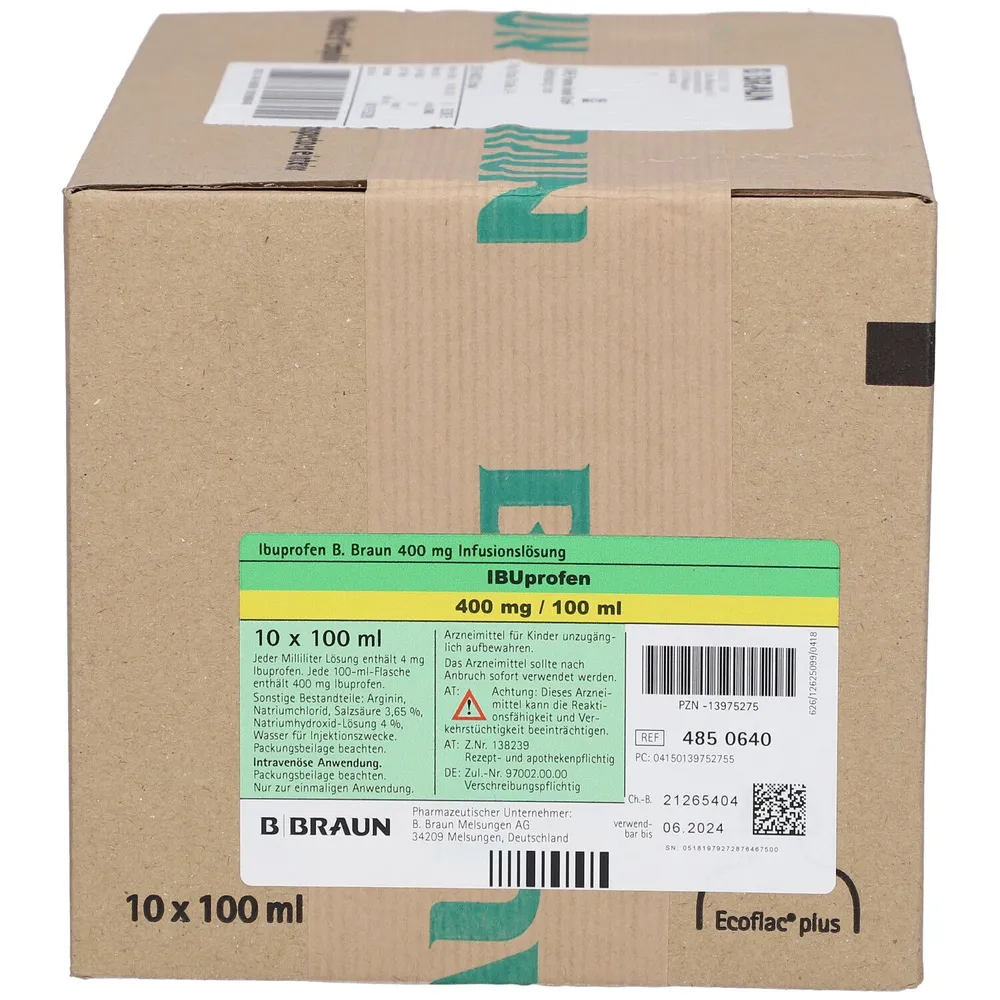
IBUPROFEN B.BRAUN
ItalyIt is used in adults for the short-term symptomatic treatment of moderate acute pain and fever, when intravenous administration is clinically justified and other routes of administration are not possible.
Frequently asked questions
How should Ibuprofene B. Braun be taken?
The drug must be administered by a doctor or a nurse in a equipped setting via intravenous infusion over 30 minutes. The adult dose is 400 mg every 6-8 hours, as needed, without exceeding the maximum daily dose of 1200 mg. Treatment should not exceed 3 days.
Who must not take this medicine?
It must not be used by those allergic to ibuprofen or its components, by those who have had allergic reactions (such as asthma, rash, or swelling) when taking ibuprofen or other NSAIDs, by those with bleeding problems or stomach ulcers, by those suffering from severe kidney, liver, or heart problems, by those who are severely dehydrated, or those in the last trimester of pregnancy.
What are the side effects of Ibuprofene B. Braun?
The most common effects include gastric acidity, nausea, vomiting, diarrhea, abdominal pain, fatigue, insomnia, headache, and dizziness. More serious effects may also occur, such as ulcers or gastrointestinal bleeding, heart problems (heart attack or stroke), severe allergic reactions, kidney or liver problems, and serious skin reactions.
Are there interactions with other medicines?
Yes, use may be affected by many other medicines, including other anti-inflammatories (NSAIDs), anticoagulants, blood pressure medications, corticosteroids, diuretics, certain antibiotics, and diabetes medications. It is essential to inform the doctor about all medications being taken.
Can the drug be used during pregnancy or breastfeeding?
It must not be taken during the last trimester of pregnancy. During breastfeeding, it can be used if at the recommended dose and for the shortest time possible, but if doses exceeding 1200 mg per day are used, the doctor may advise stopping breastfeeding.
Can the medicine be used by children?
No, the medicine must not be used in children and adolescents under 18 years of age.
Instructions for use
Table of contents
Package leaflet: Information for the patient
Ibuprofen B. Braun 400 mg infusion solution
ibuprofen
Read this leaflet carefully before you are given this medicine because it contains
important information for you
- Keep this leaflet. You may need to read it again.
- If you have any questions, ask your doctor or nurse.
- If you get any side effects, including those not listed in this leaflet, tell your doctor or nurse. See section 4.
Contents of this leaflet:
- What Ibuprofen B. Braun is and what it is used for
- What you need to know before being given Ibuprofen B. Braun
- How Ibuprofen B. Braun is given
- Possible side effects
- How to store Ibuprofen B. Braun
- Contents of the pack and other information
1. What Ibuprofen B. Braun is and what it is used for
Ibuprofen belongs to a group of medicines called "non-steroidal anti-inflammatory drugs" or
(NSAIDs).
This medicine is used in adults for the short-term symptomatic treatment of moderate acute pain and for the short-term symptomatic treatment of fever, when intravenous administration is clinically justified and when other routes of administration are not possible.
2. What you need to know before taking Ibuprofene B. Braun
Do not take Ibuprofene B. Braun:
- if you are allergic to ibuprofen or to any of the other ingredients of this medicine (listed in section 6)
- if you have previously experienced shortness of breath, asthma, skin rash, runny nose, itching or swelling of the face after taking ibuprofen, acetylsalicylic acid or another similar painkiller (NSAIDs)
- if you have a condition that increases the tendency to bleed or have active bleeding
- if you currently have or have had a history of stomach ulcer(s) or recurrent gastrointestinal bleeding (two or more episodes)
- if you have previously experienced bleeding or perforation of the stomach or intestine while taking NSAIDs
- if you have bleeding in the brain (cerebrovascular haemorrhage) or other ongoing bleeding
- if you have severe kidney, liver or heart problems
- if you are severely dehydrated (caused by vomiting, diarrhoea or insufficient fluid intake)
- if you are in the last trimester of pregnancy
Warnings and precautions
Talk to your doctor or nurse before using this medicine.
Anti-inflammatory/pain-relieving medicines such as ibuprofen may be associated with a small increased risk of heart attack or stroke, particularly when used at high doses. Do not exceed the recommended dose or duration of treatment.
Skin reactions
Serious skin reactions have been reported with ibuprofen treatment. Stop using Ibuprofene and consult your doctor immediately if you develop rash, mucosal lesions, blisters or other signs of allergy, as these may be early signs of a very serious skin reaction. See section 4.
Before taking Ibuprofene B. Braun, discuss with your doctor:
- If you have heart problems, including heart failure, angina (chest pain), or if you have had a heart attack, bypass surgery, peripheral arterial disease (poor circulation in the legs or feet due to narrowed or blocked arteries), or any type of stroke (including "mini-stroke" or transient ischaemic attack "TIA").
- If you have high blood pressure, diabetes, high cholesterol, a family history of heart disease or stroke, or if you smoke.
- If you have recently undergone major surgery.
- If you have had or develop an ulcer, bleeding or perforation of the stomach or duodenum. In such cases, your doctor may consider prescribing a stomach-protective medicine.
- If you have asthma or another respiratory disorder.
- If you have an infection – see section “Infections” below.
- If you have kidney or liver disease, are over 60 years old, or are taking ibuprofen for long-term treatment, your doctor may need to carry out regular check-ups. Your doctor will advise you on how often these checks should be performed.
- If you are dehydrated, for example due to diarrhoea, drink plenty of fluids and contact your doctor immediately, as ibuprofen in this case may cause kidney failure as a result of dehydration.
- If you have Crohn's disease or ulcerative colitis, as ibuprofen may worsen these conditions.
- If you notice any skin lesions, swelling or redness, or have difficulty breathing (asphyxia), stop treatment immediately and contact your doctor or nurse.
- If you have chickenpox, as complications may occur.
- If you have a congenital disorder of porphyrin metabolism (e.g. acute intermittent porphyria).
- If you drink alcohol at the same time as taking this medicine, side effects related to the stomach, intestine and nervous system may increase.
- If you suffer from hay fever, nasal polyps or chronic obstructive respiratory disorders, you are at high risk of allergic reactions. Allergic reactions may present as asthma attacks (so-called analgesic-induced asthma), rapid swelling (Quincke's oedema) or skin rash.
- It is important that you take the lowest dose that relieves and controls your pain and that you do not take this medicine longer than necessary to control your symptoms.
- Allergic reactions may occur with this medicine, mainly at the beginning of treatment. In such cases, treatment must be stopped.
- There have been some cases of aseptic meningitis with the use of this medicine. The risk is higher if you have systemic lupus erythematosus or related connective tissue diseases.
- .
- Concomitant use of NSAIDs, including selective cyclooxygenase-2 inhibitors, should be avoided.
Infections
Ibuprofen may mask symptoms of infections such as fever and pain. Therefore, this medicine may delay appropriate treatment of the infection, potentially increasing the risk of complications. This has been observed in bacterial pneumonia and bacterial skin infections associated with chickenpox. If you take this medicine while having an infection and infection symptoms persist or worsen, consult your doctor immediately.
In general, habitual use of (various types of) analgesics may lead to serious and long-lasting kidney problems.
After prolonged use of painkillers, headache may occur, which should not be treated with higher doses of the medicine.
With prolonged administration of ibuprofen, regular monitoring of liver values, kidney function and blood cell counts is necessary.
Ibuprofen may alter the following laboratory tests:
- Bleeding time (may be prolonged for 1 day after treatment ends)
- Blood glucose levels (may be decreased)
- Creatinine clearance (may be decreased)
- Haematocrit or haemoglobin (may be decreased)
- Blood urea nitrogen, serum creatinine and serum potassium (may be increased)
- Liver function tests: increased transaminase levels
Inform your doctor if you are to undergo clinical tests and are currently using or have recently used ibuprofen.
Children and adolescents
The safety and efficacy of Ibuprofene B. Braun in children and adolescents has not been established.
This medicine must not be used in children and adolescents (under 18 years of age).
Other medicines and Ibuprofene B. Braun
Inform your doctor or nurse if you are taking, have recently taken or might take any other medicine.
Ibuprofene B. Braun may affect or be affected by certain other medicines. For example:
-
Other non-steroidal anti-inflammatory drugs (NSAIDs), including COX-2 selective inhibitors (e.g. celecoxib), may increase the risk of gastrointestinal ulcers and bleeding due to an additive effect.
-
Medicines that are anticoagulants (i.e. that thin the blood / prevent clotting; e.g. acetylsalicylic acid, warfarin, ticlopidine).
-
Cardiac glycosides such as digoxin (used to treat heart failure), phenytoin (used to treat epilepsy) or lithium (used to treat depression) may have increased blood levels when taken together with ibuprofen.
-
Methotrexate (used to treat certain types of cancer or rheumatic conditions) taken concurrently with ibuprofen (within a 24-hour interval) may increase blood levels and the risk of methotrexate toxicity.
-
Mifepristone (a medicine used to terminate pregnancy).
-
SSRIs (antidepressants) such as fluoxetine may also increase the risk of stomach and intestinal bleeding.
-
Medicines that reduce high blood pressure (ACE inhibitors such as captopril, beta-blockers such as atenolol, angiotensin-II receptor antagonists such as losartan).
-
Corticosteroids (such as hydrocortisone) (used for inflammation), as they increase the risk of ulcer or bleeding in the stomach and intestine.
-
Diuretics (medicines used to increase urination, such as bendroflumethiazide), because NSAIDs may reduce the effectiveness of these medicines and increase the risk of kidney problems (use of potassium-sparing diuretics with ibuprofen may lead to high potassium levels in the blood).
-
Medicines containing probenecid and sulfinpyrazone may delay the excretion of ibuprofen.
-
Cyclosporine and tacrolimus (used to prevent transplant rejection) may increase the risk of kidney damage.
-
Sulfonylureas, such as glibenclamide (medicines used for diabetes). Monitoring of blood glucose levels is recommended when these medicines are used together.
-
Quinolone antibiotics, such as ciprofloxacin, due to an increased risk of developing convulsions (epileptic seizures).
-
Voriconazole, fluconazole (CYP2C9 inhibitors used for fungal infections) may increase ibuprofen blood levels.
-
Zidovudine (used for HIV infection) due to increased risk of blood accumulation in joints and bruising.
-
Aminoglycosides (a type of antibiotic). NSAIDs may decrease the excretion of aminoglycosides.
-
Ginkgo biloba (a herbal medicine often used in dementia) may increase the risk of bleeding.
Some other medicines may also affect or be affected by ibuprofen treatment.
Therefore, you should always seek advice from your doctor or nurse before taking ibuprofen with other medicines.
.
Pregnancy, breastfeeding and fertility
If you are pregnant, think you may be pregnant, are planning to become pregnant, or are breastfeeding, consult your doctor or nurse before taking this medicine.
. Do not take this medicine during the third trimester (the last 3 months of pregnancy).
This medicine passes into breast milk, but may be used during breastfeeding if taken at the recommended dose and for the shortest possible duration. However, if used at doses higher than 1200 mg per day or for longer periods, your doctor may advise you to stop breastfeeding.
Ibuprofen may make it more difficult to become pregnant. You should inform your doctor if you are planning a pregnancy or if you have difficulty becoming pregnant.
Driving and using machines
This medicine, when used singly or short-term, does not affect or affects negligibly the ability to drive or use machines. However, the occurrence of relevant adverse effects such as fatigue and dizziness may impair alertness, and the ability to drive a vehicle and/or use machines may be reduced. This is particularly relevant when combined with alcohol.
Ibuprofene B. Braun contains sodium. This medicine contains 358 mg of sodium (a main component of table salt) per vial. This corresponds to 17.9% of the maximum daily dietary intake recommended for an adult.
3. How to take Ibuprofen B. Braun
This medicine is prescribed to you only by a doctor and is administered to you by a doctor or nurse
only in a setting equipped with appropriate facilities.
The recommended dose for adults is 400 mg intravenously ( by intravenous infusion ), every 6-8 hours as needed. The maximum daily dose of 1200 mg must not be exceeded.
The lowest effective dose for the shortest duration necessary to relieve symptoms should be used.
If you have an infection, contact your doctor immediately if symptoms (such as fever and pain) persist or worsen (see section 2). Your doctor will also ensure that you receive adequate fluids to minimize the risk of kidney-related side effects.
Use should be limited to situations where oral administration is inappropriate. Patients should switch to oral treatment as soon as possible.
This medicinal product is indicated only for short-term acute treatment and should not be used for more than 3 days.
Method of administration
For intravenous use. The solution must be administered by intravenous infusion over a period of 30 minutes.
This medicinal product is intended for single-dose use. Inspect the solution before use. If particles or discoloration are observed, discard the solution.
If you receive more Ibuprofen B. Braun than you should
If you think you have been given more ibuprofen than you should have, contact your doctor or nurse immediately.
Symptoms may include nausea, stomach ache, vomiting (possibly with traces of blood), headache, ringing in the ears, confusion, and uncontrolled eye movements. At high doses, drowsiness, chest pain, palpitations, loss of consciousness, seizures (especially in children), lack of muscular coordination, weakness, dizziness, blood in the urine, feeling cold, and breathing problems may occur.
You may also experience low blood pressure, bluish discoloration of the skin or mucous membranes (cyanosis), gastrointestinal or intestinal bleeding, as well as liver and kidney functional disorders.
If you have any further questions about the use of this medicine, consult your doctor, pharmacist, or nurse.
4. Possible side effects
Like all medicines, this medicine can cause side effects, although not everybody gets them.
Side effects can be minimized by using the lowest effective dose for the shortest time necessary to treat symptoms. You may experience one or more of the known side effects of NSAIDs (see below). If you experience any of these side effects, you must stop taking this medicine and consult a doctor as soon as possible. Elderly patients taking this medicine are at greater risk of developing problems associated with side effects.
The most commonly observed adverse events are gastrointestinal side effects (affecting the stomach and intestine). Peptic ulcers (ulcers of the stomach or intestine), perforation (a hole in the wall of the stomach or intestine), or bleeding from the stomach or intestine, sometimes fatal, particularly in the elderly, may occur. Other gastrointestinal symptoms include nausea, vomiting, diarrhoea, flatulence, constipation, indigestion, abdominal pain, tarry stools, vomiting blood, ulcerative stomatitis (inflammation of the oral mucosa with ulceration), exacerbation of colitis (inflammation of the large intestine) and Crohn's disease. Less frequently, gastritis (inflammation of the stomach) has been observed. In particular, the risk of gastrointestinal bleeding is dose- and duration-dependent.
Oedema (fluid accumulation in tissues), high blood pressure and heart failure have been reported in association with NSAID treatment. Medicines such as ibuprofen may be associated with a small increased risk of heart attack ("myocardial infarction") or stroke.
Very rarely, severe allergic reactions (including infusion site reactions, anaphylactic shock) and serious skin side effects such as blistering reactions (skin rashes with blisters), including Stevens-Johnson syndrome and toxic epidermal necrolysis (Lyell's syndrome), erythema multiforme, alopecia (hair loss), photosensitivity (skin becomes sensitive to light), and allergic vasculitis (inflammation of a blood vessel) have been reported.
Exacerbation of infection-related inflammation (e.g. development of necrotising fasciitis) has been very rarely described in association with NSAID use.
In exceptional cases, severe skin infections and soft tissue complications may occur during varicella infection.
Very common side effects (may affect more than 1 in 10 people):
- Tiredness or insomnia, headache and dizziness.
- Heartburn, abdominal pain, nausea, vomiting, flatulence, diarrhoea, constipation and minor gastrointestinal bleeding which may exceptionally lead to anaemia.
Common side effects (may affect up to 1 in 10 people):
- Dizziness.
- Skin rash.
- Pain and burning sensation at the site of administration.
- Gastrointestinal ulceration, potentially with bleeding and perforation. Ulcerative stomatitis, exacerbation of colitis and Crohn's disease.
Uncommon side effects (may affect up to 1 in 100 people):
- Insomnia (sleep disturbances), restlessness, irritability or fatigue, anxiety and lack of rest.
- Visual disturbances.
- Tinnitus (ringing or buzzing in the ears).
- Inflammation of the gastric mucosa.
- Reduced urine production and oedema formation, particularly in patients with high blood pressure or kidney problems, nephrotic syndrome, interstitial nephritis, which may be accompanied by acute renal failure.
- Urticaria, pruritus, purpura (including allergic purpura), skin rash.
- Allergic reactions with skin rash and pruritus, as well as asthma attacks (possibly with hypotension).
Rare side effects (may affect up to 1 in 1,000 people):
- Reversible toxic amblyopia (double vision).
- Hearing difficulties.
- Oesophageal stricture (blood vessels in the oesophagus), complications of colonic diverticula, non-specific haemorrhagic colitis. If there is bleeding in the stomach or intestine, anaemia may result.
- Kidney tissue damage (papillary necrosis), particularly with long-term treatment, increased serum uric acid concentration in blood.
- Yellowing of the skin or whites of the eyes, liver dysfunction, liver damage, particularly with long-term treatment, acute hepatitis (liver inflammation).
- Psychotic reactions, nervousness, irritability, confusion or disorientation, and depression.
- Neck stiffness.
Very rare side effects (may affect up to 1 in 10,000 people):
- Disorders in blood cell formation (anaemia, leucopenia, thrombocytopenia, pancytopenia, agranulocytosis). Initial symptoms include: fever, sore throat, superficial mouth ulcers, flu-like symptoms, severe fatigue, nosebleeds and skin bleeding.
- Palpitations (rapid heartbeat), heart failure, myocardial infarction.
- Arterial hypertension.
- Aseptic meningitis (stiff neck, headache, nausea, vomiting, fever or confusion). Patients with autoimmune disorders (SLE, mixed connective tissue disease) appear to be predisposed.
- Inflammation of the oesophagus (throat) or pancreas, intestinal stricture.
- Asthma, breathing difficulties (bronchospasm), shortness of breath and noisy respiration.
- Systemic lupus erythematosus (an autoimmune disease), severe allergic reaction (facial oedema, tongue swelling, throat swelling with airway constriction, breathing difficulties, rapid heartbeat, drop in blood pressure and life-threatening shock).
Side effects not known (frequency cannot be estimated from the available data):
- Liver failure.
- Reactions at the injection site, such as swelling, lesions or bleeding.
- A serious skin reaction known as DRESS syndrome may occur. Symptoms of DRESS include: skin rash, fever, swollen lymph nodes and increased eosinophils (a type of white blood cell).
- A widespread, red, scaly rash with pustule formation under the skin and blisters located mainly in skin folds, trunk and upper limbs, accompanied by fever at the beginning of treatment (generalised exanthematic pustulosis). Stop using Ibuprofene B. Braun if you develop these symptoms and contact your doctor immediately. See also section 2.
Reporting of side effects
If you experience any side effect, talk to your doctor. This includes any possible side effect not listed in this leaflet. You can also report side effects directly via the national reporting system at:
https://www.aifa.gov.it/content/segnalazioni-reazioni-avverse
By reporting side effects, you can help provide more information on the safety of this medicine.
5. How to store Ibuprofen B. Braun
Keep this medicine out of the reach and sight of children.
This medicine does not require any special storage conditions.
The product must be used immediately after opening.
For single use only. Any unused solution must be discarded.
Do not use this medicine after the expiry date stated on the label after EXP. The expiry date refers to the last day of the month.
Do not use this medicine if you notice particles or discoloration.
6. Package contents and other information
What Ibuprofene B. Braun contains
- The active substance is ibuprofen. Each 100 ml vial contains 400 mg of ibuprofen.
- The other ingredients are L-arginine, sodium chloride, hydrochloric acid, sodium hydroxide, water for injections.
Description of the appearance of Ibuprofene B. Braun and package contents
Clear solution for infusion, from colourless to pale yellow, free from particles.
The solution is contained in 100 ml LDPE vials with an outer cap, packed in cartons containing
10 vials or 20 vials.
It is possible that not all pack sizes are marketed.
Marketing Authorisation Holder
B. Braun Melsungen AG
Carl-Braun-Straße 1
34212 Melsungen
Germany
Manufacturer
B. Braun Medical, S.A.
Ctra. Terrasa, 121
Rubí
08191 Barcelona, Spain
This medicinal product is authorised in the European Economic Area Member States
under the following names:
| AT | Ibuprofen B. Braun 400 mg infusion solution |
| BE | Ibuprofen B. Braun 400 mg solution for infusion |
| BG | Ibuprofen B. Braun 400 mg/100 ml infusion solution |
| CZ | Ibuprofen B. Braun |
| DE | Ibuprofen B. Braun 400 mg infusion solution |
| DK | Ibuprofen B. Braun 400 mg infusion solution |
| EE | Ibuprofen B. Braun 400 mg infusion solution |
| ES | Ibuprofen B. Braun 400 mg solution for perfusion |
| FI | Ibuprofen B. Braun 400 mg infusion solution |
| FR | Ibuprofen B. Braun 400 mg solution for perfusion |
| HU | Ibuprofen B. Braun 400 mg infusion solution |
| IE | Ibuprofen 400 mg solution for infusion |
| IT | Ibuprofen B. Braun 400 mg solution for infusion |
| LU | Ibuprofen B. Braun 400 mg solution for perfusion |
| LV | Ibuprofen B. Braun 400 mg solution for infusion |
| LT | Ibuprofen B. Braun 400 mg infusion solution |
| NL | Ibuprofen B. Braun 400 mg solution for infusion |
| NO | Ibuprofen B. Braun 400 mg infusion solution, solution |
| PL | Ibuprofen B. Braun |
| PT | Ibuprofen B. Braun 400 mg/100 ml solution for perfusion |
| RO | Ibuprofen B. Braun 400 mg perfusion solution |
| SE | Ibuprofen B. Braun 400 mg infusion solution |
| SI | Ibuprofen B. Braun 400 mg solution for infusion |
| SK | Ibuprofen B. Braun |
| UK ( | Ibuprofen 400 mg Solution for Infusion |
This leaflet has been revised
Similar drugs
| Brand name | Dosage form | Active substance / Dosage | Manufacturer |
|---|---|---|---|
| IBUPROFEN B. BRAUN MELSUNGEN | solution for infusion | B. BRAUN MELSUNGEN AG |
The original data is available in the language of the country of manufacture.
Data source: Italian Medicines Agency (AIFA)
Data last verified: September 21, 2026