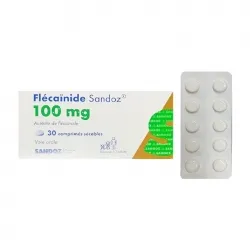
FLECAINIDE SANDOZ
ItalyThis medicine is used to treat certain serious cardiac arrhythmias that cause strong palpitations or tachycardia, including those that do not respond to other medicines or cannot be tolerated.
Frequently asked questions
When should you not take Flecainide Sandoz?
You must not take this medicine if you are allergic to the active substance or to any of its components, if you suffer from other heart diseases other than the one being treated, or if you are already taking other antiarrhythmics such as disopyramide or quinidine.
How should you take Flecainide Sandoz?
The tablets should be swallowed with plenty of liquid, such as water. The dose is usually divided throughout the day and must be determined by a doctor based on your specific needs.
What are the side effects of Flecainide Sandoz?
Common side effects include dizziness, visual disturbances (double or blurred vision), shortness of breath, weakness, fatigue, fever, or fluid retention. Other less common or rare side effects may also occur, such as nausea, intestinal problems, skin allergic reactions, anxiety, insomnia, or tremors.
Are there interactions with other drugs?
Yes, taking other medicines may affect the effect of this drug or cause unwanted side effects. It is important to inform your doctor if you are taking beta-blockers, amiodarone, certain antidepressants, anti-epileptics, antihistamines, or other drugs, including natural products or over-the-counter medicines.
What to do if you forget a dose?
If you forget a tablet, take it as soon as you remember, unless it is almost time for your next dose. In that case, continue with your regular schedule without taking a double dose to compensate.
Can the drug affect your ability to drive?
Yes, if side effects such as dizziness, double or blurred vision, or a lightheaded sensation occur, your reaction time may be reduced, making it dangerous to drive vehicles or operate machinery.
Instructions for use
Patient Information Leaflet
Flecainide Sandoz 100 mg tablets
Flecainide acetate
Generic medicine
Please read this entire leaflet carefully before you start taking this medicine, as it contains important information for you.
- Keep this leaflet. You may need to read it again.
- If you have any questions, consult your doctor or pharmacist.
- This medicine has been prescribed for you only. Do not give it to others, even if they have the same symptoms as you, as it may be harmful.
- If you experience any side effects, including those not listed in this leaflet, inform your doctor or pharmacist. See section 4.
Contents of this leaflet
- What Flecainide Sandoz is and what it is used for
- What you need to know before taking Flecainide Sandoz
- How to take Flecainide Sandoz
- Possible side effects
- How to store Flecainide Sandoz
- Contents of the pack and other information
1. What Flecainide Sandoz is and what it is used for
Flecainide Sandoz belongs to a group of medicines that counteract cardiac arrhythmias (known as antiarrhythmics). This medicine inhibits the conduction of electrical impulses in the heart and prolongs the time during which the heart is at rest, resulting in the heart returning to a normal pumping rhythm.
Flecainide Sandoz is used
- for certain serious cardiac arrhythmias, which usually present as severe palpitations or tachycardia;
- for serious cardiac arrhythmias that have not responded well to treatment with other medicines or when other treatments cannot be tolerated.
2. What you need to know before taking Flecainide Sandoz
Do not take Flecainide Sandoz:
- if you are allergic to flecainide or to any of the other ingredients of this medicine (listed in section 6);
- if you have another heart disease different from the heart condition for which you are taking this medicine. If you are unsure or wish to obtain further information, consult your doctor or pharmacist;
- if you are taking certain other antiarrhythmics (sodium channel blockers, such as disopyramide and quinidine).
Warnings and precautions
Inform your doctor before taking Flecainide Sandoz
- if you have impaired liver function and/or impaired kidney function, as the concentration of flecainide in the blood may increase. In such cases, your doctor must regularly monitor the concentration of flecainide in your blood;
- if you have a permanent pacemaker or temporary pacing electrodes;
- if you have experienced cardiac arrhythmia after heart surgery;
- if you suffer from severe bradycardia or marked hypotension;
- if you have had a heart attack. These conditions must be corrected before taking Flecainide Sandoz. Low or high levels of potassium in the blood can affect the action of Flecainide Sandoz. Potassium levels must be corrected before taking Flecainide Sandoz.
Children under 12 years of age
Flecainide is not approved for use in children under 12 years of age, but flecainide toxicity has been reported during treatment with flecainide in children who reduced their milk intake, and in newborns who switched from formula milk to dextrose feeding.
Other medicines and Flecainide Sandoz
If you take other medicines together with Flecainide Sandoz, be aware that medicines can sometimes affect each other in terms of their action and/or side effects (i.e., interactions may occur). Interactions may occur, for example, with:
- sodium channel blockers (Class I antiarrhythmics), such as disopyramide and quinidine: see section "Do not take Flecainide Sandoz",
- beta-blockers such as propranolol (medicines that reduce the pumping function of the heart),
- amiodarone (for heart diseases); in some patients, the dose of Flecainide Sandoz may need to be reduced,
- calcium channel blockers, such as verapamil (lowers blood pressure),
- diuretics, laxatives (medicines that stimulate intestinal movement), and adrenal cortex hormones (corticosteroids): your doctor may monitor the amount of potassium in your blood,
- mizolastine and terfenadine (medicines for treating allergies known as “antihistamines”),
- ritonavir, lopinavir, and indinavir (medicines for treating HIV infections),
- fluoxetine, paroxetine, and certain other antidepressants known as “tricyclic antidepressants”,
- phenytoin, phenobarbital, and carbamazepine (medicines for epilepsy): these substances may accelerate the elimination of flecainide,
- clozapine, haloperidol, and risperidone (medicines for treating psychotic disorders known as “neuroleptics”),
- quinine (a medicine for malaria),
- terbinafine (a medicine for treating fungal infections known as “antifungals”),
- cimetidine (an antacid): may increase the effect of Flecainide Sandoz,
- bupropion (a medicine for smoking cessation),
- digoxin (a medicine to stimulate the heart): Flecainide Sandoz may increase digoxin levels in the blood.
Inform your doctor or pharmacist if you are taking, have recently taken, or might take any other medicines. This includes also non-prescription medicines, herbal or natural remedies.
Flecainide Sandoz with food
Dairy products (milk, formula milk, and possibly yogurt) may reduce the absorption of flecainide in children and newborns. Flecainide is not approved for use in children under 12 years of age, but flecainide toxicity has been reported during treatment with flecainide in children who reduced their milk intake and in newborns who switched from formula milk to dextrose feeding.
Pregnancy and breastfeeding
Flecainide crosses the placenta and passes into breast milk in small amounts. If you are pregnant, suspect you may be pregnant, plan to become pregnant, or are breastfeeding, consult your doctor before taking this medicine.
Do not take this medicine during pregnancy or breastfeeding unless expressly advised by your doctor.
Driving and using machines
If you experience side effects such as dizziness, double or blurred vision, or a sensation of emptiness in the head, your reaction ability may be reduced. This may be dangerous in situations requiring concentration and attention, such as driving vehicles, operating dangerous machinery, or working at heights. If you are unsure whether this medicine is negatively affecting your ability to drive, discuss it with your doctor.
Flecainide Sandoz contains sodium
This medicine contains less than 1 mmol (23 mg) of sodium per tablet, i.e., essentially ‘sodium-free’.
3. How to take Flecainide Sandoz
Always take this medicine exactly as instructed by your doctor or pharmacist. If you have any doubts, consult your doctor or pharmacist. Your doctor will prescribe a personalized dose, adjusted according to your condition. Treatment with Flecainide Sandoz should normally begin under medical supervision (if necessary, in hospital).
When and how should the tablets be taken?
Take the tablets by swallowing them with sufficient liquid (for example, water). The daily dose is usually taken in divided doses throughout the day.
The general dose is only a guideline and is as follows:
The usual starting dose ranges between 50 and 200 mg. This dose may be increased by your doctor up to a maximum of 400 mg per day.
Elderly patients
Your doctor may prescribe a lower dose. The dose for elderly patients should not exceed 300 mg per day (or 150 mg twice daily).
Patients with impaired liver or kidney function
Your doctor may prescribe a lower dose.
Patients with a permanent pacemaker
The daily dose should not exceed 100 mg twice daily.
Patients being treated concurrently with cimetidine (a medicine for gastric disorders) or amiodarone (a medicine for cardiac arrhythmias)
Your doctor must monitor you regularly and may prescribe a lower dose for some patients.
During treatment, your doctor must regularly determine flecainide blood levels and perform what is known as an electrocardiogram (ECG). A simple ECG should be performed once a month, and a more detailed ECG once every 3 months. An ECG should be performed every 2–4 days at the beginning of treatment or when the dose is increased.
ECGs must be performed more frequently in patients taking a lower dose than normally prescribed. Your doctor may adjust doses at intervals of 6–8 days. In these patients, an ECG should be performed during the second and third weeks after starting treatment.
Use in children
These tablets must not be taken by children under 12 years of age.
If you take more Flecainide Sandoz than you should
If you suspect an overdose, inform your doctor immediately.
If you forget to take Flecainide Sandoz
Take the missed dose as soon as you remember, unless you remember only when it is almost time for the next dose. In this case, do not take the missed dose as an extra, but continue following your regular schedule. It is very important to take the tablets as prescribed. Consult your doctor if you have any doubts.
Do not take a double dose to make up for a forgotten tablet.
If you stop taking Flecainide Sandoz
If you suddenly stop taking Flecainide Sandoz, you may not experience withdrawal symptoms. However, your arrhythmia may not be adequately controlled. Therefore, do not stop taking this medicine without informing your doctor.
If you have any questions about the use of this medicine, consult your doctor, pharmacist, or nurse.
4. Possible side effects
Like all medicines, this medicine can cause side effects, although not everyone will experience them.
The side effects that may occur include the following:
Very common (may affect more than 1 in 10 people):
dizziness, visual disturbances such as double vision and blurred vision.
Common (may affect more than 1 in 10 people):
development of a more severe type of arrhythmia or increased frequency or severity of a pre-existing arrhythmia,
shortness of breath, weakness, fatigue, fever, and fluid accumulation in tissues (edema).
Uncommon (may affect more than 1 in 100 people):
decrease in red blood cells, white blood cells, and platelets, increased heart rate in patients with atrial flutter,
nausea, vomiting, constipation, abdominal pain, loss of appetite, diarrhoea, indigestion, flatulence, allergic skin reactions such as rashes, hair loss.
Rare (may affect more than 1 in 1,000 people):
seeing, hearing or perceiving things that are not there (hallucinations), depression, confusion, anxiety, amnesia,
insomnia, skin tingling ("as if ants were crawling over it"), coordination problems, reduced sensitivity, increased sweating, fainting, tremors, hot flushes, drowsiness, headache, nerve-related problems, for example in arms and legs, seizures, movement difficulties (tics), ringing in the ears, sensation of dizziness (vertigo), lung inflammation, increased liver enzymes with or without yellowing of eyes and skin, severe hives.
Very rare (may affect more than 1 in 10,000 people):
increase in levels of certain antibodies which may indicate an autoimmune disease (with or without inflammation in the body), deposits in the cornea of the eye, increased skin sensitivity to sunlight.
Not known (frequency cannot be estimated from the available data):
some changes in the electrocardiogram (prolongation of PR and QRS intervals), increased stimulation threshold in patients with pacemakers or temporary pacing electrodes, impaired conduction between the atria and ventricles of the heart (second- or third-degree atrioventricular block), cardiac arrest, slow or fast heartbeat, loss of the heart's ability to pump sufficient blood to body tissues, chest pain, low blood pressure, heart attacks, awareness of heartbeat, a pause in the normal heart rhythm (sinus arrest), life-threatening irregular heartbeat (ventricular fibrillation), emergence of a pre-existing heart condition (Brugada syndrome) not previously observed before treatment with Flecainide Sandoz, lung scarring or lung disease (called interstitial lung disease causing breathing difficulties), liver disorders, limb pain, muscle pain.
If you experience any side effect, tell your doctor, pharmacist or nurse. This includes any side effect not listed in this leaflet.
Reporting of side effects
If you get any side effects, including those not listed in this leaflet, talk to your doctor, pharmacist or nurse. You can also report side effects directly via the national reporting system at https://www.aifa.gov.it/content/segnalazioni-reazioni-avverse .
By reporting side effects, you can help provide more information on the safety of this medicine.
5. How to store Flecainide Sandoz
Keep this medicine out of the sight and reach of children.
Do not use this medicine after the expiry date which is stated on the blister pack and on the carton or bottle
after "Exp.". The expiry date refers to the last day of that month.
This medicine does not require any special storage conditions.
Do not dispose of medicines via wastewater or household waste. Ask your pharmacist how to dispose of
medicines you no longer use. This will help protect the environment.
6. Package contents and other information
What Flecainide Sandoz contains
- The active substance is flecainide acetate. Each tablet contains 100 mg of flecainide acetate.
- The other components are: sodium croscarmellose (E 468), magnesium stearate (E 470b), pregelatinized corn starch, corn starch, microcrystalline cellulose (E 460).
Description of the appearance of Flecainide Sandoz and pack contents
100 mg tablet:
Circular, white tablet, with a break line inscribed on one side, marked “FJ” on one side of the line and “C” on the other; on the opposite side of the tablet, only the break line is present.
The tablets are packaged in PVC/PVDC/Al blisters or in polypropylene bottles with snap-cap closures made of polyethylene, all contained in cardboard cartons.
Pack sizes:
Blister packs: 20, 28, 30, 50, 56, 60, 84, 90, 100, 112, 120, 168, 180 tablets
Bottles: 100, 250, 500, 1000 tablets
Not all pack sizes may be marketed.
Marketing Authorisation Holder and Manufacturer
Marketing Authorisation Holder:
Sandoz S.p.A. – Largo U. Boccioni, 1 – 21040 Origgio (VA), Italy
Manufacturer:
Salutas Pharma GmbH – Otto-von-Guericke-Allee 1 – D-39179 Barleben, Germany
This medicinal product is authorised in the European Economic Area countries under the following names:
Belgium: FLECAINIDE SANDOZ 50 MG TABLETTEN
FLECAINIDE SANDOZ 100 MG TABLETTEN
Denmark: FLECAINID SANDOZ
Germany: Flecainid HEXAL® 50 mg Tabletten
Flecainid HEXAL® 100 mg Tabletten
Italy: FLECAINIDE SANDOZ 100 MG TABLETS
Luxembourg: Flecainid Hexal 50 mg tabletten
Flecainid Hexal 100 mg tabletten
Norway: FLECAINID SANDOZ
Netherlands: Flecaïnideacetaat Sandoz 50 mg, tabletten
Flecaïnideacetaat Sandoz 100 mg, tabletten
Slovakia: FLEKAINID SANDOZ 50 MG TABLETY
FLEKAINID SANDOZ 100 MG TABLETY
This leaflet was last approved on
Similar drugs
| Brand name | Dosage form | Active substance / Dosage | Manufacturer |
|---|---|---|---|
| ALMARYTM | tablets | Viatris Healthcare Limited | |
| FLECAINIDE AUROBINDO | tablets | AUROBINDO PHARMA (ITALIA) S.R.L. | |
| FLECAINIDE DOC GENERICI | tablets | DOC GENERICI SRL | |
| FLECAINIDE EG | tablets | EG S.P.A. | |
| FLECAINIDE TEVA | tablets | TEVA ITALIA S.R.L. |
The original data is available in the language of the country of manufacture.
Data source: Italian Medicines Agency (AIFA)
Data last verified: September 21, 2026