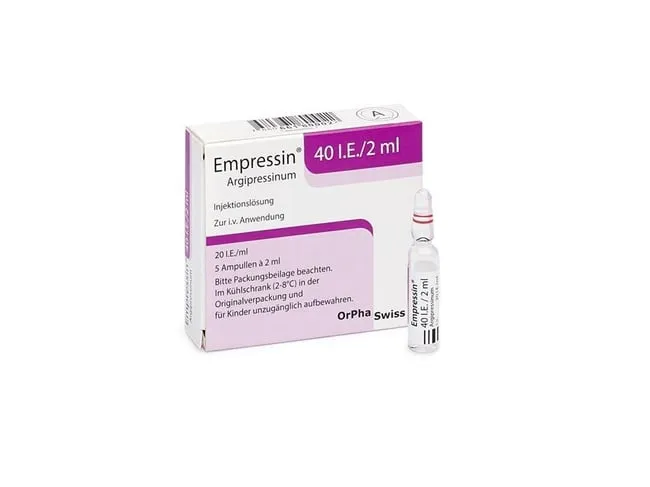
EMPRESSIN
ItalyIt is used in states of septic shock to help regulate the body's water balance and to achieve optimal blood pressure values established by physicians, when other methods have not been effective.
Frequently asked questions
How should Empressin be taken?
The drug is administered by a physician via continuous intravenous infusion, after being diluted with physiological saline solution. The initial dose is 0.01 I.U. per minute and can be gradually increased up to a maximum of 0.03 I.U. per minute.
When must this drug not be used?
It must not be used if you are allergic to argipressin or any of its components. Use is not recommended in patients with cardiovascular disease, chronic nephritis, epilepsy, migraine, asthma, or heart failure, or in situations where a rapid increase in extracellular water represents a risk.
What are the side effects of Empressin?
Common side effects may include irregular heartbeat, chest tightness, abdominal cramps, pallor, or necrosis (death) of skin tissue. Other less common effects include dizziness, headache, nausea, vomiting, tremors, or low blood sodium levels. In rare cases, severe allergic reactions may occur.
Are there interactions with other medicines or substances?
The use of drugs such as carbamazepine, chlorpropamide, clofibrate, fludrocortisone, or tricyclic antidepressants may increase the effect of the drug, while demeclocycline, noradrenaline, lithium, heparin, or alcohol may reduce it. The use of alcohol is prohibited.
Can the drug be used during pregnancy or breastfeeding?
Use during pregnancy and breastfeeding is not recommended; during pregnancy, it may cause uterine contractions and reduce uterine blood pressure.
Can the medicine be used in children?
The use of Empressin in children and infants is not recommended.
Instructions for use
PACKAGE LEAFLET: INFORMATION FOR THE PATIENT
Empressin 40 I.U./2 ml concentrate for solution for infusion
Argipressin
Please read this leaflet carefully before using this medicine because it contains important information for you.
- Keep this leaflet. You may need to read it again.
- If you have any questions, ask your doctor or pharmacist.
- This medicine has been prescribed for you only. Do not give it to other people, even if they have the same symptoms as you, because it may be harmful.
- If you experience any side effects, including those not listed in this leaflet, consult your doctor or pharmacist. See section 4.
Contents of this leaflet
- What Empressin is and what it is used for
- What you need to know before using Empressin
- How to use Empressin
- Possible side effects
- How to store Empressin
- Contents of the pack and other information
1. What Empressin is and what it is used for
Empressin is an artificially produced active substance equivalent to the natural hormone vasopressin.
It regulates the body's water balance and reduces urinary excretion. Empressin is used in septic shock states after unsuccessful use of other appropriate methods to achieve optimal blood pressure values, as determined by physicians.
2. What you need to know before using Empressin
Do not use Empressin:
- if you are allergic to argipressin or to any of the other components of Empressin. Special precautions for the use of Empressin are required:
- if it is used to increase blood pressure in shock resulting from other treatments. Administration must be performed under close monitoring of vital parameters.
- if used in patients with cardiovascular diseases.
- if administered to patients with epilepsy, migraine, asthma, heart failure, or with a condition where a rapid increase in extracellular water represents a risk.
- if the patient suffers from chronic nephritis.
Children and adolescents
The use of Empressin is not recommended for this indication in children and newborns.
Other medicines and Empressin
Empressin should be administered with caution together with carbamazepine, chlorpropamide, clofibrate, urea, fludrocortisone, or tricyclic antidepressants, as these agents may enhance the effect of Empressin. Empressin should be administered with caution together with demeclocycline, noradrenaline, lithium, heparin, or alcohol, as its effects may be reduced. Concomitant use of Empressin with drugs that affect blood pressure may increase or decrease the blood pressure rise induced by Empressin. Inform your doctor or pharmacist if you are taking or have recently taken any other medicines, including over-the-counter medicines.
Empressin with food and drinks
Empressin must not be used in combination with alcohol.
Pregnancy and breastfeeding
During pregnancy, Empressin may cause uterine contractions, increased intrauterine pressure, and reduced uterine perfusion. Empressin must not be used during pregnancy unless clearly necessary.
It is not known whether Empressin is excreted in breast milk.
The use of Empressin during pregnancy and breastfeeding is not recommended.
Consult your doctor or pharmacist before taking any medicine.
Driving and using machines
No studies have been conducted regarding the effects on the ability to drive or use machinery.
Important information about some excipients of Empressin
This medicine contains less than 1 mmol of sodium (23 mg) per dose, i.e. it is almost sodium-free.
3. How to use Empressin
Empressin is administered by a physician.
Empressin should only be used as an addition to conventional treatment. Treatment is started with 0.01 I.U. of Empressin per minute as an infusion. This dose may be increased every 15–20 minutes up to a maximum of 0.03 I.U. of Empressin per minute. Higher doses should only be used in emergencies.
Empressin is administered as a long-term infusion and must be diluted with physiological saline solution.
Use in children and adolescents
Empressin has been used for the treatment of certain shock conditions in neonates, infants, and adolescents in intensive care units and operating rooms. However, the use of Empressin for this indication is not recommended in children and neonates.
If you use more Empressin than you should
This medicine is administered by a physician. If you think you have been given too high a dose of this medicine, speak to your doctor immediately.
If you stop treatment with Empressin
Discontinuation of treatment with this medicine must be done gradually; this means that treatment should not be stopped abruptly. If you think that use of the medicine has been stopped too early, consult your doctor immediately. If you have any doubts about how to use this medicine, speak to your doctor or pharmacist.
4. Possible side effects
Like all medicines, Empressin can cause side effects, although not everybody gets them.
Common (may affect up to 1 in 10 people):
- irregular heartbeat
- chest tightness
- circulatory disorders affecting the heart, intestines, or fingertips
- peripheral constriction of blood vessels
- necrosis (tissue death)
- abdominal cramps
- pallor around the mouth
- necrosis (death) of the skin tissue
Uncommon (may affect up to 1 in 100 people):
- low blood sodium levels
- tremor
- dizziness
- headache
- reduced cardiac output
- life-threatening changes in heart rhythm
- cardiac arrest
- respiratory disorder caused by narrowing of the airways
- nausea
- vomiting
- flatulence
- necrosis (death) of intestinal tissue
- sweating
- skin rash
- changes in certain blood laboratory values
Rare (may affect up to 1 in 1,000 people):
- severe, life-threatening allergic reaction
Not known (frequency cannot be estimated from the available data):
- water intoxication, diabetes insipidus after discontinuation.
Reporting of side effects
If you experience any side effects, including those not listed in this leaflet, please inform your doctor or pharmacist.
You can also report side effects directly via the national reporting system at: www.agenziafarmaco.gov.it/content/come-segnalare-una-sospetta-reazione-avversa.
By reporting side effects, you can help provide more information on the safety of this medicine.
5. How to store Empressin
Keep this medicine out of the sight and reach of children.
Store in the refrigerator (2°C - 8°C).
Do not use this medicine after the expiry date stated on the label and the carton. The expiry date refers to the last day of that month.
Once opened, it must be diluted and used immediately.
Do not dispose of any medicine via wastewater or household waste. Ask your pharmacist how to dispose of medicines you no longer use. This will help protect the environment.
6. Package contents and other information
What Empressin contains
The active substance is argipressin.
One vial containing 2 ml of concentrate for solution for infusion contains argipressin acetate
corresponding to 40 I.U. of argipressin (equivalent to 133 micrograms).
The other components are: sodium chloride, glacial acetic acid to adjust pH, water for
injections.
Description of the appearance of Empressin and contents of the pack
Empressin is a colourless, clear concentrate for infusion solution.
Each pack contains 5 or 10 vials.
Not all pack sizes may be marketed.
Marketing Authorisation Holder
Orpha-Devel Handels und Vertriebs GmbH
Wintergasse 85/1B
3002 Purkersdorf
Austria
Manufacturer
Amomed Pharma GmbH
Storchengasse 1
1150 Vienna
Austria
This medicinal product is authorised in the Member States under the following names:
Austria Empesin 40 I.E./2 ml Konzentrat zur Herstellung einer Infusionslösung
Belgium Reverpleg 40 I.E./2 ml concentraat voor oplossing voor infusie
Bulgaria Емпресин 40 IU/2ml Концентрат за инфузионен разтвор
Empressin 40 I.U./2ml concentrato per soluzione per infusione
Czech Republic Embesin
Germany Empressin 40 I.E./2 ml Konzentrat zur Herstellung einer Infusionslösung
Denmark Empressin
Estonia Empesin
Greece Empressin 40 I.U./2 ml Πυκνό διάλυμα για παρασκευή διαλύματος προς έγχυση
Spain Empressin 40 I.U./2 ml concentrado para solución para perfusión
Finland Empressin 40 I.U./2 ml infuusiokonsentraatti, liuosta varten
France Reverpleg 40 U.I./2ml solution à diluer pour perfusion
Hungary Embesyn 40 N.E./2ml koncentrátum oldatos infúzióhoz
Ireland Embesin
Italy Empressin 40 I.U./2 ml concentrato per soluzione per infusione
Lithuania Empesin
Luxembourg Empressin 40 I.U./2 ml solution à diluer pour perfusion
Latvia Empesin 40 SV/2 ml koncentrāts infūziju šķīduma pagatavošanai
Netherlands Empressine 40 I.E./2ml, concentraat voor oplossing voor infusie
Norway Empressin
Poland Empesin
Portugal Empressin 40 U.I./2ml concentrado para solução para perfusão
Romania Reverpleg
Sweden Empressin 40 I.E./2 ml koncentrat till infusionsvätska, lösning
Slovenia Empesin 40 I.E./2 ml koncentrat za raztopino za infundiranje
Slovak Republic Embesin 40 IU/2 ml infúzny koncentrát
The following information is intended exclusively for healthcare professionals:
Dosage and method of administration
Treatment with argipressin in patients with hypotension refractory to catecholamines should preferably be initiated within the first six hours after the onset of septic shock, or within three hours in patients treated with high doses of catecholamines (see section 5.1 of the Summary of Product Characteristics, SmPC). Argipressin must be administered by continuous intravenous infusion at a rate of 0.01 I.U. per minute using an infusion pump. Depending on the clinical response, the dose may be increased every 15–20 minutes up to a maximum of 0.03 I.U. per minute. In intensive care patients, the optimal target arterial pressure is 65–75 mmHg. Argipressin should only be used in addition to conventional vasopressor therapy with catecholamines. Doses exceeding 0.03 I.U. per minute should only be administered as emergency treatment, as this may cause intestinal and cutaneous necrosis and increase the risk of cardiac arrest (see section 4.4 of the SmPC).
The duration of treatment should be determined according to the individual clinical situation, but should preferably last at least 48 hours. Treatment with argipressin must not be discontinued abruptly, but should be tapered gradually according to the patient's clinical course. The total duration of argipressin treatment is at the discretion of the responsible physician.
Prepare an infusion solution by diluting 2 ml of concentrate with 48 ml of sodium chloride 9 mg/ml (0.9%) solution (equivalent to 0.8 I.U. of argipressin per ml). The total volume after dilution must be 50 ml.
Infusion rates according to recommended doses:
| Empressin dose / min | Empressin dose / hour | Infusion rate |
| 0.01 I.U. | 0.6 I.U. | 0.75 ml / hour |
| 0.02 I.U. | 1.2 I.U. | 1.50 ml / hour |
| 0.03 I.U. | 1.8 I.U. | 2.25 ml / hour |
Pediatric population
Argipressin has been used for the treatment of vasodilatory shock in children and neonates in intensive care units and during surgical procedures. Since argipressin has not shown improvement in survival compared to standard treatment and has been associated with higher rates of adverse events, its use is not recommended in children and neonates.
Contraindications
Hypersensitivity to the active substance or to any of the excipients listed in section 6.1 of the Summary of Product Characteristics (SmPC).
Special warnings and precautions for use
This product must not be used interchangeably with other medicinal products containing argipressin with a different dosage indication [e.g., pressor units (Pressor Units, P.U.)].
Argipressin must not be administered as a bolus for the treatment of catecholamine-refractory shock.
Argipressin may only be administered under strict, continuous monitoring of hemodynamic and organ-specific parameters.
Treatment with argipressin should only be initiated when adequate perfusion pressure cannot be maintained despite appropriate volume resuscitation and administration of catecholaminergic vasopressors.
Argipressin must be used with particular caution in patients with cardiac or vascular diseases.
Administration of high doses of argipressin for other indications has been reported as a cause of myocardial and intestinal ischemia, myocardial and intestinal infarction, and reduced perfusion of the extremities.
Argipressin may rarely cause water intoxication. Early signs such as drowsiness, lethargy, and headache must be promptly recognized to prevent terminal coma and seizures.
Argipressin should be used cautiously in patients with epilepsy, migraine, asthma, heart failure, or any condition in which a rapid increase in extracellular water may pose risks to an already overloaded system.
In the pediatric population, a positive risk-benefit ratio has not been demonstrated. The use of argipressin for this indication in children and neonates is not recommended (see section 5.1 of the SmPC).
The original data is available in the language of the country of manufacture.
Data source: Italian Medicines Agency (AIFA)
Data last verified: September 21, 2026