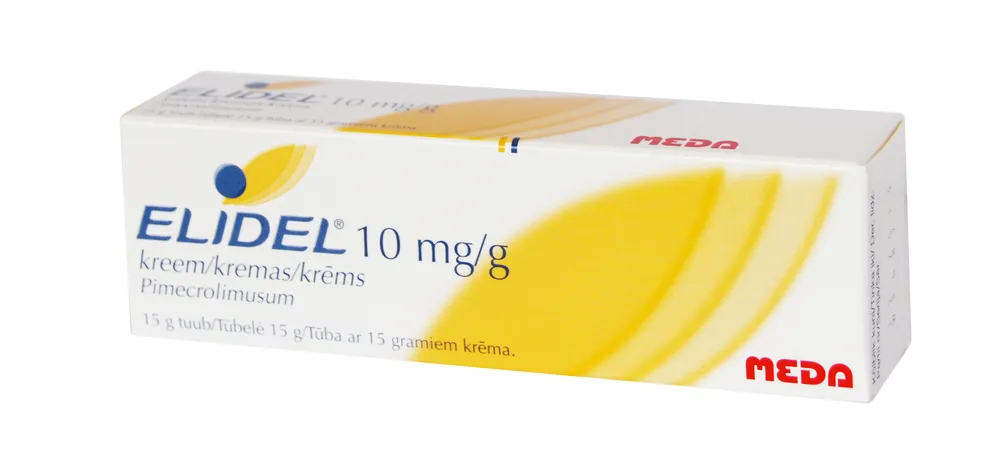
ELIDEL
ItalyIt is used to treat the signs and symptoms of mild to moderate atopic dermatitis (eczema), such as redness and itching, in children aged 2 years and older, adolescents, and adults.
Frequently asked questions
How should Elidel cream be applied?
The cream should be applied twice daily, for example once in the morning and once in the evening, massaging a thin layer onto the affected area of skin. If moisturizing products are used, they should be applied immediately after the cream.
When should you not use this medicine?
It must not be used if you are allergic to pimecrolimus or any of the other ingredients, if you have active viral infections on the skin (such as herpes or chickenpox), or if you are pregnant. It should not be applied to the eyes, nose, or mouth, and must not be used in children under 2 years of age.
What are the side effects of Elidel cream?
The most common side effects are a sensation of warmth or burning at the site where the cream is applied. Other effects may include irritation, itching, redness, or skin infections. In very rare cases, serious allergic reactions may occur (such as swelling of the throat or tongue, or difficulty breathing).
What should I do if I notice painful sores on the skin?
If painful sores appear during treatment, you must inform your doctor immediately, as a herpes simplex infection may have developed. In this case, treatment must be discontinued until the infection has cleared.
Can I expose myself to the sun during treatment?
It is necessary to avoid excessive exposure to sunlight, sunlamps, and tanning beds. If you are outdoors after application, it is advisable to wear protective clothing, use sun protection products, and minimize time spent in the sun.
Are there interactions with other drugs or treatments?
It must not be used concurrently with ultraviolet light treatments or systemic immunosuppressant drugs. It is important to inform your doctor if you are taking other medicines or if you need to undergo vaccinations.
Instructions for use
PACKAGE LEAFLET: INFORMATION FOR THE USER
ELIDEL 10 mg/g cream
Pimecrolimus
Please read this leaflet carefully before using this medicine because it contains important information for you.
- Keep this leaflet. You may need to read it again.
- If you have any questions, consult your doctor or pharmacist.
- This medicine has been prescribed for you only. Do not give it to other people, even if their symptoms are the same as yours, because it may be harmful.
- If you experience any adverse reaction, including those not listed in this leaflet, contact your doctor or pharmacist. See section 4.
Contents of this leaflet:
- What Elidel cream is and what it is used for
- What you need to know before using Elidel cream
- How to apply Elidel cream
- Possible side effects
- How to store Elidel cream
- Contents of the pack and other information
1. WHAT ELIDEL CREAM IS AND WHAT IT IS USED FOR
Elidel cream contains an active substance called pimecrolimus. It does not contain steroids.
Elidel cream specifically treats a skin inflammation known as atopic dermatitis (eczema). It acts on skin cells responsible for the inflammation, redness, and itching characteristic of eczema.
The cream is used to treat the signs and symptoms of mild to moderate eczema (e.g. redness and itching) in children (from the age of 2 years), adolescents, and adults. When used at the first signs and symptoms of the disease, it may prevent severe flare-ups.
Elidel cream should only be used after other prescription medicines or emollients have not helped you, or if your doctor has advised you not to use other prescription medicines.
Consult your doctor if you do not feel better or feel worse after 6 weeks.
2. WHAT YOU SHOULD KNOW BEFORE USING ELIDEL CREAM
Follow carefully all instructions provided by your doctor.
Read the following information before using Elidel cream.
Do not use Elidel cream
- if you are allergic (hypersensitive) to pimecrolimus or to any of the excipients of Elidel cream (listed in section 6).
Take special care with Elidel cream
Elidel is not approved for use in children under 2 years of age. Therefore, it must not be used in this age group. Consult your doctor.
Warnings and precautions
Talk to your doctor before using Elidel if you have a weakened immune system (immunocompromised), regardless of the cause.
Elidel cream should only be used for atopic dermatitis. Do not use it for other skin diseases.
Elidel cream is for external use only. Do not use it in the nose, eyes, or mouth. In case of accidental application to these areas, carefully clean and/or thoroughly rinse them. Be careful not to swallow it or accidentally get it inside your mouth, for example when applying it to the hands.
Do not apply the cream to areas of skin affected by active viral infection, such as herpes simplex or chickenpox.
If you have a skin infection, consult your doctor before using Elidel. Your doctor will ask you to use an appropriate medicine to treat the infection. You may start treatment with Elidel once the infection in the treated areas has cleared up. If a skin infection develops during treatment with Elidel, inform your doctor. Your doctor may ask you to stop treatment with Elidel until the infection is adequately controlled.
Treatment with Elidel may be associated with an increased risk of developing a severe herpes simplex skin infection (herpetic eczema). Therefore, inform your doctor immediately if painful sores develop anywhere on the body. You must stop treatment with Elidel until the infection resolves.
The use of Elidel may cause application site reactions, such as a sensation of warmth and/or burning. These reactions are usually mild and short-lived. If you experience severe reactions while using Elidel, inform your doctor immediately.
During treatment with Elidel, do not cover the treated skin area with bandages or dressings. However, you may continue to wear your normal clothing.
During treatment with Elidel, avoid excessive exposure to sunlight, sunlamps, and tanning beds. If you are outdoors after applying Elidel, wear protective clothing, use sunscreen products with appropriate protection factors, and minimize your time in the sun.
If you suffer from erythroderma (redness affecting almost the entire body) or a skin condition called Netherton syndrome, talk to your doctor before starting treatment with Elidel.
Before starting treatment with Elidel, also talk to your doctor if you have any type of skin malignancy.
Inform your doctor if you experience swollen lymph nodes during treatment with Elidel cream.
Children
The use of Elidel in patients under 2 years of age is not recommended until further data are available.
Other medicines and Elidel cream
Inform your doctor or pharmacist if you are using, have recently used, or might use any other medicines.
Application of pimecrolimus to vaccination sites, while local reactions persist, is not recommended.
If you have extensive eczema, you may need to interrupt treatment with Elidel before any vaccination. Your doctor will inform you if this is necessary.
Elidel must not be used simultaneously with ultraviolet light treatments (such as UVA, PUVA, UVB) or with systemic immunosuppressive drugs (such as azathioprine or cyclosporine).
It is unlikely that interactions will occur with other medicines you are taking.
Use of Elidel cream with food, drinks, and alcohol
In rare cases, you may experience reactions such as warmth, rash, burning sensation, itching, or swelling shortly after consuming alcohol.
Pregnancy and breastfeeding
If you are pregnant, think you may be pregnant, planning to become pregnant, or are breastfeeding, ask your doctor or pharmacist for advice before using this medicine. You must not use Elidel if you are pregnant.
It is not known whether Elidel passes into breast milk after application to the skin. If you are breastfeeding, do not apply Elidel to the breast.
Driving and using machines
Elidel has no known effects on the ability to drive or operate machinery.
Elidel cream contains cetyl alcohol, stearyl alcohol, benzyl alcohol, and propylene glycol (E 1520).
Cetyl alcohol and stearyl alcohol may cause local skin reactions (e.g., contact dermatitis). Benzyl alcohol may cause allergic reactions and mild local irritation. Propylene glycol (E 1520) may cause skin irritation.
3. HOW TO USE ELIDEL CREAM
Use this medicine exactly as directed by your doctor or pharmacist. If you have any doubts, consult your doctor or pharmacist.
Elidel can be applied to all areas of the skin, including the head, face, neck, and skin folds.
Apply the cream as described below:
- Wash and dry your hands.
- Open the tube (if using the tube for the first time, break the seal by using the pointed part located on the outer side of the cap).
- Squeeze the cream onto your fingertip.
- Apply a thin layer of Elidel, completely covering the affected area of skin.
- Apply only to skin areas affected by eczema.
- Gently massage in.
- Close the tube with the cap.
The cream should be applied twice daily, for example once in the morning and once in the evening. Moisturisers (emollients) may be used together with Elidel. If using moisturisers, they should be applied immediately after Elidel.
Do not bathe, shower, or swim immediately after applying Elidel. These activities could wash off the cream.
How long to use Elidel
Long-term treatment should be intermittent, not continuous. As soon as the signs of eczema disappear, stop treatment with Elidel.
Continue using the cream for the entire duration of treatment recommended by your doctor.
If there is no improvement after 6 weeks or if eczema worsens, stop treatment and consult your doctor.
For long-term management of eczema, start using Elidel as soon as you notice signs and symptoms (redness and itching). This may help prevent progression to severe flare-ups.
If signs and symptoms reappear, restart treatment.
If you use more Elidel than you should
If you apply more cream than needed, simply remove the excess.
If you forget to use Elidel
If you miss an application, apply it as soon as you remember and then continue with your usual application schedule. However, if it is almost time for the next application, skip the missed dose and continue with your regular schedule. Do not apply a double amount of cream to make up for a forgotten application.
If you stop treatment with Elidel
If you have any further questions about the use of this medicine, consult your doctor or pharmacist.
If Elidel is accidentally swallowed
Inform your doctor immediately if you or someone else accidentally swallows Elidel.
4. POSSIBLE ADVERSE REACTIONS
Like all medicines, Elidel cream can cause adverse reactions, although not everyone experiences them.
The most common adverse reactions with Elidel are reactions at the application site (such as irritation or discomfort). These reactions are generally mild/moderate, occur at the beginning of treatment, and last only briefly.
Some adverse reactions may be serious
Rare adverse reactions (occur in fewer than 1 in 1,000 patients)
- Angioedema – signs include itching, urticaria, red rash on hands, feet and throat, swelling of the throat and tongue, swelling around the eyes and lips, difficulty breathing and swallowing.
Very rare adverse reactions (occur in fewer than 1 in 10,000 patients)
-
Anaphylactic reactions: skin rash including itchy and red skin, swelling of the hands, feet, ankles, face, lips, mouth or throat (these symptoms are also described as angioedema and may cause difficulty in swallowing or breathing), and you may feel faint.
If any of these symptoms occur shortly after using Elidel cream, stop treatment immediately and inform your doctor without delay.
Other adverse reactions
Very common adverse reactions (occur in more than 1 in 10 patients) -
Sensation of warmth and/or burning at the application site.
Common adverse reactions (occur in more than 1 in 100 patients)
- Irritation, itching, and redness of the skin where the cream has been applied.
- Skin infections (such as folliculitis).
Uncommon adverse reactions (occur in fewer than 1 in 100 patients)
- Skin infections such as impetigo (a bacterial skin infection), herpes simplex, herpes zoster (shingles), dermatitis due to herpes simplex (herpetic eczema), molluscum contagiosum (a viral skin infection), warts, and boils.
- Reactions at the application site such as rash, pain, stinging sensation, slight peeling of the skin, dryness, swelling, and worsening of eczema symptoms.
Rare adverse reactions (occur in fewer than 1 in 1,000 patients)
- Sensation of warmth, rash, burning, itching, or swelling shortly after drinking alcohol.
- Change in skin color (becoming darker or lighter than the surrounding area).
Cases of cancer, including lymphoma and skin cancer, have been reported in patients treated with Elidel.
Cases of lymphadenopathy have been reported in patients treated with Elidel. However, a link to the use of Elidel has not been established.
If any of the adverse reactions worsen , or if you notice any adverse reaction not listed in this leaflet, inform your doctor or pharmacist.
Reporting of adverse reactions
If you experience any adverse reaction, including those not listed in this leaflet, consult your doctor or pharmacist. You may also report adverse reactions directly via the national reporting system at https://www.aifa.gov.it/content/segnalazioni-reazioni-avverse. By reporting adverse reactions, you can help provide more information on the safety of this medicine.
5. HOW TO STORE ELIDEL CREAM
Keep this medicine out of the sight and reach of children.
Do not use this medicine after the expiry date stated on the carton and tube. The expiry date refers to the last day of that month.
Do not store above 25°C. Do not freeze.
Store in the original packaging. Keep the tube tightly closed.
After first opening, the tube must be used within 12 months. Write the date of opening of the tube in the space provided on the carton.
Do not dispose of any medicine via wastewater or household waste. Ask your pharmacist how to dispose of medicines you no longer use. This will help protect the environment.
6. PACKAGING CONTENTS AND OTHER INFORMATION
What Elidel cream contains
- The active substance is pimecrolimus. 1 gram of Elidel cream contains 10 mg of pimecrolimus.
- The excipients are: medium-chain triglycerides, oleic alcohol, propylene glycol (E 1520), stearyl alcohol, cetyl alcohol, mono- and diglycerides, sodium cetostearyl sulfate, benzyl alcohol, anhydrous citric acid, sodium hydroxide, purified water.
This medicinal product contains 10 mg of benzyl alcohol and 50 mg of propylene glycol (E 1520) per 1 g of cream. See section 2.
Description of the appearance of Elidel and packaging contents
Elidel is a white, odourless, colourless and easily spreadable cream. The cream is available in tubes of 5 g, 15 g, 30 g, 60 g and 100 g.
Not all pack sizes may be marketed.
Marketing Authorisation Holder and Manufacturer
Marketing Authorisation Holder
Viatris Healthcare Limited
Damastown Industrial Park, Mulhuddart,
Dublin 15,
DUBLIN,
Ireland
Manufacturers
Meda Pharma GmbH & Co. KG,
Benzstrasse 1, 61352 Bad Homburg, Germany
MEDA Manufacturing, Avenue J. F. Kennedy, 33700 Merignac, France
This medicinal product is authorised in the European Economic Area countries under the following names:
Austria: Elidel 10 mg/g Creme
Belgium: Elidel 10 mg/g crème
Bulgaria: Елидел 10 mg/g крем
Croatia: Elidel 10 mg/g krema
Cyprus: Elidel cream 10 mg/g
Czech Republic: Elidel 10 mg/g krém
Denmark: Elidel 10 mg/g Creme
Estonia: Elidel 10 mg/g kreem
Finland: Elidel 10 mg/g emulsiovoide
Germany: Elidel 10 mg/g Creme
Greece: Elidel, κρέμα 10 mg/g
Hungary: Elidel 10 mg/g krém
Iceland: Elidel 10 mg/g krem
Italy: Elidel 10 mg/g crema
Latvia: Elidel 10 mg/g krēms
Lithuania: Elidel 10 mg/g kremas
Luxembourg: Elidel 10 mg/g Creme
Malta: Elidel 10 mg/g cream
Netherlands: Elidel 10 mg/g crème
Norway: Elidel 10 mg/g krem
Poland: Elidel 10 mg/g krem
Portugal: Elidel 10 mg/g creme
Romania: Elidel 10 mg/g cremă
Slovakia: Elidel 10 mg/g krém
Slovenia: Elidel 10 mg/g krema
Spain: Elidel 10 mg/g crema
Sweden: Elidel 10 mg/g kräm
United Kingdom: Elidel 10 mg/g cream
If you have any questions or doubts about this medicine, consult your doctor or pharmacist.
The original data is available in the language of the country of manufacture.
Data source: Italian Medicines Agency (AIFA)
Data last verified: September 21, 2026