EKTERLY
ItalyEkterly is indicated for the symptomatic treatment of acute attacks of hereditary angioedema (HAE) in adults and adolescents aged 12 years and older.
Frequently asked questions
How should I take Ekterly?
The recommended dose is one 300 mg tablet to be taken at the first signs of an attack. If symptoms persist, a second 300 mg tablet may be taken after 3 hours. Do not exceed two 300 mg tablets within a 24-hour period. Tablets should be swallowed whole with a little water and can be taken with or without food.
When must I not take this medicine?
Do not take this medicine if you are allergic to the active substance (sebetralstat) or to any of the other ingredients. It is necessary to consult a doctor before use if you have impaired liver function or if you are at risk of heart rhythm abnormalities (QT prolongation).
What are the common side effects of Ekterly?
Common side effects, which may affect up to 1 in 10 people, include headache, vomiting, nausea, abdominal pain, dizziness, back pain, hot flashes, and diarrhea.
Are there interactions with other medicines?
Yes, some medicines may affect the action of Ekterly. For example, antibiotics (such as erythromycin or clarithromycin), antifungal drugs (such as itraconazole or ketoconazole), and certain antivirals may increase its levels in the blood, increasing the risk of side effects. Other drugs such as rifampicin, efavirenz, or certain epilepsy medicines may instead reduce its levels.
What should I do in case of a laryngeal attack?
After taking the medicine for an attack affecting the larynx, it is important to contact a doctor immediately, especially if symptoms worsen after treatment.
Can I take the medicine if I am pregnant or breastfeeding?
Due to limited safety information, it is preferable to avoid the use of Ekterly during pregnancy, and it is advised to avoid breastfeeding for 24 hours after taking the medicine. The doctor will assess the benefits and risks.
Instructions for use
Package leaflet: Information for the patient
Ekterly 300 mg film-coated tablets
sebetralstat
This medicinal product is subject to additional monitoring. This will allow for rapid identification of new safety information. You can help by reporting any side effects you experience while taking this medicine. See the end of section 4 for information on how to report side effects.
Please read all of this leaflet carefully before taking this medicine, as it contains important information for you.
- Keep this leaflet. You may need to read it again.
- If you have any questions, ask your doctor or pharmacist.
- This medicine has been prescribed for you only. Do not give it to others, even if they have the same symptoms as you, because it could be harmful.
- If you experience any side effect, including those not listed in this leaflet, consult your doctor or pharmacist. See section 4.
Contents of this leaflet
- What Ekterly is and what it is used for
- What you need to know before taking Ekterly
- How to take Ekterly
- Possible side effects
- How to store Ekterly
- Contents of the pack and other information
1. What Ekterly is and what it is used for
Ekterly is a medicine that contains the active substance sebetralstat.
Ekterly is indicated for the symptomatic treatment of acute attacks of hereditary angioedema (HAE) in adults and adolescents aged 12 years and older.
HAE is often hereditary, but some people may not have a family history. There are three types of HAE, based on the type of genetic defect and its effect on a protein circulating in the blood called C1 esterase inhibitor (C1-INH). A person may have low levels of C1-INH in the body (HAE type 1), dysfunctional C1-INH (HAE type 2), or HAE with normal C1 esterase inhibitor (nC1-INH-HAE). The latter type is extremely rare. All three types can cause attacks and produce the same clinical symptoms of localized swelling and pain in various parts of the body, including:
- hands and feet
- face, eyelids, lips, or tongue
- larynx, which can make breathing difficult
- genitals
When C1-INH does not function properly, excessive amounts of an enzyme called "plasma kallikrein" are produced, which in turn increases levels of "bradykinin" in the bloodstream. Overproduction of bradykinin causes swelling and inflammation.
The active substance in Ekterly, sebetralstat, works by blocking the activity of plasma kallikrein and helps reduce bradykinin levels. When taken at the onset or during an attack, it prevents the attack from progressing and stops swelling and pain.
2. What you need to know before taking Ekterly
Do not take Ekterly
- if you are allergic to sebetralstat or to any of the other ingredients of this medicine (listed in section 6).
Warnings and precautions
Talk to your doctor or pharmacist before taking Ekterly if:
- you have moderate or severe liver function impairment, which may increase sebetralstat levels in the blood
- you are at risk of a specific heart rhythm abnormality known as QT prolongation, or if you are taking a medicine known to prolong the QT interval.
After taking Ekterly for a laryngeal attack (affecting the larynx), it is important to seek medical
attention immediately, especially if symptoms of the laryngeal attack worsen after treatment.
Hereditary angioedema with normal C1 inhibitor may not respond to treatment with Ekterly. Consult your
doctor if you have any doubts about this medicine.
Children
Ekterly is not recommended for children under 12 years of age, as it has not been studied in this age
group.
Other medicines and Ekterly
Tell your doctor or pharmacist if you are taking, have recently taken, or might take any other medicines.
This is because some other medicines may affect the action of Ekterly.
In particular, inform your doctor or pharmacist if you are taking any of the following medicines.
- These medicines may increase Ekterly levels in the blood and, consequently, increase the risk of side effects:
o antibiotics (e.g., erythromycin, clarithromycin)
o antifungal medicines (e.g., itraconazole, ketoconazole)
o antiviral medicines (e.g., ritonavir) - These medicines may reduce Ekterly levels in the blood and, consequently, may require dose adjustment:
o antibiotics (e.g., rifampicin)
o antiviral medicines (e.g., efavirenz)
o certain medicines used for epilepsy (e.g., carbamazepine, phenytoin, phenobarbital)
If you have any doubts, consult your doctor or pharmacist before taking Ekterly.
Ekterly with food and drink
This medicine can be taken with or without food (see section 3).
Pregnancy, breastfeeding and fertility
If you are pregnant, think you may be pregnant, are planning to become pregnant, or are breastfeeding,
please seek advice from your doctor or pharmacist before taking this medicine. There is limited
information on the safety of using Ekterly during pregnancy and breastfeeding. As a precautionary
measure, it is preferable to avoid using Ekterly during pregnancy and to avoid breastfeeding for 24 hours
after taking Ekterly. Your doctor will discuss with you the benefits and risks of taking Ekterly during
pregnancy and breastfeeding.
Driving and using machines
Do not drive or operate machinery if you feel dizzy due to an HAE attack or after using Ekterly.
Ekterly contains sodium
This medicine contains less than 1 mmol (23 mg) of sodium per tablet, i.e., essentially ‘sodium-free’.
3. How to take Ekterly
Take this medicine exactly as your doctor or pharmacist has told you. If you are not sure, consult your doctor or pharmacist.
The recommended dose is one 300 mg tablet of Ekterly, to be taken at the first sign of an attack. An additional dose of one 300 mg tablet of Ekterly may be taken 3 hours after the first dose if symptoms persist. No more than two 300 mg tablets of Ekterly should be taken within 24 hours.
Swallow the tablet whole with a little water, if needed. The tablet may be taken with or without food.
Your doctor will prescribe only a single 300 mg tablet of Ekterly for the treatment of an attack if you have liver problems (moderately reduced liver function) and if you are also taking other medicines known as strong CYP3A4 inhibitors, such as itraconazole, which is used to treat fungal infections.
If you are taking medicines known as strong or moderate CYP3A4 inducers, such as phenytoin (used to treat epilepsy) or efavirenz (an antiviral medicine), your doctor will prescribe three 300 mg tablets of Ekterly to be taken together at the same time for the treatment of an attack.
If you take more Ekterly than you should
Tell your doctor immediately if you have taken too many tablets of Ekterly.
4. Possible side effects
Like all medicines, this medicine can cause side effects, although not everybody gets them.
Common side effects (may affect up to 1 in 10 people):
- Headache
- Vomiting
- Feeling unwell (nausea)
- Abdominal pain
- Dizziness
- Back pain
- Hot flush
- Diarrhoea
Reporting of side effects
If you experience any side effect, including those not listed in this leaflet, talk to your doctor or pharmacist. You can also report side effects directly via the national reporting system detailed in Annex V. By reporting side effects, you can help provide more information on the safety of this medicine.
5. How to store Ekterly
Keep this medicine out of the sight and reach of children.
Do not use this medicine after the expiry date stated on the carton and blister pack after "Exp". The expiry date refers to the last day of that month.
This medicine does not require any special storage conditions.
Do not dispose of medicines via wastewater or household waste. Ask your pharmacist how to dispose of medicines you no longer use. This will help protect the environment.
6. Package contents and other information
What Ekterly contains
- The active substance is sebetralstat.
- The other components are: Tablet core: microcrystalline cellulose; sodium croscarmellose; povidone K30; magnesium stearate (see section 2 “Ekterly contains sodium”). Film coating: poly(vinyl alcohol) graft copolymer with polyethylene glycol, talc; titanium dioxide (E171), glycerol monocapril caprate (type 1), polyvinyl alcohol, iron oxide yellow (E172), iron oxide black (E172), maltodextrin, guar galactomannan, hypromellose, medium-chain triglycerides.
Description of the appearance of Ekterly and contents of the pack
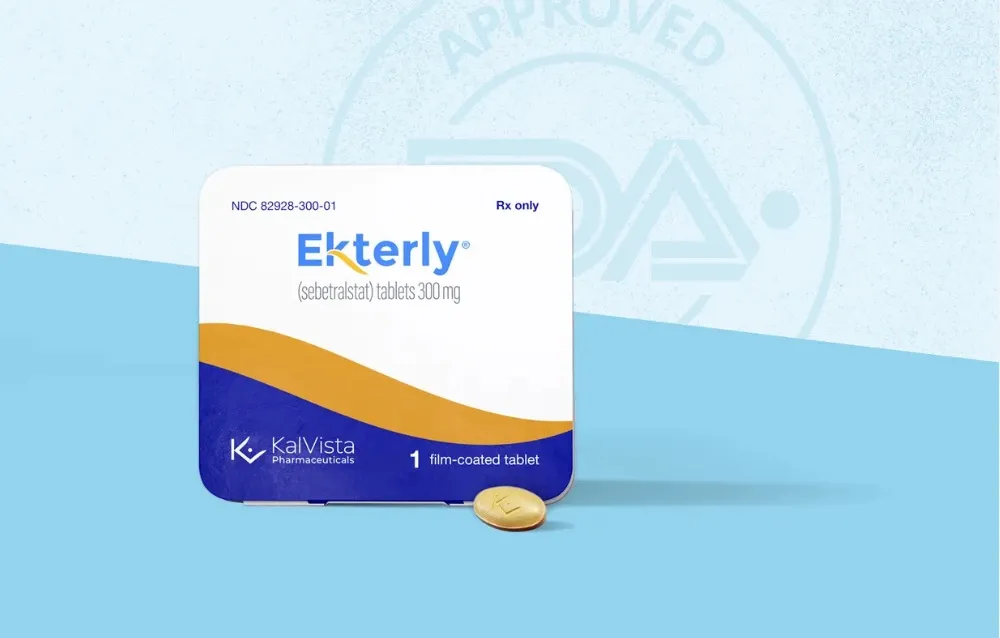
Ekterly 300 mg film-coated tablets are yellow, oval-shaped (approximately 15 mm × 9 mm), biconvex tablets, with the KalVista logo “K” imprinted on one side and “300” on the other. The film-coated tablets are packaged in a blister pack contained within a child-resistant cardboard carton. The cartons are placed in an outer cardboard box. See the packaging for instructions on how to open. The pack contains 4 or 6 film-coated tablets. It is possible that not all pack sizes are marketed.
Marketing Authorization Holder
KalVista Pharmaceuticals (Ireland) Ltd.,
Magennis Place,
Block C,
Dublin 2,
D02 FK76,
Ireland
Manufacturer
Almac Pharma Services Limited
Seagoe Industrial Estate
Portadown
Craigavon
Northern Ireland
BT63 5UA
United Kingdom
Other sources of information
More detailed information on this medicinal product is available on the website of the European Medicines Agency, https://www.ema.europa.eu/.
The original data is available in the language of the country of manufacture.
Data source: Italian Medicines Agency (AIFA)
Data last verified: September 21, 2026