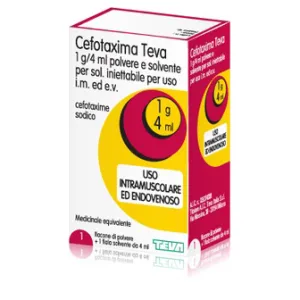
CEFOTAXIME TEVA
ItalyIt is used to treat serious bacterial infections caused by bacteria resistant to common antibiotics, especially when the immune system is weakened. It is also used to prevent possible infections during surgical procedures.
Frequently asked questions
When should you not take Cefotaxima Teva?
It must not be used if you are allergic to the active substance, to cephalosporins, or if you have previously experienced anaphylactic shock with penicillin. It is also contraindicated in cases of severe skin reactions after using cephalosporins, during pregnancy, or while breastfeeding. If the drug is reconstituted with a solvent containing lidocaine, it cannot be used intravenously, in children under 30 months, or in people with serious heart problems.
How should the drug be taken?
The medicinal product is administered via intramuscular or intravenous injection by healthcare personnel. The dose and method depend on the severity of the infection, weight, and health conditions (such as renal function). Adults usually receive 2 g per day, while for children, the dose is calculated based on body weight.
What are the side effects of Cefotaxima Teva?
Side effects may include pain at the injection site, diarrhea, skin rashes, itching, fever, or changes in blood and liver values. Serious reactions that require immediate discontinuation are possible, such as severe skin rashes (e.g., Stevens-Johnson syndrome), allergic reactions (facial swelling, difficulty breathing), or severe intestinal infections.
Are there interactions with other medicines?
You must inform the doctor if you are taking aminoglycoside antibiotics, diuretics (such as furosemide), or medications for gout (such as probenecid), as they could increase kidney toxicity or alter the concentration of the drug in the blood. The medicinal product must not be mixed in the same syringe with other drugs.
What to do in case of overdose?
In case of accidental ingestion of an excessive dose, it is necessary to immediately inform a doctor or go to the nearest hospital, as confusion, seizures, or other neurological disturbances may occur.
Instructions for use
Table of contents
- 1. What Cefotaxime Teva is and what it is used for
- 2. What you need to know before using Cefotaxime Teva
- 3. How to use Cefotaxime Teva
- 4. Possible side effects
- 5. How to store Cefotaxime Teva
- 6. Package contents and other information
- The following information is intended exclusively for healthcare professionals:
Patient Information Leaflet
Cefotaxime Teva 1 g/4 ml powder and solvent for injectable solution for intramuscular and
intravenous use
Cefotaxime Teva 1 g/4 ml powder and solvent for injectable solution for intramuscular use
Cefotaxime Teva 2 g/10 ml powder and solvent for injectable solution for intravenous use
Generic medicine
Please read this leaflet carefully before using this medicine as it contains important information for you.
- Keep this leaflet. You may need to read it again.
- If you have any questions, ask your doctor, pharmacist, or nurse.
- This medicine has been prescribed for you only. Do not give it to other people, even if they have the same symptoms as you, because it could be harmful.
- If you experience any side effects, including those not listed in this leaflet, tell your doctor, pharmacist, or nurse. See section 4.
Contents of this leaflet:
- What Cefotaxime Teva is and what it is used for
- What you need to know before using Cefotaxime Teva
- How to use Cefotaxime Teva
- Possible side effects
- How to store Cefotaxime Teva
- Contents of the pack and other information
1. What Cefotaxime Teva is and what it is used for
Cefotaxime Teva contains cefotaxime sodium, a substance belonging to a group of antibiotic medicines called cephalosporins, which works by fighting bacterial infections.
Cefotaxime Teva is indicated for the treatment of severe infections caused by bacteria known as Gram-negative, particularly when resistant to more common antibiotics, and especially when the body is severely weakened or the immune system is impaired.
This medicine is also used to prevent possible infections that may occur in a surgical setting.
Contact your doctor if you do not feel better or if you feel worse.
2. What you need to know before using Cefotaxime Teva
Do not use Cefotaxime Teva
- if you are allergic to the active substance, to cephalosporins, or to any of the other ingredients of this medicine (listed in section 6);
- if you have previously had an allergic reaction, even severe (anaphylactic shock), after taking an antibiotic belonging to the penicillin family. It is important to note that if you are allergic to antibiotics in this group, you may also be allergic to cefotaxime (cross-allergenicity);
- if you have developed a severe skin rash or skin peeling, skin rash with blisters and/or mouth ulcers after taking cefotaxime or other cephalosporins;
- during pregnancy and breastfeeding (see section “Pregnancy and breastfeeding”).
Furthermore, NEVER use Cefotaxime Teva when reconstituted with the solvent containing lidocaine
(for intramuscular use):
- by intravenous route;
- to administer to a child under 30 months of age;
- if you have previously had an allergic reaction to lidocaine or to other local anaesthetic medicines with a similar structure (amide-type);
- in the presence of heart block without stimulation;
- if your heart function is severely impaired (severe heart failure).
Warnings and precautions
Talk to your doctor or pharmacist before taking Cefotaxime Teva.
Before starting treatment with cefotaxime, your doctor will check whether you have had previous allergic reactions to cefotaxime, cephalosporins, penicillin, or other medicines.
Pay special attention and consult your doctor before taking Cefotaxime Teva if:
- you are elderly or if your kidney function is impaired (severe renal insufficiency); in this case, your doctor will determine the most appropriate dose based on your blood creatinine levels and kidney function;
- you suffer from gastrointestinal disorders, especially if you have a history of colitis;
- you are taking aminoglycoside antibiotics, probenecid, or other medicines that may cause kidney problems (nephrotoxic); see also “Other medicines and Cefotaxime Teva”;
- your infection does not improve or worsens, as the bacteria causing your infection may be resistant to cefotaxime (antibiotic resistance), leading to the development of additional infections (superinfections). This may occur particularly if you use cefotaxime for a prolonged period.
You should also pay particular attention, stop treatment and contact your doctor immediately if you experience:
- skin rashes, itching, difficulty breathing (bronchospasm) or swallowing, swelling of the face, hands and feet, eyes, lips, tongue and/or face (angioedema). These may be signs of allergic reactions, even severe (anaphylactic shock);
- episodes of particularly severe and persistent diarrhoea during treatment or in the first few weeks after stopping treatment, as this may be due to an infection caused by a bacterium called Clostridium difficile, which in severe cases can lead to intestinal inflammation (pseudomembranous colitis) that may even be life-threatening. Mild cases may resolve upon discontinuation of treatment. Do not take medicines that reduce intestinal motility during treatment with this medicine, as they may promote the development of this condition;
- symptoms such as altered consciousness, confusion, movement disorders, seizures, especially if your kidney function is impaired (renal insufficiency), as these may be symptoms of brain disorders (encephalopathies); this may occur with high doses of the medicine.
Severe skin reactions, including Stevens-Johnson syndrome, toxic epidermal necrolysis, drug reaction with eosinophilia and systemic symptoms (DRESS), and acute generalized exanthematous pustulosis (AGEP), have been reported during treatment with cefotaxime. Stop using cefotaxime and contact your doctor immediately if you develop any of the symptoms related to these severe skin reactions described in section 4.
Treatment should also be discontinued if blood abnormalities develop (leucopenia, neutropenia, bone marrow failure, pancytopenia, agranulocytosis, thrombocytopenia, haemolytic anaemia), which may occur especially if the antibiotic is taken for prolonged periods (treatment cycles longer than 7–10 days).
During treatment with Cefotaxime Teva, irritation at the injection site may occur after intravenous administration. This can be avoided by administering the medicine very slowly (3–5 minutes).
This medicine, if administered rapidly intravenously through a small tube (central venous catheter), may cause changes in heart rhythm (arrhythmias), which may be life-threatening (see section “How to use Cefotaxime Teva”).
Cefotaxime Teva may not be effective (antibiotic resistance), especially against certain families of bacteria (Enterobacteriaceae and Pseudomonas), in people with weakened immune defences (immunocompromised) or following concomitant use of similar medicines (antibiotics).
Laboratory tests
Depending on your health status before taking cefotaxime, the duration of treatment, and your response to the medicine, your doctor may prescribe certain monitoring tests during treatment to assess kidney function or white blood cell levels, and to determine whether the dose should be reduced or treatment discontinued in some cases.
Also bear in mind that Cefotaxime Teva may interfere with certain laboratory tests (e.g. certain methods for determining glycosuria, Coombs test, and blood compatibility tests), leading to misleading results.
Other medicines and Cefotaxime Teva
Inform your doctor or pharmacist if you are taking, have recently taken, or might take any other medicine.
This antibiotic must not be mixed in the same syringe with other medicines (including antibiotics and aminoglycosides).
Inform your doctor if you are taking or need to take:
- aminoglycoside antibiotics and diuretics such as furosemide (used mainly to reduce fluid accumulation or lower blood pressure), as cefotaxime, like other cephalosporins, may enhance the toxic effects of these medicines on the kidneys (nephrotoxicity);
- uricosuric medicines such as probenecid (used to treat gout), as concomitant use with cefotaxime may significantly reduce its excretion, resulting in increased cefotaxime blood concentrations;
- medicines that inhibit intestinal motility (peristalsis), as faecal retention (faecal stasis) may promote the onset or worsening of certain intestinal infections such as that caused by the bacterium Clostridium difficile (see also “Warnings and precautions”).
Pregnancy, breastfeeding and fertility
If you are pregnant, think you may be pregnant, are planning a pregnancy, or are breastfeeding, consult your doctor or pharmacist before using this medicine.
Pregnancy
Cefotaxime Teva must not be used during pregnancy unless your doctor considers it strictly necessary.
Breastfeeding
Do not take Cefotaxime Teva if you are breastfeeding, as cefotaxime passes into breast milk.
Your doctor will help you decide whether to discontinue treatment with this medicine or to stop breastfeeding.
Driving and using machines
Cefotaxime Teva may affect your ability to drive and use machines. This medicine may cause dizziness or encephalopathy (a brain disorder) which may include seizures, confusion, altered consciousness, and movement disorders. If you experience any of these symptoms, do not drive and do not operate machinery.
Cefotaxime Teva contains sodium
Cefotaxime Teva 1 g/4 ml powder and solvent for injectable solution for intramuscular and intravenous use
This medicine contains 50.5 mg of sodium (main component of table salt) per vial. This is approximately 2.5% of the maximum daily intake recommended in an adult’s diet.
Cefotaxime Teva 1 g/4 ml powder and solvent for injectable solution for intramuscular use
This medicine contains 50.5 mg of sodium (main component of table salt) per vial. This is approximately 2.5% of the maximum daily intake recommended in an adult’s diet.
Cefotaxime Teva 2 g/10 ml powder and solvent for injectable solution for intravenous use
This medicine contains 101 mg of sodium (main component of table salt) per vial. This is approximately 5% of the maximum daily intake recommended in an adult’s diet.
3. How to use Cefotaxime Teva
Use this medicine exactly as directed by your doctor or pharmacist. If you have any doubts, consult your doctor or pharmacist.
Your doctor will decide whether you should receive the antibiotic intramuscularly or intravenously, depending on the severity of the infection to be treated. Additionally, your doctor will determine the dose based on the type of infection and bacterial sensitivity to cefotaxime, taking into account your general health and body weight.
The duration of treatment varies depending on your response to the medicine, and therapy should generally continue for at least 3 days after your fever has resolved.
Adults and adolescents (aged > 12 years)
The recommended dose is 2 g per day (1 g every 12 hours). If your doctor considers it necessary, the dose may be increased up to 3–4 g per day and, in severe cases, up to 12 g per day administered intravenously, reducing the interval between doses to 8–6 hours.
Patients with impaired kidney function
If you are an adult with kidney problems, the recommended maintenance dose is half the normal dose (1 g per day). Your doctor may decide to further reduce the dose depending on the severity of your kidney impairment.
Patients undergoing hemodialysis
If you are undergoing hemodialysis or peritoneal dialysis, a daily dose of 1–2 g of Cefotaxime Teva is recommended, depending on the severity of the infection. On the day of hemodialysis, Cefotaxime Teva should be administered at the end of each dialysis session. This precaution is not necessary in the case of peritoneal dialysis.
Use in children
Neonates, infants, and children (1 month – 12 years of age)
The recommended dose is 50–100 mg of cefotaxime per kg of body weight, divided into 2–4 daily doses.
In very severe conditions (life-threatening), it may be necessary to increase the daily dose to 200 mg of cefotaxime per kg of body weight.
Premature and full-term neonates (0–27 days)
The recommended dose should not exceed 50 mg of cefotaxime per kg of body weight per day (divided into 2–4 doses), as kidney function is not yet fully developed.
In case of very severe infections (life-threatening), it may be necessary to increase the daily dose (e.g., 150–200 mg per kg of body weight per day).
Method of administration
Intramuscular route
Open the vial of solvent by holding it vertically and pushing back the top part. Then, withdraw the solvent from the vial using a syringe and transfer it into the vial containing the powder. Once the powder is completely dissolved, withdraw the solution from the vial with the syringe and proceed with the injection. The reconstituted solution appears yellow from the beginning. This does not affect the efficacy or tolerability of the medicine.
Use the medicine immediately after mixing the powder with the solvent. Any unused portion must be discarded.
If you are sensitive and experience pain after intramuscular injection, your doctor may recommend using the formulation of Cefotaxime Teva containing lidocaine-based solvent (an anesthetic), administered up to twice daily.
Cefotaxime Teva 1 g/4 ml powder and solvent for injectable solution for intramuscular use MUST NEVER be used for intravenous injections or in children under 30 months of age, as it contains lidocaine (in children, intramuscular administration must be performed using a solution in water for injectable preparations only).
Intravenous route
Your doctor will determine whether you should receive the antibiotic intravenously. In such cases, Cefotaxime Teva will be administered by trained healthcare personnel (see also “The following information is intended exclusively for healthcare professionals”).
The medicine will be administered slowly (3–5 minutes in case of direct injection and 20 minutes in case of infusion) to avoid certain adverse effects associated with rapid administration, such as changes in heart rhythm (arrhythmias) and irritation at the injection site.
If you use more Cefotaxime Teva than you should
If you accidentally ingest or receive an excessive dose of this medicine, contact your doctor immediately or go to the nearest hospital.
An overdose may cause symptoms such as seizures, confusion, altered consciousness, and movement disorders typical of brain dysfunction (encephalopathy).
If you forget to use Cefotaxime Teva
Do not take a double dose to make up for the missed dose.
If you stop treatment with Cefotaxime Teva
If you have any questions about how to use this medicine, consult your doctor, pharmacist, or nurse.
4. Possible side effects
Like all medicines, this medicine can cause side effects, although not everybody gets them.
Stop taking cefotaxime and inform your doctor immediately if you experience any of the following symptoms:
- reddish, flat spots on the trunk, target-shaped or circular, often with central blisters, skin peeling, mouth, throat, nose, genital, and eye ulcers. These serious skin rashes may be preceded by fever and flu-like symptoms (Stevens-Johnson syndrome, toxic epidermal necrolysis);
- widespread rash, high body temperature, and swollen lymph nodes (DRESS syndrome or drug hypersensitivity syndrome);
- generalized, red, scaly rash with formation of subcutaneous pustules and blisters accompanied by fever. Symptoms usually appear at the beginning of treatment (acute generalized exanthematous pustulosis).
Very common (may affect more than 1 in 10 people)
- pain at the injection site after intramuscular administration.
Uncommon (may affect up to 1 in 100 people)
- decrease or increase in white blood cells in the blood (leucopenia, eosinophilia);
- reduction in the number of blood cells called platelets (thrombocytopenia);
- Jarisch-Herxheimer reaction, which may occur during the first days of treatment for Lyme disease and may manifest with one or more of the following symptoms after a few weeks of treatment: skin rash, itching, fever, decrease in white blood cells (leucopenia), increased liver enzyme levels, breathing difficulties, joint discomfort;
- epileptic seizures (see section “Warnings and Precautions”);
- diarrhoea;
- skin rashes (rash);
- itching;
- urticaria;
- impaired kidney function and increased levels of a substance in the blood called creatinine (a substance indicating kidney function, especially when administered concomitantly with aminoglycosides);
- fever;
- inflammatory reactions at the injection site, including vein inflammation with possible blood clot formation (phlebitis/thrombophlebitis);
- increased levels of certain liver enzymes (increased alanine aminotransferase (ALT), increased aspartate aminotransferase (AST), increased gamma-glutamyltransferase (GGT), increased alkaline phosphatase in blood);
- increased bilirubin levels (a substance contained in bile produced by the liver);
- increased levels of a blood enzyme called lactate dehydrogenase.
Frequency not known (frequency cannot be estimated from the available data)
- development of additional infections on top of the existing one (superinfections; see section “Warnings and Precautions”);
- reduced bone marrow activity (bone marrow failure);
- decrease in all blood cells (pancytopenia) (see section “Warnings and Precautions”);
- reduction in white blood cells in the blood (neutropenia, agranulocytosis, or granulocytopenia) (see section “Warnings and Precautions”);
- destruction of red blood cells in the blood (haemolytic anaemia);
- bronchial constriction with breathing difficulties (bronchospasm) or difficulty swallowing, swelling of the face, hands and feet, eyes, lips, tongue, and/or face (angioedema). These may be signs of allergic reactions, even severe ones (anaphylactic reactions, anaphylactic shock);
- joint pain (arthralgia);
- drug-induced fever (drug fever);
- headache (cephalalgia);
- dizziness;
- symptoms such as confusion, altered consciousness, movement disorders, seizures, especially if kidney function is impaired (renal failure), as these may indicate brain disorders (encephalopathy); this may occur with high doses of the medicine;
- changes in heart rhythm (arrhythmia) following rapid intravenous infusion via a central venous catheter;
- nausea;
- vomiting;
- abdominal pain;
- severe intestinal inflammation (pseudomembranous colitis) which could become life-threatening (see section “Warnings and Precautions”);
- reduced appetite;
- inflammation of the tongue (glossitis);
- heartburn (dyspepsia);
- impaired liver function (hepatitis), sometimes accompanied by yellowing of the skin and whites of the eyes (jaundice);
- erythema multiforme (widespread redness);
- inflammation of a part of the kidney called renal interstitium (tubulointerstitial nephritis);
- acute kidney injury (see section “Warnings and Precautions”);
- transient increase in nitrogen levels in urine;
- reactions involving multiple organs (systemic reactions) caused by lidocaine (contained in the solvent for intramuscular injection formulation);
- hardening and fragility at the injection site (with intramuscular administration).
Other reactions
- sensation of chest tightness (chest constriction);
- vaginal infection (vaginitis) caused by Candida;
- agitation;
- confusion;
- reduced muscle strength (asthenia);
- night sweats.
Reporting of side effects
If you experience any side effect, including those not listed in this leaflet, talk to your doctor, pharmacist, or nurse. You can also report side effects directly via the national reporting system at:
www.aifa.gov.it/content/segnalazioni-reazioni-avverse.
By reporting side effects, you can help provide more information on the safety of this medicine.
5. How to store Cefotaxime Teva
Keep this medicine out of the sight and reach of children.
Store below 30°C, in the original packaging to protect the medicine from light.
Use the medicine immediately after mixing the contents of the vial with the corresponding solvent vial. Any unused portion must be discarded.
Solutions prepared with infusion solutions (including those diluted aseptically) remain chemically stable for 24 hours at 2–8°C and protected from light; however, in accordance with good pharmaceutical practice, it is recommended to use them, wherever possible, within 3 hours after preparation. After use, the solution must be discarded even if only partially used.
Do not use this medicine after the expiry date stated on the carton after "Exp.". The expiry date refers to the last day of that month.
Do not dispose of any medicine via wastewater or household waste. Ask your pharmacist how to dispose of medicines no longer in use. This will help protect the environment.
6. Package contents and other information
What Cefotaxima Teva contains
Cefotaxima Teva 1 g/4 ml powder and solvent for injectable solution – for intramuscular and
intravenous use
- The active substance is cefotaxime. One vial of powder contains 1.048 g of cefotaxime sodium (equivalent to 1 g of cefotaxime).
- The other component in the vial containing the solvent is water for injections.
Cefotaxima Teva 1 g/4 ml powder and solvent for injectable solution – for intramuscular use
- The active substance is cefotaxime. One vial of powder contains 1.048 g of cefotaxime sodium (equivalent to 1 g of cefotaxime).
- The other components in the vial containing the solvent are: lidocaine hydrochloride monohydrate (final concentration 1%), water for injections.
Cefotaxima Teva 2 g/10 ml powder and solvent for injectable solution – for intravenous use
- The active substance is cefotaxime. One vial of powder contains 2.096 g of cefotaxime sodium (equivalent to 2 g of cefotaxime).
- The other component in the vial containing the solvent is water for injections.
Description of the appearance of Cefotaxima Teva and contents of the pack
Cefotaxima Teva 1 g/4 ml powder and solvent for injectable solution for intramuscular and
intravenous use is supplied in a carton containing one 1 g powder vial and one 4 ml solvent vial.
Cefotaxima Teva 1 g/4 ml powder and solvent for injectable solution for intramuscular use is
supplied in a carton containing one 1 g powder vial and one 4 ml solvent vial.
Cefotaxima Teva 2 g/10 ml powder and solvent for injectable solution for intravenous use is supplied
in a carton containing one 2 g powder vial and one 10 ml solvent vial.
Marketing Authorisation Holder and Manufacturer
Marketing Authorisation Holder
Teva Italia S.r.l. - Piazzale Luigi Cadorna, 4 – 20123 Milano, Italy
Manufacturer
Laboratorio Farmaceutico C.T. S.r.l. - Via Dante Alighieri, 71 - Sanremo (IM), Italy
MITIM S.r.l. - Via Cacciamali, 34-38 - 25125 Brescia, Italy
The following information is intended exclusively for healthcare professionals:
Intravenous injections and infusions
The solvent from the vial should be withdrawn using a syringe and transferred into the
vial containing the powder.
After complete dissolution, withdraw the contents of the vial and proceed with the injection.
The reconstituted solution has a yellow hue from the very beginning. This does not affect the
efficacy or tolerability of the drug.
When administering via the intravenous route, it is advisable to initiate therapy by directly injecting
cefotaxime into the vein.
Lower doses may be administered by direct injection over 3–5 minutes.
If the patient is already receiving an intravenous infusion, the infusion tubing may be clamped approximately 10 cm above the needle, and cefotaxime injected into the tubing below the clamp.
For higher doses, cefotaxime may be administered by short intravenous infusion (20 minutes) after dissolving 2 g in 40 ml of water for injections, isotonic saline solution, or glucose solution, or by continuous intravenous infusion (50–60 minutes) after dissolving 2 g in 100 ml of solvent, plasma expanders (Emagel or dextrans).
Administration via catheter must be performed according to recommended timeframes to avoid adverse effects (e.g., cardiac arrhythmias) that could endanger the patient's life.
Incompatibilities
Cefotaxima Teva is incompatible with sodium bicarbonate solutions, antibiotics, and other drugs.
Cefotaxima Teva must not be used in combination, in the same syringe or in the same infusion fluid, with sodium bicarbonate solutions or with other medicinal products (including antibiotics and aminoglycosides).
Recommended doses
See “How to use Cefotaxima Teva”.
Similar drugs
| Brand name | Dosage form | Active substance / Dosage | Manufacturer |
|---|---|---|---|
| BATIXIM | solution for injection, powder and solvent | SO.SE.PHARM S.R.L. SOCIETA' DI SERVIZIO PER L'INDUSTRIA FARMACEUTICA ED AFFINI | |
| CEFOTAXIME ABC | solution for injection, powder and solvent | ABC FARMACEUTICI S.P.A. | |
| CEFOTAXIME EG | solution for injection, powder and solvent | EG S.P.A. | |
| CEFOTAXIME MYLAN GENERICS | solution for injection, powder and solvent | MYLAN S.P.A. | |
| SALOCEF | solution for injection, powder and solvent | NEW RESEARCH S.R.L. | |
| ZIMANEL | solution for injection, powder and solvent | PROGE FARM S.R.L. |
The original data is available in the language of the country of manufacture.
Data source: Italian Medicines Agency (AIFA)
Data last verified: September 21, 2026