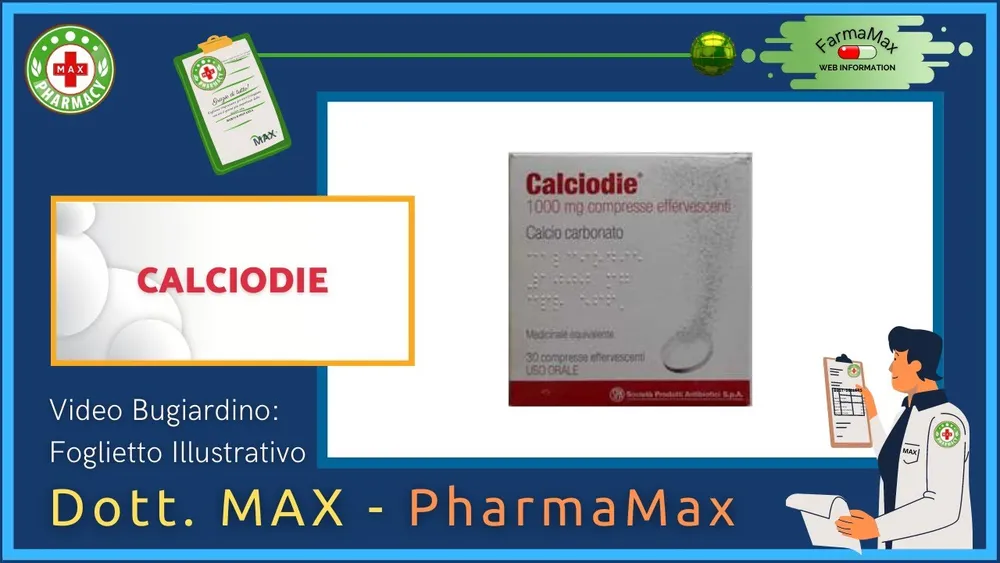
CALCIODIE
ItalyIt is used to prevent and treat calcium deficiency and for all situations where a higher intake of this element is required by the body.
Frequently asked questions
When should you not take CALCIODIE?
It must not be taken if you are allergic to calcium carbonate or any of its components, if you have excessively high levels of calcium in your blood or urine, if you suffer from kidney stones, severe kidney problems, or if you have been immobilized for a long time with high levels of calcium in your blood or urine.
How should the medicine be taken correctly?
The effervescent tablet should be dissolved in a glass of water and the solution should be drunk immediately, preferably during meals. It is essential to follow the instructions of the doctor or pharmacist.
What is the recommended dosage for CALCIODIE?
For adults and children over 6 years of age, the recommended dose is 1 tablet per day, unless otherwise directed by a doctor.
What are the possible side effects of CALCIODIE?
Possible adverse effects may include increased blood calcium, nausea, vomiting, flatulence, constipation, abdominal pain, excessive thirst, frequent need to urinate, changes in cardiac parameters, increased blood pressure, circulatory problems, and decreased blood phosphate levels.
Are there interactions with other drugs?
Caution should be exercised if taking medicines containing vitamin D (unless otherwise medically indicated). Tetracyclines must be taken at least 3 hours before or 3 hours after the medicine; digitalis glycosides should be taken under medical supervision, and sodium fluoride should be taken at a different time from the calcium intake.
What to do in case of overdose?
In case of excessive intake, stop treatment immediately and drink plenty of fluids. In case of severity, contact a doctor or emergency services immediately.
Instructions for use
Package leaflet: Information for the patient
CALCIODIE 1000 mg effervescent tablets
Calcium carbonate
Generic medicine
Please read this leaflet carefully before taking this medicine because it contains important information for you.
- Keep this leaflet. You may need to read it again.
- If you have any questions, ask your doctor or pharmacist.
- This medicine has been prescribed for you only. Do not give it to others, even if their symptoms are the same as yours, because it could be harmful.
- If you experience any side effects, including those not listed in this leaflet, consult your doctor or pharmacist. See section 4.
Contents of this leaflet:
- What CALCIODIE is and what it is used for
- What you need to know before taking CALCIODIE
- How to take CALCIODIE
- Possible side effects
- How to store CALCIODIE
- Contents of the pack and other information
1. What CALCIODIE is and what it is used for
CALCIODIE contains the active substance calcium carbonate, which is a calcium salt, an essential element
for bones and for many functions of the human body.
The use of calcium salts is beneficial in physiological conditions, or those due to diseases, where calcium
intake through diet is insufficient or inadequate.
CALCIODIE is indicated:
- for the prevention and treatment of calcium deficiency;
- for pathological conditions requiring increased calcium intake.
2. What you need to know before taking CALCIODIE
Do not take CALCIODIE
- if you are allergic to calcium carbonate, to similar substances, or to any of the other ingredients of this medicine (listed in section 6);
- if you have high levels of calcium in your blood (hypercalcemia) and high levels of calcium in your urine (hypercalciuria), for example due to overactivity of the parathyroid gland (a gland located in the neck), vitamin D overdose, tumors such as plasmacytoma or multiple myeloma, or bone metastases;
- if you suffer from kidney stones (calcium lithiasis);
- if you have severe kidney problems (severe renal failure);
- if you have been immobilized for a prolonged period and have high levels of calcium in your blood and/or urine; in this case, treatment with this medicine should only begin once you resume normal activity.
Warnings and precautions
Talk to your doctor or pharmacist before taking CALCIODIE.
If you have heart disease or suffer from kidney problems (renal failure), take this medicine with caution and only when strictly necessary. Indeed, particularly in cases of renal failure, this medicine, when taken at high doses and for prolonged periods, may cause increased calcium levels in the blood (hypercalcemia).
During prolonged treatment, calcium levels in the blood (calcemia) and in the urine (calciuria) should be monitored periodically, and the dose of CALCIODIE may need to be reduced accordingly.
Other medicines and CALCIODIE
Inform your doctor or pharmacist if you are taking, have recently taken, or might take any other medicines, in order to avoid possible interactions (mutual effects between medicines leading to changes in their actions).
Do not take this medicine if you are taking medicines containing vitamin D, unless otherwise prescribed by your doctor. In case of concomitant use, your doctor will monitor your calcium levels in blood and urine.
Use with caution and inform your doctor if you are taking:
- tetracyclines, medicines used to treat bacterial infections. Take these medicines at least 3 hours before or 3 hours after taking CALCIODIE;
- digitalis preparations, medicines used to treat heart rhythm disorders. Take these medicines together with CALCIODIE under regular medical supervision, especially if you are also taking vitamin D;
- sodium fluoride, used in the treatment of bone disorders. Take these medicines at a different time from CALCIODIE.
Pregnancy and breastfeeding
If you are pregnant, suspect you may be pregnant, planning a pregnancy, or are breastfeeding, consult your doctor or pharmacist before taking this medicine.
If you have calcium deficiency and are pregnant or breastfeeding, you may take this medicine.
Driving and operating machinery
The use of this medicine does not impair your ability to drive vehicles or operate machinery.
CALCIODIE contains the colouring agent orange yellow (E 110)
This medicine contains the colouring agent orange yellow (E110), which may cause allergic reactions.
3. How to take CALCIODIE
Take this medicine exactly as directed by your doctor or pharmacist. If you have
any doubts, consult your doctor or pharmacist.
Dissolve the effervescent tablet in a glass of water and drink the resulting solution immediately,
preferably with meals.
Always follow your doctor's instructions precisely.
For the treatment of osteoporosis and calcium deficiency in adults, the recommended dose is 1 tablet
per day (equivalent to 1 g of calcium), unless otherwise advised by your doctor.
Use in children and adolescents
In children above 6 years of age, the recommended dose is 1 tablet per day (equivalent to 1 g of calcium),
unless otherwise advised by the doctor.
If you take more CALCIODIE than you should
Overdose, especially in individuals with kidney problems or heart disease, may cause an
increase in blood calcium levels (hypercalcemia) and reduced body acidity (alkalosis), which may
manifest as nausea, vomiting, abdominal pain, thirst (polydipsia), increased need to urinate
(polyuria), constipation (constipation), changes in certain heart parameters (electrocardiogram (E.C.G.) pattern), increased blood pressure (arterial hypertension), and circulatory problems (vasomotor disturbances).
In children, excess calcium may cause a halt in body weight gain.
In case of overdose, stop treatment with this medicine and drink large amounts of fluids. Depending on the severity of intoxication, administration of drugs that increase urine elimination (diuretics) or corticosteroid medicines may be required.
If you have taken or ingested too much of this medicine, contact your doctor immediately or go to the nearest hospital.
If you forget to take CALCIODIE
Do not take a double dose to make up for the forgotten tablet.
If you have any doubts about how to use this medicine, consult your doctor or pharmacist.
4. Possible side effects
Like all medicines, this medicine can cause side effects, although not everybody will get them.
The following side effects may occur:
- increased levels of calcium in the blood (hypercalcaemia);
- nausea and vomiting;
- flatulence, constipation;
- abdominal pain;
- thirst (polydipsia);
- increased need to urinate (polyuria);
- changes in certain heart parameters (electrocardiogram (ECG) trace);
- increased blood pressure (arterial hypertension);
- problems with blood circulation (vasomotor disorders);
- decreased levels of phosphate in the blood (hypophosphataemia).
Reporting of side effects
If you experience any side effect, including those not listed in this leaflet, talk to your doctor or pharmacist.
You can also report side effects directly via the national reporting system at: www.agenziafarmaco.gov.it/it/responsabili. By reporting side effects, you can help provide more information on the safety of this medicine.
5. How to store CALCIODIE
Keep this medicine out of the sight and reach of children.
Do not use this medicine after the expiry date stated on the packaging after “Expiry”.
The expiry date refers to the last day of that month.
Close the container with its cap immediately after use. Store protected from moisture.
Do not dispose of any medicine via wastewater or household waste. Ask your pharmacist how to dispose of medicines you no longer use. This will help protect the environment.
6. Package contents and other information
What CALCIODIE contains
- The active substance is calcium carbonate. Each effervescent tablet contains 2,500 mg of calcium carbonate (equivalent to 1,000 mg of calcium).
- The other components are: citric acid, sodium cyclamate, sodium saccharin, orange flavor, sunset yellow (E 110).
Description of the appearance of CALCIODIE and contents of the pack
Orange-colored, round effervescent tablets. Pack containing 3 tubes, each containing 10 effervescent tablets.
Marketing Authorization Holder
SPA - Società Prodotti Antibiotici S.p.A. - Via Biella 8 - 20143 Milan.
Manufacturer and final controller
E-Pharma Trento S.p.A. – Ravina hamlet, Via Provina, 2 – 38123 Trento (TN).
The original data is available in the language of the country of manufacture.
Data source: Italian Medicines Agency (AIFA)
Data last verified: September 21, 2026