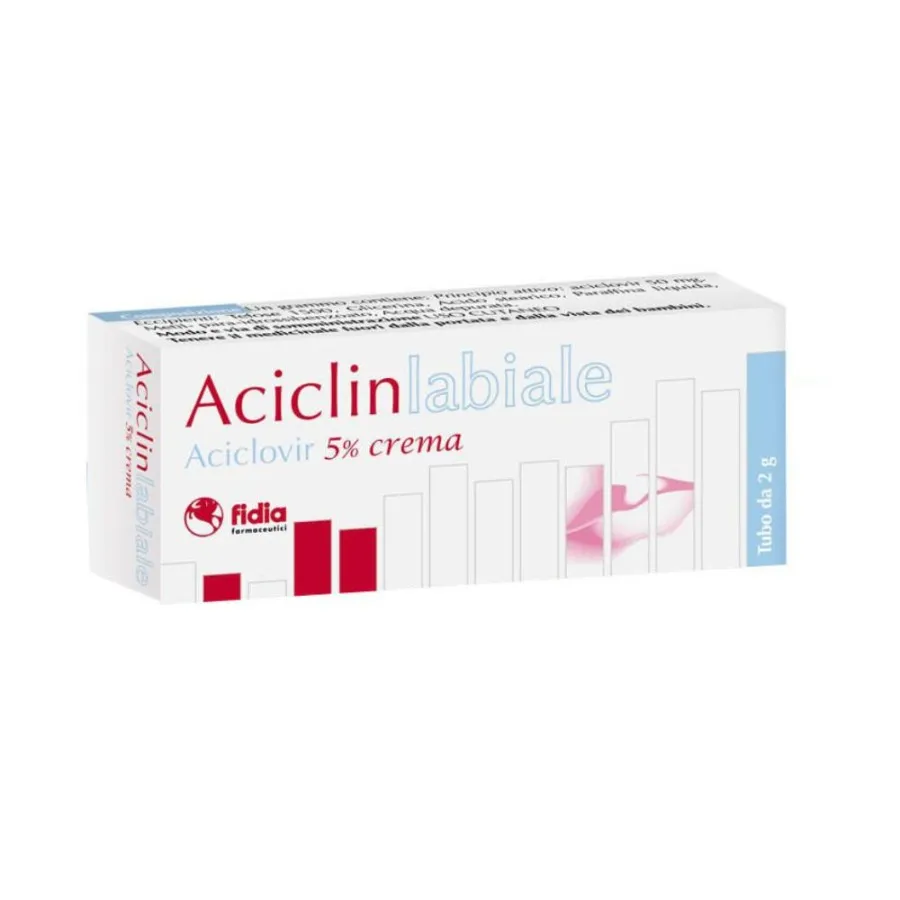
ACICLINLABIALE
ItalyIt is used to treat herpes simplex virus infections on the lips (recurrent herpes labialis) in adults and adolescents over 12 years of age.
Frequently asked questions
When should Aciclinlabiale not be used?
It must not be used if you are allergic to the active substance acyclovir, valacyclovir, or any other components of the medicine, or if you are under 12 years of age.
How should the drug be applied?
The product should be applied 5 times a day, every 4 hours during the day (avoiding nighttime), for at least 5 consecutive days. If healing does not occur within the first 5 days, treatment may be continued for another 5 days, up to a maximum of 10 days total.
What are the side effects of Aciclinlabiale?
Uncommon side effects may include transient burning or pain, itching, and dryness or peeling of the skin. Skin irritation or inflammatory reactions are also possible. In very rare cases, immediate allergic reactions such as swelling or hives may occur.
Can I use other products on the skin while using this medicine?
Other dermatological products (such as cosmetics, sunscreens, or lip balm) or other medicines for herpes should not be applied during treatment.
What should I do if the symptoms do not go away?
It is necessary to consult a doctor if no improvement is noted after 10 days of treatment or if symptoms worsen at any time.
Are there any special precautions for application?
The cream or pencil should only be applied to the lesions present on the lips. Contact with the eyes, nose, mouth (mucous membranes), or vagina must be avoided to prevent irritation. It is important to always wash your hands before and after application.
Instructions for use
Table of contents
- Package leaflet: information for the patient
- Aciclinlabiale 50 mg/g cream
- 1. What Aciclinlabiale is and what it is used for
- 2. What you need to know before using Aciclinlabiale
- 3. How to use Aciclinlabiale
- 4. Possible side effects
- 5. How to store Aciclinlabiale
- 6. Package contents and other information
- Package leaflet: Information for the patient
- Aciclinlabiale 50 mg/g cutaneous pencil
- 1. What Aciclinlabiale is and what it is used for
- 2. What you need to know before using Aciclinlabiale
- 3. How to use Aciclinlabiale
- 4. Possible side effects
- 5. How to store Aciclinlabiale
- 6. Package contents and other information
PACKAGE LEAFLET
Package leaflet: information for the patient
Aciclinlabiale 50 mg/g cream
Aciclovir
Please read this leaflet carefully before using this medicine because it contains important information for you.
Use this medicine exactly as described in this leaflet or as your doctor or pharmacist has instructed you.
- Keep this leaflet. You may need to read it again.
- If you need more information or advice, consult your pharmacist.
- If you experience any of the side effects listed in this leaflet, or any not listed, contact your doctor or pharmacist. See section 4.
- Contact your doctor if you do not notice improvement or if your symptoms worsen after 10 days.
Contents of this leaflet:
- What Aciclinlabiale is and what it is used for
- What you need to know before using Aciclinlabiale
- How to use Aciclinlabiale
- Possible side effects
- How to store Aciclinlabiale
- Contents of the pack and other information
1. What Aciclinlabiale is and what it is used for
What is Aciclinlabiale?
Aciclinlabiale contains the active substance aciclovir; it is a specific and selective antiviral medicine that acts against herpes viruses, including the herpes simplex virus.
What is Aciclinlabiale used for?
Aciclinlabiale is used for the treatment of herpes simplex virus infections of the lips (recurrent herpes labialis) in adults and adolescents over 12 years of age.
What is cold sore (herpes labialis)?
The term herpes refers to a group of infections caused by viruses of the Herpesviridae family. Herpes Simplex 1 (HSV1) is the virus responsible for cold sores (herpes labialis), which manifests as painful, rounded lesions and blisters accompanied by redness, primarily located on the lips.
Below are some hygiene measures to follow in case of herpes labialis infection:
Herpes labialis is contagious; therefore, do not allow other people to touch the lesions or use personal items that could transmit the infection (for example, towels).
Always wash your hands before and after touching the lesions.
After applying the cream, do not touch other parts of the body, especially the eyes, with your fingers before washing your hands. Herpes infection of the eyes may lead to corneal ulcers.
Avoid kissing, especially children, when lesions are present on the lips.
Avoid breaking the blisters and scratching the scabs; not only could this lead to secondary infection by other viruses, but it could also infect your fingers with the herpes labialis virus.
Do not share glasses, cutlery, or other personal items with other people.
2. What you need to know before using Aciclinlabiale
Do not use Aciclinlabiale:
- if you are allergic to the active substance aciclovir, valaciclovir, or to any of the other ingredients of this medicine (listed in section 6);
- if you are under 12 years of age.
Warnings and precautions
Talk to your doctor or pharmacist before using Aciclinlabiale.
Apply the cream only to lesions present on the lips; do not apply the cream to soft tissues (mucous membranes) of the mouth, eyes, nose, or vagina, as this may cause irritation.
Do not use Aciclinlabiale for the treatment of genital herpes.
Take particular care when using the cream to avoid accidental application into the eyes.
The use of this medicine, especially if prolonged, may lead to allergic reactions (sensitization phenomena). If this occurs, stop treatment and consult your doctor.
It is not known whether Aciclinlabiale may lead to habituation or dependence.
It is important to avoid virus transmission, particularly when active lesions are present.
Inform your doctor before using this medicine:
- if you have a particularly severe and/or recurrent form of cold sore;
- if you have a severely weakened immune system (immunocompromised), e.g. if you have acquired immunodeficiency syndrome (AIDS) or have undergone bone marrow transplantation. In such cases, your doctor may prescribe oral aciclovir.
Children and adolescents
Aciclinlabiale is not recommended for children under 12 years of age.
Other medicines and Aciclinlabiale
Inform your doctor or pharmacist if you are taking, have recently taken, or might take any other medicines.
Do not apply other types of dermatological products for skin and body care (such as cosmetics, sunscreen creams, lip balm) or other medicines for the treatment of herpes while using Aciclinlabiale.
However, no clinically significant interactions have been reported.
Pregnancy, breastfeeding and fertility
If you are pregnant, suspect you may be pregnant, planning a pregnancy, or are breastfeeding, consult your doctor or pharmacist before using this medicine.
Pregnancy
Following marketing authorization, pregnancy outcomes have been monitored in women who took aciclovir in various formulations during pregnancy.
Analysis of these data has not shown an increased number of birth defects in children born to women exposed to aciclovir compared to the general population, and all birth defects observed did not show specific or common characteristics suggesting a single cause.
Your doctor will assess whether the potential benefits of treatment outweigh the possibility of unknown risks.
Breastfeeding
Limited data indicate that Aciclinlabiale may pass into breast milk following systemic administration. However, the dose received by an infant from a mother using Aciclinlabiale is expected to be negligible.
Fertility
Aciclovir cream has not shown effects on sperm count, morphology, and motility in humans. There are no data available on the effects of aciclovir cream on female fertility.
Driving and using machines
There are no known effects of Aciclinlabiale on the ability to drive vehicles or operate machinery.
Aciclinlabiale contains methyl parahydroxybenzoate and propylene glycol
- Methyl parahydroxybenzoate may cause allergic reactions (including delayed reactions).
- Propylene glycol may cause skin irritation.
3. How to use Aciclinlabiale
Use this medicine exactly as stated in this leaflet or as directed by your doctor or pharmacist. If you have any doubts, consult your doctor or pharmacist.
Apply Aciclinlabiale 5 times a day, every 4 hours during the day, for at least 5 consecutive days, avoiding nighttime application.
Take a small amount of cream and apply it to the affected area, covering the lesion completely. Always wash your hands before and after applying the cream.
Avoid unnecessarily rubbing the lesions or touching them with a towel, in order to prevent worsening or spreading of the infection.
If healing has not occurred within the first 5 days of treatment, application of the cream may be continued for a further 5 days (up to a maximum of 10 days). Never exceed the recommended doses.
Aciclinlabiale is most effective when used promptly at the first signs of a lesion. For optimal results, apply the cream at the first symptoms of herpes (tingling, redness, swelling, or itching). Consult your doctor if the condition recurs frequently or if you have noticed any recent changes in its characteristics.
Consult your doctor if symptoms persist after 10 days of treatment or if they worsen at any time.
Use in children and adolescents
Aciclinlabiale is not recommended for children under 12 years of age (see section “Children and adolescents”).
If you use more Aciclinlabiale than you should
In case of accidental ingestion or overdose of Aciclinlabiale, contact your doctor immediately or go to the nearest hospital.
If you forget to use Aciclinlabiale
If you forget to apply the cream, do so as soon as you remember. Then continue applying it according to the recommended dosing schedule.
If you have any doubts about the use of this medicine, consult your doctor or pharmacist.
4. Possible side effects
Like all medicines, this medicine can cause side effects, although not everybody gets them.
Following the instructions contained in this leaflet reduces the risk of side effects.
Stop treatment with Aciclinlabiale and contact your doctor immediately if you experience any of the following serious side effects:
Very rare (may affect up to 1 in 10,000 patients)
- allergic reactions immediately after application (immediate hypersensitivity) including skin swelling (angioedema) and skin rashes (urticaria).
Uncommon (may affect up to 1 in 100 patients)
- transient burning or pain after application of Aciclinlabiale;
- moderate dryness or loss of the upper layer of skin (skin desquamation);
- itching.
Rare (may affect up to 1 in 1,000 patients)
- skin irritation (erythema);
- inflammatory skin reaction after application (contact dermatitis). Sensitivity tests have shown that the substances responsible for these reactions are components of the cream, rather than aciclovir.
Reporting of side effects
If you experience any side effect, including those not listed in this leaflet, talk to your doctor or pharmacist.
You can also report side effects directly via the national reporting system at: http://www.agenziafarmaco.it/it/responsabili
By reporting side effects, you can help provide more information on the safety of this medicine.
5. How to store Aciclinlabiale
Keep this medicine out of sight and reach of children.
Do not use this medicine after the expiry date stated on the label. The expiry date refers to the last day of
that month.
Do not store above 25°C. Do not refrigerate.
After first opening the tube, use Aciclinlabiale within 3 months; after this period, any remaining cream should
be discarded.
Do not dispose of any medicine via wastewater or household waste. Ask your pharmacist how to dispose of
medicines no longer in use. This will help protect the environment.
6. Package contents and other information
What Aciclinlabiale contains
- The active substance is aciclovir 50 mg
- The other ingredients are: Tefose 1500, glycerin, stearic acid, liquid paraffin, methyl parahydroxybenzoate, purified water.
Description of the appearance of Aciclinlabiale and contents of the pack
Aciclinlabiale is a white, homogeneous cream.
The pack contains one 2 g aluminium tube of cream.
Marketing Authorisation Holder and Manufacturer
Marketing Authorisation Holder
Fidia Farmaceutici S.p.A.
Via Ponte della Fabbrica, 3/A
35031 Abano Terme (PD)
Manufacturer
Fidia Farmaceutici S.p.A.
Via Ponte della Fabbrica, 3/A
35031 Abano Terme (PD)
Package leaflet: Information for the patient
Aciclinlabiale 50 mg/g cutaneous pencil
Aciclovir
Please read this leaflet carefully before using this medicine because it contains important information for you.
Use this medicine exactly as described in this leaflet or as your doctor or pharmacist has instructed you to do.
- Keep this leaflet. You may need to read it again.
- If you need more information or advice, consult your pharmacist.
- If you experience any of the side effects, including those not listed in this leaflet, consult your doctor or pharmacist. See section 4.
- Consult your doctor if you do not notice improvement or if you notice worsening of symptoms after 10 days.
Contents of this leaflet:
- What Aciclinlabiale is and what it is used for
- What you need to know before using Aciclinlabiale
- How to use Aciclinlabiale
- Possible side effects
- How to store Aciclinlabiale
- Package contents and other information
1. What Aciclinlabiale is and what it is used for
What is Aciclinlabiale?
Aciclinlabiale contains the active substance aciclovir; it is a specific and selective antiviral medicine that acts against herpes viruses, including the herpes simplex virus.
What is Aciclinlabiale used for?
Aciclinlabiale is used for the treatment of herpes simplex virus infections of the lips (recurrent herpes labialis) in adults and adolescents over 12 years of age.
What is cold sore (herpes labialis)?
The term "herpes" refers to a category of infections caused by viruses of the Herpesviridae family. Herpes Simplex 1 (HSV1) is the virus responsible for cold sores (herpes labialis), which manifests as painful round lesions, blisters, and redness, primarily located on the lips.
Below are some hygiene recommendations to follow in case of herpes labialis infection:
Herpes labialis is contagious; therefore, avoid allowing other people to touch the lesions or to use personal items that could transmit the infection (for example, towels).
Always wash your hands before and after touching the lesions.
After applying the topical pencil, do not touch other parts of the body, especially the eyes, before washing your hands. Herpes infection of the eyes may lead to corneal ulcers.
Avoid kissing, especially children, when lesions are present on the lips.
Avoid breaking the blisters and scratching the scabs; not only could this lead to secondary viral infection of the lesions, but it could also cause herpes labialis infection of your fingers.
Do not share glasses, cutlery, or other personal items with other people.
2. What you need to know before using Aciclinlabiale
Do not use Aciclinlabiale:
- if you are allergic to the active substance aciclovir, valaciclovir, or to any of the other ingredients of this medicine (listed in section 6);
- in children under 12 years of age.
Warnings and precautions
Talk to your doctor or pharmacist before using Aciclinlabiale.
Apply the pencil only to lesions present on the lips; do not apply the pencil to soft tissues (mucous membranes) of the mouth, eyes, nose, or vagina, as this may cause irritation.
Do not use Aciclinlabiale for the treatment of genital herpes.
Take particular care when using the topical pencil to avoid accidental application into the eyes.
Use of this medicine, especially if prolonged, may lead to allergic reactions (sensitization phenomena). If this occurs, stop treatment and consult your doctor.
It is not known whether Aciclinlabiale may lead to habituation or dependence.
It is important to avoid virus transmission, particularly when active lesions are present.
Inform your doctor before using this medicine:
- if you suffer from a particularly severe and/or recurrent form of cold sores;
- if you have a severely weakened immune system (immunocompromised), e.g. if you have acquired immunodeficiency syndrome (AIDS) or have undergone bone marrow transplantation. In such cases, your doctor may prescribe oral aciclovir.
Children and adolescents
Aciclinlabiale is not recommended for children under 12 years of age.
Other medicines and Aciclinlabiale
Inform your doctor or pharmacist if you are taking, have recently taken, or might take any other medicines.
Do not apply other types of dermatological products for skin and body care (such as cosmetics, sun protection creams, lip balm) or other medicines for the treatment of herpes while using Aciclinlabiale.
However, no clinically significant interactions have been reported.
Pregnancy and breastfeeding
If you are pregnant, think you may be pregnant, are planning to become pregnant, or are breastfeeding, ask your doctor or pharmacist for advice before using this medicine.
Pregnancy
Following marketing authorization, pregnancy outcomes have been monitored in women who took aciclovir in various formulations during gestation.
Analysis of these data has not shown an increased number of birth defects in babies born to women exposed to aciclovir compared to the general population, and all birth defects observed lacked specific or common characteristics suggesting a single cause.
Your doctor will assess whether the potential benefits of treatment outweigh the possibility of unknown risks.
Breastfeeding
Limited data indicate that Aciclinlabiale may pass into breast milk following systemic administration. However, the dose received by a breastfed infant following use of Aciclinlabiale by the mother is expected to be negligible.
Driving and using machines
There are no known effects of Aciclinlabiale on the ability to drive vehicles or operate machinery.
Aciclinlabiale contains propyl-parahydroxybenzoate and butyl-hydroxytoluene
- Propyl-parahydroxybenzoate may cause allergic reactions (including delayed reactions).
- Butyl-hydroxytoluene may cause local skin reactions (e.g. contact dermatitis) or irritation of the eyes and mucous membranes.
3. How to use Aciclinlabiale
Use this medicine exactly as stated in this leaflet or as directed by your doctor or pharmacist. If you have any doubts, consult your doctor or pharmacist.
This medicine is for personal use only; therefore, once opened, you should be the only one to use it and must not share it with other people.
Apply Aciclinlabiale 5 times a day, every 4 hours during the day, for at least 5 consecutive days, avoiding nighttime application.
Apply a small amount of the skin pencil directly from the container onto the affected area, without touching it with your hands. Always wash your hands after applying Aciclinlabiale.
Avoid unnecessarily rubbing the lesions or touching them with a towel, in order to prevent worsening or spreading of the infection.
If healing has not occurred within the first 5 days of treatment, the application may be continued for a further 5 days (up to a maximum of 10 days). Never exceed the recommended doses.
Aciclinlabiale is most effective when the skin pencil is used promptly at the first signs of a lesion. For optimal results, apply Aciclinlabiale at the first symptoms of herpes (tingling, redness, swelling, or itching). Consult your doctor if the condition recurs frequently or if you have noticed any recent changes in its characteristics.
Consult your doctor if symptoms persist after 10 days of treatment or if they worsen at any time.
Use in children and adolescents
Aciclinlabiale is not recommended for children under 12 years of age (see section “Children and adolescents”).
If you use more Aciclinlabiale than you should
In case of accidental ingestion or overdose of Aciclinlabiale, contact your doctor immediately or go to the nearest hospital.
If you forget to use Aciclinlabiale
If you have forgotten to apply the skin pencil, do so as soon as you remember. Then continue applying it according to the recommended dosing schedule.
If you have any doubts about how to use this medicine, consult your doctor or pharmacist.
4. Possible side effects
Like all medicines, this medicine can cause side effects, although not everybody will experience them.
Following the instructions contained in this leaflet reduces the risk of side effects.
Discontinue treatment with Aciclinlabiale and contact your doctor immediately if you experience any of the
following serious side effects:
Very rare (may affect up to 1 in 10,000 patients)
- allergic reactions immediately after application (immediate hypersensitivity) including swelling of the skin (angioedema) and skin rashes (urticaria).
Uncommon (may affect up to 1 in 100 patients)
- transient burning or pain after application of Aciclinlabiale;
- moderate dryness or loss of the upper layer of the skin (desquamation of the skin);
- itching.
Rare (may affect up to 1 in 1,000 patients)
- skin irritations (erythema);
- inflammatory skin reaction after application (contact dermatitis). Sensitivity tests have shown that the substances responsible for these reactions are components of the skin pencil, rather than aciclovir.
Reporting of side effects
If you experience any side effect, including those not listed in this leaflet, talk to your doctor or pharmacist.
You can also report side effects directly via the national reporting system at: http://www.agenziafarmaco.it/it/responsabili
By reporting side effects, you can help provide more information on the safety of this medicine.
5. How to store Aciclinlabiale
Keep this medicine out of the sight and reach of children.
Do not use this medicine after the expiry date stated on the label. The expiry date refers to the last day of the month.
Do not store above 25°C. Do not refrigerate.
Do not dispose of any medicine via wastewater or household waste. Ask your pharmacist how to dispose of medicines you no longer use. This will help protect the environment.
6. Package contents and other information
What Aciclinlabiale contains
- The active substance is aciclovir 50 mg.
- The other components are: liquid paraffin, white soft paraffin, solid paraffin, beeswax, white ceresin, Arlacel 582, sodium hyaluronate, allantoin, d, l-alpha-tocopheryl acetate, propyl parahydroxybenzoate, butylhydroxytoluene, purified water, disodium edetate, vanillin, sweet flavour.
Description of the appearance of Aciclinlabiale and contents of the pack
Aciclinlabiale is supplied as a cutaneous pencil (stick) with a cylindrical white plastic applicator and a screw cap closure that dispenses the medicine by rotating the base.
The pack contains 1 applicator of 2.5 g.
Marketing Authorization Holder and Manufacturer
Marketing Authorization Holder
Fidia Farmaceutici S.p.A.
Via Ponte della Fabbrica, 3/A
35031 Abano Terme (PD)
Manufacturer
Laboratorio Chimico Farmaceutico A. Sella S.r.l.
Via Vicenza, 67
Schio (VI)
Similar drugs
| Brand name | Dosage form | Active substance / Dosage | Manufacturer |
|---|---|---|---|
| ACICLOVIR ALMUS PHARMA | cream | ALMUS S.R.L. | |
| ACICLOVIR AUROBINDO ITALIA | cream | AUROBINDO PHARMA (ITALIA) S.R.L. | |
| ACICLOVIR PENSA | cream | TOWA PHARMACEUTICAL S.P.A. | |
| ACKLAB | cream | S.F. GROUP S.R.L. | |
| ACYCLOVIR MYLAN GENERICS | cream | MYLAN S.P.A. | |
| ZOVIRAX LABIALE | cream | HALEON ITALY S.R.L. |
The original data is available in the language of the country of manufacture.
Data source: Italian Medicines Agency (AIFA)
Data last verified: September 21, 2026